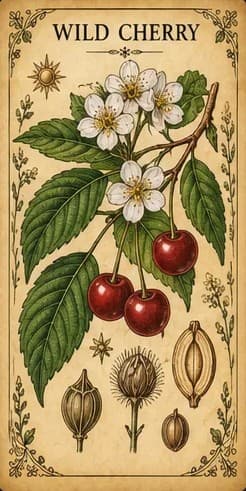
Wild Cherry
Prunus serotina
Black cherry (capulín), a North American tree used in Mexican folk medicine for cough, high blood pressure and digestive problems. Its seeds and leaves contain compounds that can release cyanide.
What is Wild Cherry?
- Plant family
- Rosaceae, the rose family
- Parts used
- The leaves and seeds
- Where it grows
- Native to North America; introduced into Europe, where it has become invasive
- Genus
- Prunus
- Species
- serotina
Also called
Black Cherry, Wild Black Cherry
Regional names
Capulín, Capulin
Traditionally used for
- Cough (traditional)
- Digestion (traditional)
Traditionally described as
- Traditionally used for cough
Health topics
Where Wild Cherry appears in symptom search, and why. Being listed doesn't mean it's a proven treatment.
- Cough
Traditionally used for cough in Mexico. It hasn't been studied in people, and its seeds and leaves can release cyanide.
Safety
What does the research say?
Traditional use
These are traditional uses, not proven treatments.
In Mexican traditional medicine, black cherry (capulín) is used for heart, breathing and digestive problems. Its seeds, eaten as snacks in Mexico, are used for cough.[3]
Capulín is sold and used in folk medicine for high blood pressure, digestive illnesses and cough, most often as an infusion (tea) of the leaves.[4]
In short
Seeds and leaves contain compounds that release cyanide when crushed.
Sources
- [1] Quantitative analysis of amygdalin and prunasin in Prunus serotina Ehrh. using 1H-NMR spectroscopy — Phytochemical Analysis · DOI: 10.1002/pca.2476Peer-reviewed study
- [2] Development of the Potential for Cyanogenesis in Maturing Black Cherry (Prunus serotina Ehrh.) Fruits — Plant Physiology · DOI: 10.1104/pp.98.4.1423Peer-reviewed study
- [3] Nutritional value and volatile compounds of black cherry (Prunus serotina) seeds — Molecules · DOI: 10.3390/molecules20023479Peer-reviewed study
- [4] Simultaneous quantification by HPLC of the phenolic compounds for the crude drug of Prunus serotina subsp. capuli — Pharmaceutical Biology · DOI: 10.3109/13880209.2013.876054Peer-reviewed study
This information is educational and traditional in nature, and is not a substitute for professional medical advice.