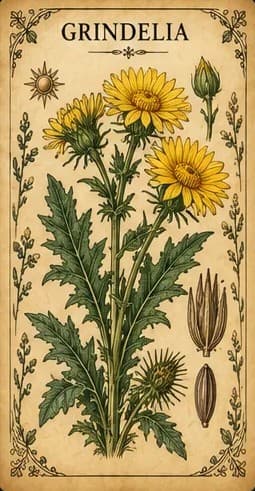
Grindelia
Grindelia robusta
Gumweed, a daisy-family plant whose above-ground parts are recognized in Europe as a traditional medicine for cough with a cold in adults.
What is Grindelia?
- Plant family
- Asteraceae, the daisy family
- Parts used
- The above-ground parts (herb)
- Genus
- Grindelia
- Species
- robusta
Also called
Gumweed, Grindelia squarrosa
Traditionally used for
- Cough
- Colds
Traditionally described as
- Traditionally used for cough
Health topics
Where Grindelia appears in symptom search, and why. Being listed doesn't mean it's a proven treatment.
- Colds and Nasal Congestion
Recognized in Europe for cough with a cold.
- Cough
Recognized in Europe as a traditional medicine for cough with a cold, in adults.
Traditions that use it
European Folk Medicine
Recognized in Europe as a traditional herbal medicine for cough with a cold.
Safety
Allergies
Don't use it if you're allergic to grindelia or other daisy-family plants.[1]
Side effects
No side effects are known.[1]
Pregnancy
Its safety during pregnancy and breastfeeding hasn't been established, so it isn't recommended at these times.[1]
How much to use
Not recommended for anyone under 18. See a doctor straight away if symptoms get worse or you get shortness of breath, a high fever or colored phlegm, and if symptoms last more than 1 week.[1]
What does the research say?
Traditional use
These are traditional uses, not proven treatments.
Based on long-standing use, the European Medicines Agency recognizes grindelia as a traditional herbal medicine to relieve cough with a cold in adults. It is taken as a tea, liquid extract or tincture.[1]
Laboratory & animal research
Lab and animal results show what might be worth studying in people. They don't show that the herb has these effects in humans.
Grindelia is one of several plants traditionally used in Europe for breathing problems. In lab tests on human immune cells and airway cells, its compounds reduced signals that drive inflammation.[2]
In short
For adults only; avoid if you're allergic to daisy-family plants.
Sources
- [1] Community herbal monograph on Grindelia robusta Nutt., Grindelia squarrosa (Pursh) Dunal, Grindelia humilis Hook. et Arn., Grindelia camporum Greene, herba (EMA/HMPC/748220/2011) — European Medicines Agency, Committee on Herbal Medicinal Products (HMPC)Government health agency
- [2] Inula helenium and Grindelia squarrosa as a source of compounds with anti-inflammatory activity in human neutrophils and cultured human respiratory epithelium — Journal of Ethnopharmacology · DOI: 10.1016/j.jep.2019.112311Peer-reviewed study
This information is educational and traditional in nature, and is not a substitute for professional medical advice.