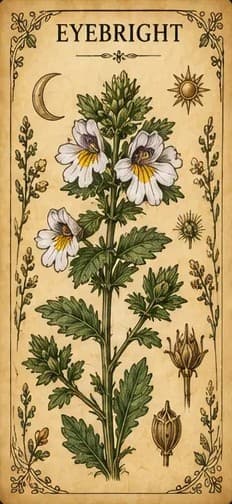
Eyebright
Euphrasia officinalis
A plant traditionally used on the eyes and in nasal ointments for colds. European regulators declined to approve it because its benefits aren't documented and home-made eye washes aren't safe.
What is Eyebright?
- Plant family
- Orobanchaceae, the broomrape family
- Parts used
- The above-ground parts (herb)
- Genus
- Euphrasia
- Species
- officinalis
Also called
Euphrasia, Euphrasia rostkoviana
Traditionally used for
- Eye irritation (traditional)
- Nasal irritation with colds (traditional)
Traditionally described as
- Traditionally used for eye irritation
Health topics
Where Eyebright appears in symptom search, and why. Being listed doesn't mean it's a proven treatment.
- Colds and Nasal Congestion
A nasal ointment has traditionally been used for nose irritation with a cold, but European regulators found no adequate data.
Safety
Depends on how it's prepared
Home-made eyebright preparations put on the eyes aren't hygienic or safe, so this use can't be recommended.[1]
What does the research say?
Traditional use
These are traditional uses, not proven treatments.
Eyebright has traditionally been made into water-based infusions and used as soaked dressings on the eyes for minor eye irritation. A nasal ointment containing eyebright has also been used for nose irritation with a cold.[1]
Research in people
The European Medicines Agency decided not to recognize eyebright as a traditional medicine, because there isn't adequate data showing it works or is harmless for these uses.[1]
In short
Don't put home-made eyebright preparations in your eyes: they aren't hygienic or safe.
Sources
- [1] Public statement on Euphrasia officinalis L. and Euphrasia rostkoviana Hayne, herba (EMA/HMPC/727465/2009) — European Medicines Agency, Committee on Herbal Medicinal Products (HMPC)Government health agency
This information is educational and traditional in nature, and is not a substitute for professional medical advice.