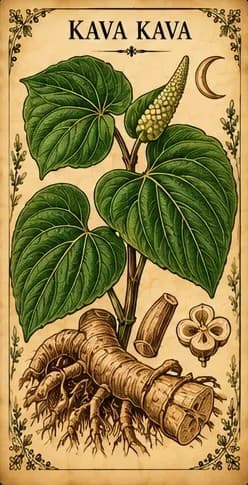
Kava
Piper methysticum
A root from the South Pacific, drunk in ceremonies for thousands of years. It may ease anxiety short term, but it has been linked to rare, sometimes fatal, liver damage.
Kava may interact with some medicines. If you take any medicine, read Interactions with medicines below and talk to your doctor or pharmacist before using it.
What is Kava?
- Plant family
- Piperaceae, the pepper family
- Parts used
- The root and underground stem
- Where it grows
- Native to the South Pacific
- Genus
- Piper
- Species
- methysticum
Also called
Kava Kava, Kava-kava
Traditionally used for
- Anxiety
- Relaxation
- Ceremonial drink
Traditionally described as
- May ease anxiety
Health topics
Where Kava appears in symptom search, and why. Being listed doesn't mean it's a proven treatment.
- Anxiety
May ease anxiety short term, but doesn't appear to help generalized anxiety disorder, and has been linked to serious liver damage.
- Liver Safety Warnings
Kava products have been linked to rare but serious liver damage, including deaths.
Natural compounds
Safety
Interactions with medicines
Don't combine kava with alcohol, sedatives (medicines that make you sleepy) or benzodiazepines. Talk to your healthcare provider before using it with any medicine.[1]
Side effects
Kava can cause stomach upset, headache and dizziness. Long-term, heavy use can cause dry, scaly, flaky skin, red eyes, and temporary yellowing of the skin and nails.[1]
Pregnancy
Kava carries special risks during pregnancy and breastfeeding because it contains harmful substances.[1]
Toxicity testing
Kava products have been linked to rare but sometimes serious liver damage, including deaths. Early cases involved extracts made with alcohol or acetone, but traditional water-based kava drinks have also caused liver injury.[1]
What does the research say?
Traditional use
These are traditional uses, not proven treatments.
Kava, a member of the pepper family, has been used by Pacific Islanders for thousands of years in ceremonies and as a medicine. In the United States it is sold as a supplement and promoted for anxiety.[1]
Research in people
Research suggests kava supplements may help with anxiety, but it takes several weeks to work. It doesn't appear to help symptoms of generalized anxiety disorder. There's little research on other uses.[1]
A 2018 review of 7 placebo-controlled trials found kava worked better than placebo in 3 of them. Pooling 5 trials (330 people), people taking kava were 1.5 times as likely to respond. Side effects were no more common than with placebo. The authors concluded kava may be a short-term treatment for anxiety, and that liver damage is especially possible if it's taken for more than 8 weeks.[2]
Technical detail: responder risk ratio 1.50 (95% CI 1.12 to 2.01).
A 2018 review of kava for generalized anxiety disorder found mixed results: two placebo-controlled trials and one comparison trial favored kava, but one trial found no difference from placebo. Pooled results favored kava but weren't statistically significant, so the evidence isn't enough to confirm it works better than placebo.[3]
Technical detail: 3 placebo-controlled trials (n = 130), SMD 0.59 to 0.99; 120 to 280 mg kavalactones a day for 4 to 8 weeks was well tolerated.
In short
Linked to serious liver damage; don't combine with alcohol or sleep and anxiety medicines.
Sources
- [1] Kava: Usefulness and Safety — National Center for Complementary and Integrative Health (NIH)Government health agency
- [2] The effectiveness and safety of Kava Kava for treating anxiety symptoms: A systematic review and analysis of randomized clinical trials — Complementary Therapies in Clinical Practice · DOI: 10.1016/j.ctcp.2018.09.003Review or clinical trial
- [3] Kava for Generalized Anxiety Disorder: A Review of Current Evidence — Journal of Alternative and Complementary Medicine · DOI: 10.1089/acm.2018.0001Review or clinical trial
This information is educational and traditional in nature, and is not a substitute for professional medical advice.