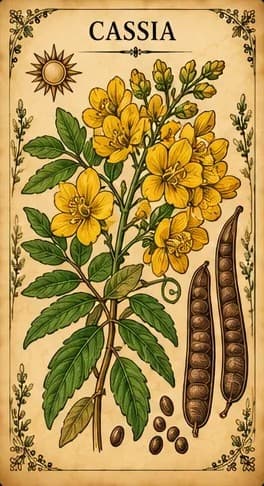
Siamese Cassia
Senna siamea
A tree whose leaves are eaten in Thailand, where it is called khi lek and traditionally used for sleep. A calming product made from it caused cases of hepatitis.
What is Siamese Cassia?
- Plant family
- Fabaceae, the pea and bean family
- Parts used
- The leaves, pods and heartwood
- Genus
- Senna
- Species
- siamea
Also called
Cassia
Regional names
Khi Lek, Khi-lek
Older scientific names
Cassia siamea
Traditionally used for
- Sleep (traditional)
- Anxiety (traditional)
- Fever
- Food
Traditionally described as
- May make you feel sleepy (in animals)
Health topics
Where Siamese Cassia appears in symptom search, and why. Being listed doesn't mean it's a proven treatment.
- Anxiety
Sold in Thailand as an anti-anxiety product, but animal tests found no anti-anxiety effect, and it has caused hepatitis.
- Liver Safety Warnings
Barakol tablets made from Siamese cassia caused hepatitis in 12 people in Thailand.
- Sleep Problems (Insomnia)
Traditionally used for insomnia. Its compound barakol made animals sleepy, but it hasn't been tested in people.
Natural compounds
Safety
Toxicity testing
In Thailand, 12 people developed hepatitis (liver inflammation) after taking barakol tablets for 3 to 180 days, most with loss of appetite and yellow skin or eyes. Liver damage wasn't linked to the dose. Two people who restarted it had liver problems again. Everyone recovered within 2 to 20 weeks of stopping.[1]
What does the research say?
Traditional use
These are traditional uses, not proven treatments.
Laboratory & animal research
Lab and animal results show what might be worth studying in people. They don't show that the herb has these effects in humans.
In mice and rats, barakol, the plant's main calming compound, reduced activity, made more animals fall asleep and made sleep last longer. It didn't reduce anxiety in standard animal tests.[4]
In rats given barakol by mouth, once or daily for 30 days, it didn't reduce anxiety but had a calming effect, making them explore less.[5]
Research in people
Barakol from Siamese cassia has been sold in Thailand as a natural anti-anxiety product. No clinical trials of its effects in people were found.[1]
In short
Barakol, its calming compound, has caused liver inflammation (hepatitis).
Sources
- [1] Acute hepatitis associated with Barakol — Journal of the Medical Association of ThailandPeer-reviewed study
- [2] Cassia siamea-Derived Silver Nanoparticles: Synthesis and Their Impact on Male Fertility Through Biochemical and Histopathological Insights in Rats — Biological Trace Element Research · DOI: 10.1007/s12011-025-04658-2Peer-reviewed study
- [3] Antidiabetic Potential of Senna siamea: α-Glucosidase Inhibition, Postprandial Blood Glucose Reduction, Toxicity Evaluation, and Molecular Docking — Scientifica · DOI: 10.1155/sci5/6650349Peer-reviewed study
- [4] CNS inhibitory effects of barakol, a constituent of Cassia siamia Lamk. — Journal of Ethnopharmacology · DOI: 10.1016/s0378-8741(02)00206-4Peer-reviewed study
- [5] Behavioral effects of acute and chronic oral administration of barakol in rats — Journal of the Medical Association of ThailandPeer-reviewed study
This information is educational and traditional in nature, and is not a substitute for professional medical advice.