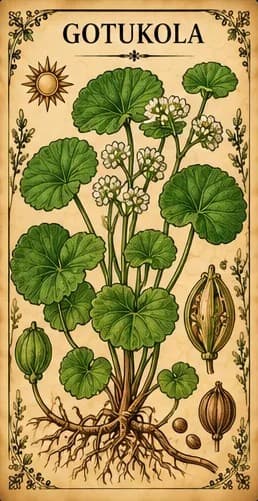
Gotu Kola
Centella asiatica
A plant used in traditional medicine for circulation, wounds and memory. Small studies suggest possible benefits for anxiety and thinking, but the evidence isn't strong.
Gotu Kola may interact with some medicines. If you take any medicine, read Interactions with medicines below and talk to your doctor or pharmacist before using it.
What is Gotu Kola?
- Plant family
- Apiaceae, the carrot and parsley family
- Parts used
- The leaves and whole plant
- Where it grows
- Common in East Asia and many parts of South Africa
- Genus
- Centella
- Species
- asiatica
Also called
Gotukola, Indian Pennywort
Traditional names
Mandukaparni
Older scientific names
Hydrocotyle asiatica
Traditionally used for
- Memory
- Anxiety
- Circulation
- Wounds
Traditionally described as
- May help wounds heal
Health topics
Where Gotu Kola appears in symptom search, and why. Being listed doesn't mean it's a proven treatment.
- Anxiety
A small study suggests it may ease generalized anxiety disorder; larger studies are needed.
- Liver Safety Warnings
Liver damage has been reported with gotu kola.
- Memory and Thinking
A preliminary study suggests benefit, but a meta-analysis found the evidence isn't strong enough.
Safety
Interactions with medicines
In lab tests, gotu kola slowed liver enzymes that break down many medicines, which may increase their side effects. Whether this matters in people isn't known.[1]
Allergies
Gotu kola can cause skin rashes (contact dermatitis).[1]
Toxicity testing
Liver damage has been reported with gotu kola.[1]
Depends on how it's prepared
Don't confuse gotu kola with kola nut: gotu kola contains no caffeine and hasn't been shown to be a stimulant. The amount of active compounds varies widely depending on where it's grown.[1]
What does the research say?
Traditional use
These are traditional uses, not proven treatments.
Gotu kola is popular in traditional medicine. Extracts of the leaf and whole plant are used for poor vein circulation, varicose veins, wound healing, scleroderma and scars.[1]
Laboratory & animal research
Lab and animal results show what might be worth studying in people. They don't show that the herb has these effects in humans.
In lab and animal studies, gotu kola protected nerve cells, showed antioxidant activity and reduced inflammation. A compound from it (asiaticoside) helped wounds heal, and in mice with Alzheimer's-like disease a water extract prevented the buildup of harmful brain proteins.[1]
Research in people
A few human studies suggest:
- It may reduce leg swelling and vein pressure in people with poor vein circulation.
- It may help wounds heal, and improved symptoms in burn patients.
- It may ease generalized anxiety disorder and improve thinking and mood in older people, but a meta-analysis didn't find strong enough evidence for thinking.
A cream didn't prevent skin damage from radiation therapy. Larger, well-designed studies are needed.[1]
In short
Liver damage and skin rashes have been reported; not the same as caffeine-containing kola nut.
Sources
- [1] Gotu Kola — Memorial Sloan Kettering Cancer Center, About HerbsGeneral reference
This information is educational and traditional in nature, and is not a substitute for professional medical advice.