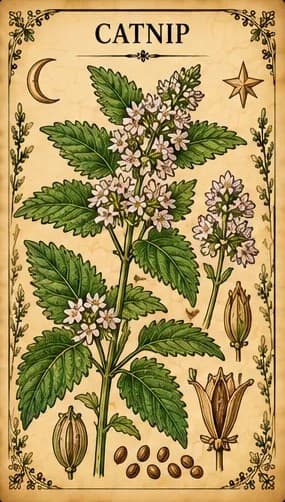
Catnip
Nepeta cataria
A plant in the mint family traditionally used for colic, coughs, asthma and nervous upset. Its oil is also an effective mosquito repellent.
What is Catnip?
- Plant family
- Lamiaceae, the mint family
- Parts used
- The leaves and flowering tops
- Where it grows
- Native to southeastern Europe, southwest Asia and the western Himalayas
- Genus
- Nepeta
- Species
- cataria
Also called
Catmint, Catnip Mint
Traditionally used for
- Colic
- Cough
- Asthma (traditional)
- Nervous upset (traditional)
- Mosquito repellent
Traditionally described as
- May ease cramps
Health topics
Where Catnip appears in symptom search, and why. Being listed doesn't mean it's a proven treatment.
- Asthma and Wheezing
Traditionally used for asthma; only lab studies exist. Don't use it in place of asthma medicine.
- Cough
Traditionally used for cough; in lab tests its oil relaxed airways.
- Stress
Historically used for nervous upset. It hasn't been tested for stress or anxiety in people.
Safety
Toxicity testing
A toddler became very drowsy and unresponsive after eating a large amount of catnip. Keep catnip away from young children.[1]
What does the research say?
Traditional use
These are traditional uses, not proven treatments.
Catnip leaves and flowering tops are aromatic and have traditionally been used as a tonic, to relieve gas, to bring on sweating and menstruation, and for colic in babies and nervous upset (historically called "hysteria").[2]
Catnip has traditionally been used for colic, diarrhea, cough and asthma.[3]
Laboratory & animal research
Lab and animal results show what might be worth studying in people. They don't show that the herb has these effects in humans.
In lab tests on animal tissue, catnip essential oil relaxed the gut and the airways, which may explain its traditional use for colic, diarrhea, cough and asthma.[3]
Technical detail: calcium-channel blocking and phosphodiesterase inhibition in isolated rabbit jejunum and guinea-pig trachea; main components 1,8-cineole, α-humulene, α-pinene.
Research in people
In field trials in Uganda, lotions containing 2% or 6% catnip oil were highly effective at stopping mosquitoes from landing on people. The 6% lotion worked as well as a 15% DEET repellent.[4]
It's uncertain whether catnip affects the human mind. No trials of catnip for sleep, anxiety or breathing problems were found.[1]
In short
A toddler became very drowsy after eating a large amount; keep away from children.
Sources
- [1] Catnip and the alteration of human consciousness — Veterinary and Human ToxicologyPeer-reviewed study
- [2] Pharmacognosy of Nepeta cataria — Ancient Science of LifePeer-reviewed study
- [3] Chemical composition and mechanisms underlying the spasmolytic and bronchodilatory properties of the essential oil of Nepeta cataria L. — Journal of Ethnopharmacology · DOI: 10.1016/j.jep.2008.11.004Peer-reviewed study
- [4] Evaluating repellence properties of a catnip essential oil-based mosquito repellent using the human landing catch method in Eastern Uganda — Scientific Reports · DOI: 10.1038/s41598-026-42618-5Peer-reviewed study
This information is educational and traditional in nature, and is not a substitute for professional medical advice.