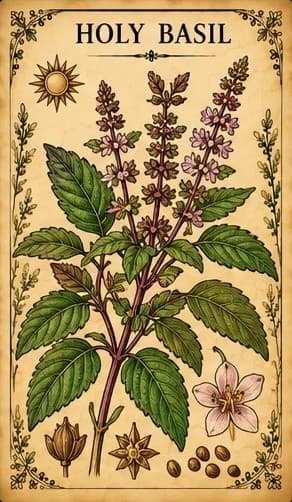
Holy Basil
Ocimum tenuiflorum
Tulsi, a highly revered plant in India used in Ayurveda for stress, coughs, asthma and many other conditions. Small studies suggest it may ease stress and anxiety.
What is Holy Basil?
- Plant family
- Lamiaceae, the mint family
- Parts used
- The leaves, and sometimes the whole plant, roots and stems
- Where it grows
- Native to the Indian subcontinent
- Genus
- Ocimum
- Species
- tenuiflorum
Traditional names
Tulsi, Tulasi
Older scientific names
Ocimum sanctum
Traditionally used for
- Stress
- Anxiety
- Cough
- Asthma (traditional)
- Memory
Traditionally described as
- Adaptogen
Health topics
Where Holy Basil appears in symptom search, and why. Being listed doesn't mean it's a proven treatment.
- Anxiety
A small study in people with generalized anxiety disorder found less anxiety after 8 weeks.
- Asthma and Wheezing
Traditionally used for asthma. One small study found tulsi leaves eased asthma symptoms; don't use it in place of asthma medicine.
- Cough
Traditionally used in Ayurveda for cough and bronchitis.
- Memory and Thinking
A small trial in healthy young adults found better attention and short-term memory after 4 weeks.
- Stress
In a 6-week trial of 150 adults, tulsi reduced stress symptoms more than placebo.
Traditions that use it
Ayurveda
Highly revered as a medicine in Ayurveda and Siddha medicine; used for bronchitis, cough, asthma, fever, headache and many other conditions.
Safety
Side effects
No study in the review reported serious side effects; one reported mild nausea. The authors note that the best doses and who is most likely to benefit still need to be worked out.[1]
What does the research say?
Traditional use
These are traditional uses, not proven treatments.
Tulsi is a highly revered cooking and medicinal herb from the Indian subcontinent, used in Ayurvedic and Siddha medicine. Its leaves have been used for bronchitis, fever and joint pain, and for many other problems, including asthma and shortness of breath, hiccups, cough, epilepsy, headache, nerve pain, skin problems and wounds.[1]
Research in people
A 2017 review found 24 studies of tulsi in people, almost all in India. All reported good results, for blood sugar, cholesterol, immunity, mood and thinking, and none reported serious side effects. However, only 7 were high-quality studies, and most weren't double-blind.[1]
Studies on the mind:
- 150 adults with stress who took tulsi for 6 weeks had fewer stress symptoms, such as tiredness and sleep problems, than with placebo.
- 35 adults with generalized anxiety disorder reported less anxiety, stress and depression after 8 weeks.
- 40 healthy young adults showed better attention and short-term memory after 4 weeks, compared with placebo.
Technical detail: Saxena et al. 2012 (OciBest, 1200 mg/day); Bhattacharyya et al. 2008 (500 mg twice daily); Sampath et al. 2015 (300 mg/day).
In a small study of people with asthma, 500 mg of dried tulsi leaves three times a day improved breathing capacity and eased symptoms within 3 days.[1]
In short
Most studies were small and done in India; long-term safety isn't well studied.
Sources
- [1] The Clinical Efficacy and Safety of Tulsi in Humans: A Systematic Review of the Literature — Evidence-Based Complementary and Alternative Medicine · DOI: 10.1155/2017/9217567Review or clinical trial
This information is educational and traditional in nature, and is not a substitute for professional medical advice.