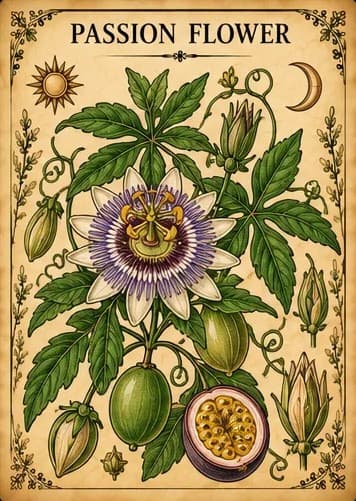
Passion Flower
Passiflora incarnata
A climbing vine from the Americas, used as a calming herb since at least the 1500s. It is recognized in Europe for mild stress and to help sleep, and small studies suggest it may ease anxiety.
Passion Flower may interact with some medicines. If you take any medicine, read Interactions with medicines below and talk to your doctor or pharmacist before using it.
What is Passion Flower?
- Plant family
- Passifloraceae, the passionflower family
- Parts used
- The above-ground parts (herb)
- Where it grows
- Native to the southeastern United States and Central and South America
- Genus
- Passiflora
- Species
- incarnata
Also called
Passionflower, Maypop
Traditionally used for
- Sleep
- Anxiety
- Stress
- Calming tea
Traditionally described as
- May make you feel sleepy or relaxed
Health topics
Where Passion Flower appears in symptom search, and why. Being listed doesn't mean it's a proven treatment.
- Anxiety
A small amount of research suggests it may ease anxiety, including before surgery, but results aren't definite.
- Sleep Problems (Insomnia)
Recognized in Europe as a traditional medicine to help sleep. Research suggests it may increase total sleep time, with mixed results otherwise.
- Stress
Recognized in Europe as a traditional medicine for mild symptoms of mental stress.
Traditions that use it
European Folk Medicine
Brought to Europe by Spanish explorers in the 1500s and used in folk medicine; recognized today as a traditional medicine for mild stress and sleep.
Safety
Interactions with medicines
Talk with your healthcare provider before using passion flower with any medicines.[1]
Side effects
Passion flower may cause drowsiness, dizziness and confusion.[1]
Pregnancy
Don't use passion flower during pregnancy: it may cause contractions of the womb. Little is known about its safety while breastfeeding.[1]
Before surgery
Stop using passion flower at least 2 weeks before surgery, because it may interact with anesthesia.[1]
How much to use
It's likely safe in the amounts used to flavor food. As a tea it may be safe for up to 7 nights, and as an extract for up to 8 weeks. Its safety on the skin isn't known.[1]
Passion flower medicines aren't recommended for children under 12. See a doctor if symptoms last more than 2 weeks or get worse.[2]
What does the research say?
Traditional use
These are traditional uses, not proven treatments.
In the 16th century, Spanish explorers learned of passion flower's traditional use as a calming herb in South America and brought it to Europe, where it became part of folk medicine. Today it is promoted for anxiety, sleep problems, stress, ADHD and pain.[1]
Based on long-standing use, the European Medicines Agency recognizes passion flower as a traditional herbal medicine for relieving mild symptoms of mental stress and to help sleep, in adults and teens over 12.[3]
Research in people
A small amount of research suggests passion flower taken by mouth might ease anxiety, including anxiety before surgery or dental work, but the findings aren't definite. It may increase total sleep time in adults with insomnia, though results for falling and staying asleep are mixed. There isn't enough evidence for ADHD, heart failure, menopause symptoms, fibromyalgia or stress.[1]
The European Medicines Agency found the clinical studies of passion flower too small and too poorly designed to draw firm conclusions.[3]
In short
Can cause drowsiness; avoid in pregnancy and for 2 weeks before surgery.
Sources
- [1] Passionflower: Usefulness and Safety — National Center for Complementary and Integrative Health (NIH)Government health agency
- [2] Community herbal monograph on Passiflora incarnata L., herba (EMA/HMPC/669740/2013) — European Medicines Agency, Committee on Herbal Medicinal Products (HMPC)Government health agency
- [3] Passion flower (Passiflora incarnata L., herba): summary of the HMPC conclusions (EMA/275240/2014) — European Medicines Agency, Committee on Herbal Medicinal Products (HMPC)Government health agency
This information is educational and traditional in nature, and is not a substitute for professional medical advice.