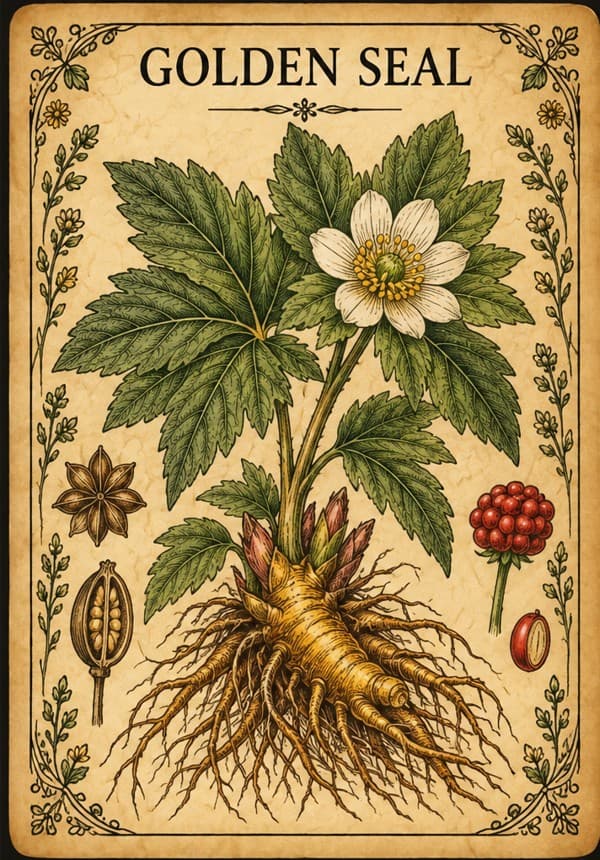
Goldenseal
Hydrastis canadensis
A North American plant with a bright yellow root, used by Native Americans on wounds and for skin and eye conditions. There isn't enough research to know whether it helps any health condition.
Goldenseal may interact with some medicines. If you take any medicine, read Interactions with medicines below and talk to your doctor or pharmacist before using it.
What is Goldenseal?
- Plant family
- Ranunculaceae, the buttercup family
- Parts used
- The root and bright yellow underground stem
- Where it grows
- Native to the northeastern United States and southeastern Canada; wild plants have become scarce from heavy harvesting
- Genus
- Hydrastis
- Species
- canadensis
Also called
Golden Seal, Yellow Root, Goldenroot, Yellow Pucoon, Eye Root, Yellow Paint Root
Traditionally used for
- Wounds (traditional)
- Skin and eye irritation (traditional)
- Colds
- Digestion
Traditionally described as
- Bitter tonic
Health topics
Where Goldenseal appears in symptom search, and why. Being listed doesn't mean it's a proven treatment.
- Colds and Nasal Congestion
Promoted for colds and upper respiratory infections, but there's no evidence it helps the common cold.
- Cuts, Wounds, Burns and Skin Ulcers
Used by Native Americans on wounds. There are no studies in people, and it may make skin more sensitive to sunlight.
- Skin Irritation, Rashes and Itching
Traditionally used for skin and eye irritation. It hasn't been studied for this in people.
Traditions that use it
Native American Ethnobotany
Used for digestive problems, wounds, skin and eye conditions, and cancer, and as a bitter tonic.
Natural compounds
Safety
Interactions with medicines
Goldenseal changes how the body handles many medicines. In one study it lowered blood levels of the diabetes medicine metformin by about 25%, which could affect blood sugar control. It also affects liver enzymes that break down many common medicines. Talk with your doctor or pharmacist before using it.[1]
Technical detail: inhibits CYP3A4 and affects CYP2D6 activity.
Goldenseal may increase the side effects of medicines broken down by certain liver enzymes, and may raise levels of the cancer medicine bosutinib.[2]
Technical detail: CYP3A4 and CYP2D6 inhibition in healthy volunteers; CYP2C9 and CYP3A5 in lab studies; about 2-fold bosutinib exposure in simulations.
Pregnancy
Don't use goldenseal during pregnancy or breastfeeding, and never give it to babies: its compound berberine can harm newborns.[1]
Breastfeeding
Berberine in goldenseal may cause or worsen jaundice (yellowing of the skin) in newborns.[2]
How much to use
In small studies, about 3 g a day for short periods caused no serious harm. Its long-term safety isn't known, and animal studies raised concerns, so avoid long-term use.[1]
Contamination
Some goldenseal products contain other herbs or ingredients instead of goldenseal, and berberine content varies widely. It's sometimes called "turmeric root" but is a different plant from turmeric.[2]
Depends on how it's prepared
Lab studies suggest goldenseal can make skin more sensitive to sunlight, which is more likely with products put on the skin than with supplements.[2]
What does the research say?
Traditional use
These are traditional uses, not proven treatments.
Native Americans used goldenseal on wounds and for skin and eye conditions, digestive problems and cancer. Today it is promoted for colds, upper respiratory infections, hay fever, diarrhea and constipation, and is often combined with echinacea.[1]
Laboratory & animal research
Lab and animal results show what might be worth studying in people. They don't show that the herb has these effects in humans.
In lab and animal studies, goldenseal and its compounds berberine and hydrastine killed bacteria and other microbes, slowed tumor growth, reduced inflammation and relaxed muscle. In the lab, goldenseal was the strongest of several herbs at stopping the stomach bacterium H. pylori. Long-term, very high doses harmed the liver and caused tumors in animals.[2]
Research in people
There isn't enough evidence to know whether goldenseal helps any health condition, because no rigorous studies have been done in people. Research on berberine for blood sugar and cholesterol may not apply, because very little berberine is absorbed when goldenseal is taken by mouth.[1]
Although goldenseal has traditionally been used for skin and eye problems, there are no studies in people on these uses, and no evidence it helps the common cold.[2]
In short
Affects many medicines, including metformin; don't use in pregnancy, breastfeeding or babies.
Sources
- [1] Goldenseal: Usefulness and Safety — National Center for Complementary and Integrative Health (NIH)Government health agency
- [2] Goldenseal — Memorial Sloan Kettering Cancer Center, About HerbsGeneral reference
This information is educational and traditional in nature, and is not a substitute for professional medical advice.