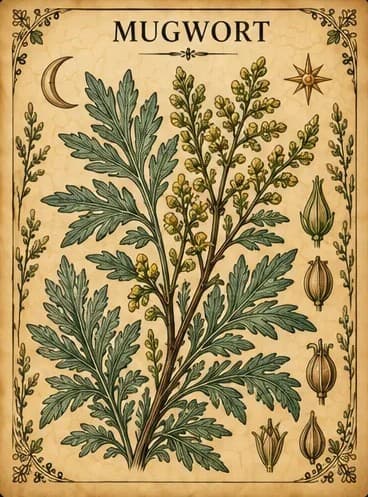
Mugwort
Artemisia vulgaris
A common plant called the "mother of herbs" in the Middle Ages, when it was used on wounds. It is also used in Chinese moxibustion. Mugwort is a major cause of pollen allergy and can cause skin allergies.
What is Mugwort?
- Plant family
- Asteraceae, the daisy family
- Parts used
- The above-ground parts (herb); sometimes the root
- Where it grows
- Common almost all over the world
- Genus
- Artemisia
- Species
- vulgaris
Also called
Common Mugwort, Moxa
Traditional names
Mother of Herbs
Traditionally used for
- Wounds (traditional)
- Digestion
- Moxibustion
- Menstrual complaints (traditional)
Traditionally described as
- Bitter
- Aromatic
Health topics
Where Mugwort appears in symptom search, and why. Being listed doesn't mean it's a proven treatment.
- Cuts, Wounds, Burns and Skin Ulcers
Used on wounds in medieval European medicine. It hasn't been tested for wounds in people.
- Menstrual Discomfort
Traditionally used since ancient times for menstrual complaints. Avoid in pregnancy.
- Skin Irritation, Rashes and Itching
Used in skin-care cosmetics, but it can itself cause skin allergies such as rashes and hives.
Traditions that use it
European Folk Medicine
In medieval Europe it was called the "mother of herbs" and used on wounds, for gout, leg tiredness, fever and stomach complaints.
Traditional Chinese Medicine
Dried leaves (moxa) are burned on or near the skin in moxibustion.
Safety
Who should avoid it
Use mugwort with caution if you have diabetes, because it can raise blood sugar.[1]
Allergies
Mugwort pollen is a major cause of hay fever and allergic asthma in northern Europe, North America and parts of Asia. It can also cause skin allergies such as rashes (dermatitis) and hives, and severe allergic reactions have occurred after swallowing the pollen. Avoid mugwort if you're allergic to it or to other daisy-family plants.[1]
People allergic to mugwort may also react to birch and grass pollen and to some foods, including cabbage, hazelnuts and honey.[1]
Pregnancy
In large doses, mugwort may cause miscarriage. Avoid it during pregnancy.[1]
Toxicity testing
Large doses may cause nausea, vomiting and nerve damage, and high blood pressure has been reported. Compounds in the essential oil (such as thujone and camphor) may be harmful in food or supplements, mainly in concentrated oil.[1]
Depends on how it's prepared
The smoke from burning moxa has been tested for harmful compounds like those found in cigarette smoke.[1]
What does the research say?
Traditional use
These are traditional uses, not proven treatments.
Mugwort has been used since ancient Egypt, Greece and Rome, especially for menstrual and pregnancy-related complaints. In medieval Europe it was called the "mother of herbs" and was used on wounds, for gout and tired legs, for fever and for stomach and gut complaints. In traditional Chinese medicine, dried leaves (moxa) are burned on or close to the skin in a practice called moxibustion.[1]
Today mugwort isn't commonly used as a medicine. Its bitter taste has been used to stimulate digestion, and its essential oil is used in insect repellents. In cosmetics, it is used as a skin-care ingredient, skin protectant, moisturizer and fragrance.[1]
Laboratory & animal research
Lab and animal results show what might be worth studying in people. They don't show that the herb has these effects in humans.
In lab and animal studies, mugwort extracts showed antioxidant, antibacterial, antifungal and pain-relieving effects, protected the liver, and eased cramps. A fermented mugwort extract increased collagen production in lab tests, which may explain its use in anti-aging cosmetics.[1]
Research in people
Research in people is limited. A review of trials found that moxibustion with mugwort, added to blood pressure medicines, lowered the top number of blood pressure more than medicines alone. The German Commission E noted in 1988 that mugwort's effectiveness hadn't been confirmed.[1]
In short
Avoid during pregnancy (large amounts may cause miscarriage) and if you're allergic to daisy-family plants.
Sources
- [1] Significance of Artemisia Vulgaris L. (Common Mugwort) in the History of Medicine and Its Possible Contemporary Applications Substantiated by Phytochemical and Pharmacological Studies — Molecules · DOI: 10.3390/molecules25194415Peer-reviewed study
This information is educational and traditional in nature, and is not a substitute for professional medical advice.