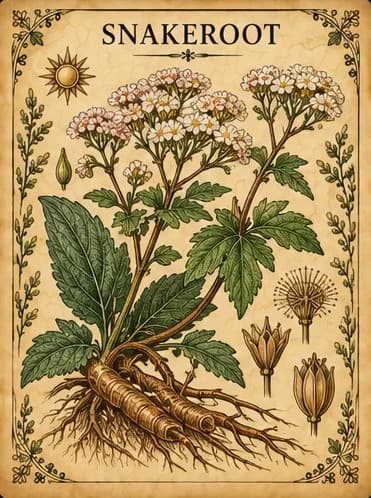
Snakeroot
Ageratina pichinchensis
A plant native to Mexico, known there as axihuitl, long used in traditional Mexican medicine for skin problems and wounds. Small trials in Mexico have tested extracts for fungal skin and nail infections and leg ulcers.
What is Snakeroot?
- Plant family
- Asteraceae, the daisy family
- Parts used
- The above-ground parts (leaves and stems)
- Where it grows
- Native to Mexico, where it grows in many states
- Genus
- Ageratina
- Species
- pichinchensis
Traditional names
Axihuitl
Traditionally used for
- Fungal skin infections
- Nail fungus
- Wounds
- Skin ulcers
Traditionally described as
- Antifungal
Health topics
Where Snakeroot appears in symptom search, and why. Being listed doesn't mean it's a proven treatment.
- Cuts, Wounds, Burns and Skin Ulcers
Traditionally used in Mexico for wounds. Small trials suggest it may help leg ulcers and diabetic foot ulcers heal.
- Fungal Skin and Nail Infections (Athlete's Foot, Nail Fungus)
Small trials in Mexico found extracts worked about as well as standard antifungal creams and lacquers for athlete's foot and nail fungus.
Safety
Side effects
No side effects were seen in the trial of a snakeroot lacquer for fungal skin and nail infections.[1]
What does the research say?
Traditional use
These are traditional uses, not proven treatments.
Snakeroot (Ageratina pichinchensis) has long been used in traditional Mexican medicine for skin conditions and injuries, and is mentioned in 16th-century sources. The above-ground parts are popularly used for skin problems, wounds, tumors and mouth sores. In rural Morelos, midwives and herbalists use it for respiratory, genital, digestive, urinary and skin infections.[1]
Laboratory & animal research
Lab and animal results show what might be worth studying in people. They don't show that the herb has these effects in humans.
In lab and animal studies, extracts showed activity against bacteria and fungi (including fungi that cause athlete's foot), and reduced inflammation. In diabetic rats, extracts helped skin wounds heal.[1]
Research in people
Small clinical trials in Mexico have tested snakeroot extracts on the skin:
- Athlete's foot: a 10% extract cream worked about as well as the antifungal ketoconazole over 4 weeks.
- Fungal skin and nail infections: a 10% lacquer worked in 71% of people, compared with 81% for the antifungal ciclopirox. No side effects were seen.
- Leg ulcers from poor vein circulation: a standardized extract helped them heal.
- Diabetic foot ulcers: a cream shortened healing time and wound size, though the difference wasn't statistically significant.
Technical detail: therapeutic efficacy 71.1% vs 80.9%, mycological efficacy 59.1% vs 63.8% (lacquer vs 8% ciclopirox); Trichophyton rubrum and T. mentagrophytes infections.
In a trial of people with type 2 diabetes and mild to moderate nail fungus, a lacquer made from a standardized snakeroot extract was applied for 6 months and compared with the antifungal ciclopirox. It worked about as well: nails improved in 78.5% of the snakeroot group and 77.2% of the ciclopirox group.[2]
Technical detail: double-blind, randomized, controlled; encecalin-standardized extract vs 8% ciclopirox; no statistically significant difference between groups.
In short
Other plants are also called snakeroot (for example black cohosh); this page is only about Ageratina pichinchensis.
Sources
- [1] Phytochemical, Pharmacological, and Biotechnological Study of Ageratina pichinchensis: A Native Species of Mexico — Plants (Basel) · DOI: 10.3390/plants10102225Peer-reviewed study
- [2] Effectiveness of an encecalin standardized extract of Ageratina pichinchensis on the treatment of onychomycosis in patients with diabetes mellitus — Phytotherapy Research · DOI: 10.1002/ptr.6644Peer-reviewed study
This information is educational and traditional in nature, and is not a substitute for professional medical advice.