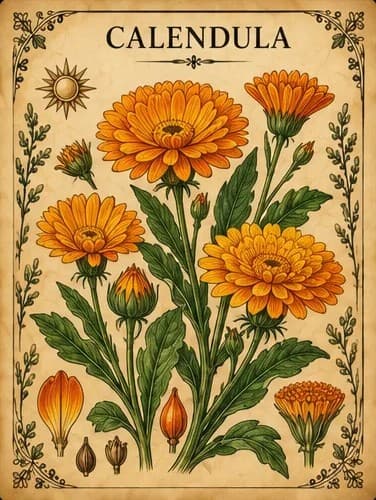
Calendula
Calendula officinalis
The pot marigold, used in creams and ointments to soothe the skin. It is recognized in Europe for minor skin inflammation such as sunburn and to help minor wounds heal.
Calendula may interact with some medicines. If you take any medicine, read Interactions with medicines below and talk to your doctor or pharmacist before using it.
What is Calendula?
- Plant family
- Asteraceae, the daisy family
- Parts used
- The flowers
- Genus
- Calendula
- Species
- officinalis
Also called
Golden Healer, Pot Marigold, Marigold, Gold-bloom, Marybud
Traditionally used for
- Minor wounds
- Sunburn
- Skin inflammation
- Mouth and throat inflammation
Traditionally described as
- May help minor wounds heal
Health topics
Where Calendula appears in symptom search, and why. Being listed doesn't mean it's a proven treatment.
- Cuts, Wounds, Burns and Skin Ulcers
Recognized in Europe as a traditional medicine to help minor wounds heal. A review found some evidence of benefit; results for burns were mixed.
- Skin Irritation, Rashes and Itching
Recognized in Europe for minor skin inflammation such as sunburn. Studies of radiation skin damage have had mixed results.
Traditions that use it
European Folk Medicine
Recognized in Europe as a traditional herbal medicine for minor skin inflammation, minor wounds, and mouth or throat inflammation.
Safety
Interactions with medicines
It's generally safe to use calendula in food and tea. Supplements are stronger and can affect how other medicines work, so talk with your healthcare provider before taking them.[1]
Allergies
Calendula can cause allergic reactions, including skin allergies. Don't use it if you're allergic to calendula or other plants in the daisy family.[2]
Pregnancy
Its safety during pregnancy and breastfeeding hasn't been studied, so don't use calendula at these times.[1]
How much to use
Calendula medicines are for use on the skin in people over 6, and in the mouth or throat in people over 12. See a doctor if the skin looks infected, symptoms get worse, or they last longer than 1 week.[2]
What does the research say?
Traditional use
These are traditional uses, not proven treatments.
Based on long-standing use, the European Medicines Agency recognizes calendula flower as a traditional herbal medicine for:
- Minor skin inflammation, such as sunburn
- Helping minor wounds heal
- Minor inflammation in the mouth or throat
On the skin it is used as a cream or ointment, or as a warm tea soaked into a dressing.[3]
Calendula comes as creams and ointments to soothe irritated skin, and is used for small cuts and burns. Fresh petals are eaten in salads, and dried petals add color to soups and stews.[1]
Laboratory & animal research
Lab and animal results show what might be worth studying in people. They don't show that the herb has these effects in humans.
In lab and animal studies, calendula reduced inflammation and showed antioxidant and antimicrobial activity. In animals, it helped burns heal faster and helped protect the skin from sun damage.[1]
Research in people
The European Medicines Agency looked at studies of calendula for leg ulcers caused by poor vein circulation, burns and skin inflammation. No firm conclusions could be drawn because of problems with how the studies were designed.[3]
A 2019 review of 7 clinical trials and 7 animal studies found some evidence that calendula extract helps wounds heal:
- Acute wounds: one trial and five animal studies found faster healing of inflammation.
- Leg ulcers from poor vein circulation: two studies found the ulcers shrank more than with comparison treatments.
- Diabetic leg ulcers and burns: trials found no benefit.
- Skin damage from radiation therapy: one trial found calendula helped prevent it, another found no benefit.
The authors say larger, well-designed trials are needed.[4]
Other small studies suggest calendula may help when used to prevent skin damage from radiation therapy, and for diabetic foot and leg ulcers, vaginal yeast infections and pain after an episiotomy. Larger studies are needed.[1]
In short
Can cause skin allergies; don't use it if you're allergic to daisy-family plants.
Sources
- [1] Calendula — Memorial Sloan Kettering Cancer Center, About HerbsGeneral reference
- [2] European Union herbal monograph on Calendula officinalis L., flos, Revision 1 (EMA/HMPC/437450/2017) — European Medicines Agency, Committee on Herbal Medicinal Products (HMPC)Government health agency
- [3] Calendula flower (Calendula officinalis L., flos): summary of the HMPC conclusions (EMA/267467/2018) — European Medicines Agency, Committee on Herbal Medicinal Products (HMPC)Government health agency
- [4] A systematic review of Calendula officinalis extract for wound healing — Wound Repair and Regeneration · DOI: 10.1111/wrr.12737Review or clinical trial
This information is educational and traditional in nature, and is not a substitute for professional medical advice.