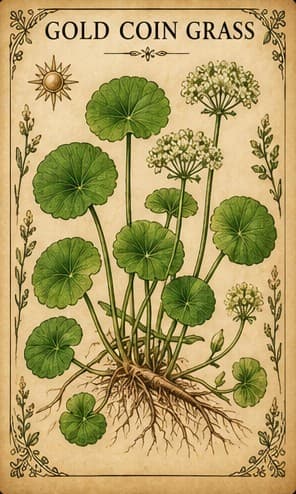
Gold Coin Grass
Lysimachia christinae, Desmodium styracifolium
A name used in traditional Chinese medicine for two plants, Lysimachia christinae (jin qian cao) and Desmodium styracifolium (guang jin qian cao). Both are used for gallstones and urinary stones; a large trial found a Desmodium extract helped small stones pass.
What is Gold Coin Grass?
- Plant family
- Primulaceae (the primrose family) for Lysimachia; Fabaceae (the pea and bean family) for Desmodium
- Parts used
- The whole plant
- Where it grows
- Lysimachia christinae grows wild in almost every part of China. Desmodium styracifolium grows in southern China and in parts of South and Southeast Asia.
- Genus
- Lysimachia / Desmodium
- Species
- christinae / styracifolium
Traditional names
Jin Qian Cao, Jinqiancao, Guang Jin Qian Cao, Guangjinqiancao, Guangdong Jin Qian Cao
Traditionally used for
- Gallstones
- Kidney stones
- Bile flow
- Urinary complaints
- Jaundice
Traditionally described as
- Traditionally used for gallstones and kidney stones
Health topics
Where Gold Coin Grass appears in symptom search, and why. Being listed doesn't mean it's a proven treatment.
- Gallbladder, Gallstones and Bile Flow
Both plants are traditionally used in Chinese medicine for gallstones. They have been studied for this only in the lab and in animals.
- Kidney Stones
Traditionally used for urinary stones. In a 2026 trial, a Desmodium styracifolium extract helped more people pass small ureter stones than placebo (45% vs 34%).
- Liver Disease (Hepatitis, Cirrhosis)
Desmodium styracifolium is traditionally used for hepatitis and jaundice. Its effects on the liver have only been studied in the lab and in animals.
Traditions that use it
Traditional Chinese Medicine
Both plants are used for gallstones and urinary stones. Lysimachia christinae is the only ingredient in Jin Qian Cao capsules. Desmodium styracifolium is listed in the Chinese Pharmacopoeia and is also used for poor bile flow, hepatitis and jaundice.
Safety
Side effects
Contamination
Several different plants are sold under similar names, including Lysimachia christinae (jin qian cao), Desmodium styracifolium (guang jin qian cao) and Glechoma longituba (lian qian cao).[3]
What does the research say?
Traditional use
These are traditional uses, not proven treatments.
Gold coin grass is a name used for two different plants in traditional Chinese medicine:
- Lysimachia christinae (jin qian cao)
- Desmodium styracifolium (guang jin qian cao, "Guangdong gold coin grass")
Both are used for gallstones and urinary stones. Research on one plant doesn't necessarily apply to the other.[3]
Lysimachia christinae is used for gallstones and inflammation of the gallbladder (cholecystitis). It is an ingredient in 8 of 13 common gallstone medicines approved in China, and the only ingredient in Jin Qian Cao capsules.[1]
In China, Lysimachia christinae has been used for thousands of years to prevent and treat kidney stones, to increase urination and to make urine more acidic. Traditional amounts are large: 150 to 200 g of the whole plant a day for more than six months.[3]
Desmodium styracifolium is listed in the Chinese Pharmacopoeia. It is traditionally used for urinary stones, bladder problems, slow and painful urination, poor bile flow, hepatitis, jaundice and gallbladder inflammation. The whole plant is boiled into a tea (a decoction), for example 24 to 60 g for urinary stones.[4]
Laboratory & animal research
Lab and animal results show what might be worth studying in people. They don't show that the herb has these effects in humans.
In mice, Lysimachia christinae helped shrink existing cholesterol gallstones, increased bile flow, and lowered cholesterol in the bile and blood. In lab tests, its extracts showed antioxidant activity.[1]
In lab experiments, Lysimachia christinae reduced inflammation and increased bile flow. Researchers linked these effects to 15 of its flavonoids (a group of plant compounds).[5]
In lab tests, a boiled extract of Lysimachia christinae slowed the growth and clumping of kidney-stone crystals.[3]
In lab and animal studies, Desmodium styracifolium reduced the buildup of stone-forming minerals in the urinary tract and made urine less acidic. Experiments also found it helped dissolve gallstones, increased bile flow and protected the liver, including from acetaminophen damage and from fat buildup on a high-fat diet.[4]
Technical detail: effects attributed mainly to the flavonoid schaftoside, acting on liver X receptor α and the farnesoid X receptor (FXR); antioxidant and anti-inflammatory activity; urine alkalinization.
Research in people
In a 2026 trial at 34 hospitals in China, 606 adults with small stones in the ureter (the tube from the kidney to the bladder) took a Desmodium styracifolium extract or a placebo 3 times a day for 28 days, alongside their usual medicines. By day 28, 44.6% of the extract group had passed their stone, compared with 33.8% of the placebo group. Side effects were about as common in both groups. Because the trial was only done in China, the authors say the results may not apply everywhere.[2]
Technical detail: phase 3, double-blind, randomized 3:1; total flavone capsules (Guang Jing), 0.6 g three times daily; stone passage confirmed by CT, RR 1.32 (95% CI 1.03 to 1.69), absolute difference 10.9 percentage points; stones 5 to 10 mm; no significant difference by day 14; adverse events 19.3% vs 18.2%; ChiCTR-IIR-17013275.
China's medicines regulator has approved a capsule made from Desmodium styracifolium flavonoids.[4]
No clinical trials of Jin Qian Cao capsules (Lysimachia christinae on its own) have been reported. A 2019 review noted that the safety and effectiveness of Chinese herbal gallstone medicines still need to be confirmed.[1]
In short
These are different plants, and research on one may not apply to the other. Gallstones and kidney stones need medical care.
Sources
- [1] Mechanisms Underlying the Prevention and Treatment of Cholelithiasis Using Traditional Chinese Medicine — Evidence-Based Complementary and Alternative Medicine · DOI: 10.1155/2019/2536452Peer-reviewed study
- [2] Desmodium styracifolium Total Flavone Capsules for Urolithiasis: A Phase 3 Randomized Clinical Trial — JAMA Network Open · DOI: 10.1001/jamanetworkopen.2026.32874Peer-reviewed study
- [3] Therapeutic effects of Chinese herbal medicines for treatment of urolithiasis: A review — Chinese Herbal Medicines · DOI: 10.1016/j.chmed.2023.09.001Peer-reviewed study
- [4] Desmodium styracifolium: Botanical and ethnopharmacological insights, phytochemical investigations, and prospects in pharmacology and pharmacotherapy — Heliyon · DOI: 10.1016/j.heliyon.2024.e25058Peer-reviewed study
- [5] Comprehensive quality evaluation of Lysimachia christinae Hance via fingerprint, spectrum-effect relationship, and quantitative analyses of multiple components by single marker — Phytochemical Analysis · DOI: 10.1002/pca.3394Peer-reviewed study
This information is educational and traditional in nature, and is not a substitute for professional medical advice.