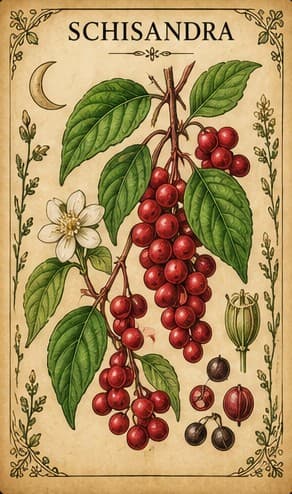
Schisandra
Schisandra chinensis
A fruit known in Chinese as wu wei zi ("five-flavor fruit"), long used in traditional Chinese medicine for the liver, coughs and energy. Studies in people are few and small.
Schisandra may interact with some medicines. If you take any medicine, read Interactions with medicines below and talk to your doctor or pharmacist before using it.
What is Schisandra?
- Plant family
- Schisandraceae, the magnolia-vine family
- Parts used
- The fruit
- Genus
- Schisandra
- Species
- chinensis
Also called
Schizandra, Five Flavor Berry, Gomishi, Omija, Omicha, Schisandra Berry, Wananfu Schisandra Berry
Traditional names
Wu Wei Zi
Traditionally used for
- Liver problems
- Cough
- Energy
- Tonic
Traditionally described as
- Tonic
- Adaptogen
Health topics
Where Schisandra appears in symptom search, and why. Being listed doesn't mean it's a proven treatment.
- Cough
Traditionally used for coughs in Chinese medicine; not tested in clinical trials.
- Fatigue
Traditionally used as a tonic for energy and in formulas for tiredness.
- Fatty Liver (NAFLD)
Some small studies suggest improvements when combined with other substances, but they are too limited to draw conclusions.
- Liver Disease (Hepatitis, Cirrhosis)
Traditionally used for liver conditions. Small, uncontrolled studies in people are inconclusive; it can also lower liver test results.
- Menopause Symptoms
A small trial in women suggests it may help hot flushes and sweating.
Traditions that use it
Traditional Chinese Medicine
Used for coughs, liver conditions, stomach problems and sweating, and as a tonic for energy. Its Chinese name, wu wei zi, means "five-flavored fruit".
Safety
Interactions with medicines
Schisandra raised blood levels of tacrolimus, a medicine that prevents organ rejection, in liver transplant patients. Talk with your doctor before using it if you take tacrolimus.[1]
Schisandra may change how the body breaks down many common medicines, and may increase the side effects of some. Talk with your doctor about possible interactions.[1]
Technical detail: CYP3A4, CYP3A5 and CYP1A2 substrates (lab and animal data; clinical relevance not yet determined); P-glycoprotein substrates.
Side effects
No serious side effects have been reported, but schisandra hasn't been well studied in people. In one small trial, sleepiness and cold hands and feet were seen in both the schisandra and placebo groups.[1]
Schisandra can lower two liver enzymes (ALT and AST) on blood tests. Tell your healthcare provider you take it if you're having liver tests.[1]
What does the research say?
Traditional use
These are traditional uses, not proven treatments.
Schisandra has a long history in traditional Chinese medicine for coughs, liver conditions, stomach problems such as diarrhea and indigestion, and sweating. It is also used as a tonic to improve energy, and in formulas for tiredness and sleep. Its name, wu wei zi, means "five-flavored fruit": sour, bitter, sweet, salty and pungent.[1]
Laboratory & animal research
Lab and animal results show what might be worth studying in people. They don't show that the herb has these effects in humans.
In lab and animal studies, schisandra showed antioxidant activity and seemed to protect the liver, heart and nervous system.[1]
A 2025 review of 54 animal studies found that compounds from schisandra lowered liver enzymes and signs of cell damage and inflammation in animals with liver injury.[2]
Technical detail: ALT SMD −4.74 (95% CI −5.42 to −4.06); AST SMD −5.10 (−5.84 to −4.37); high heterogeneity (I² above 90%); lower MDA and higher SOD and GSH.
Research in people
Only a few small studies have been done in people:
- In liver transplant patients, schisandra appeared to improve liver function and reduce diarrhea caused by the anti-rejection medicine tacrolimus.
- Some studies suggest improvements in fatty liver disease or hepatitis C when schisandra was combined with other substances.
- A small trial in women suggests it may help menopausal hot flushes and sweating.
These studies were too small or uncontrolled to draw conclusions.[1]
In China, medicines made from schisandra fruit, or lab-made versions of one of its compounds, are commonly prescribed for liver damage caused by other medicines. A 2019 review found clinical studies showing these medicines lowered raised liver test results in such patients.[3]
Technical detail: drug-induced liver injury (DILI); serum ALT, AST and total bilirubin; synthetic analogues of schisandrin C; studies published in English or Chinese.
In short
Can change blood levels of some medicines, including tacrolimus; it can also lower liver test results.
Sources
- [1] Schisandra — Memorial Sloan Kettering Cancer Center, About HerbsGeneral reference
- [2] Efficacy of Schisandra chinensis in liver injury: a systematic review and preclinical meta-analysis — Frontiers in Pharmacology · DOI: 10.3389/fphar.2025.1627081Review or clinical trial
- [3] Schisandra fruits for the management of drug-induced liver injury in China: A review — Phytomedicine · DOI: 10.1016/j.phymed.2018.11.020Peer-reviewed study
This information is educational and traditional in nature, and is not a substitute for professional medical advice.