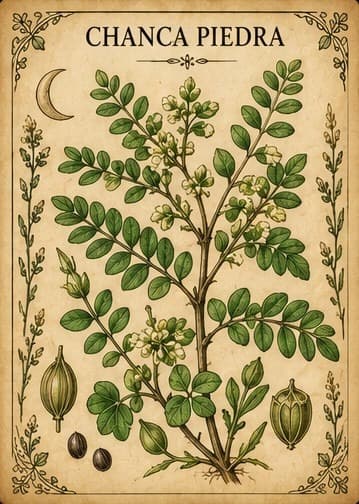
Chanca Piedra
Phyllanthus niruri
A plant traditionally used in Malay, Chinese and Ayurvedic medicine for kidney stones and liver problems. It has been studied for both, with mixed results.
What is Chanca Piedra?
- Plant family
- Phyllanthaceae, the leafflower family
- Genus
- Phyllanthus
- Species
- niruri
Traditionally used for
- Kidney stones
- Liver problems
- Jaundice
- Indigestion
Traditionally described as
- Traditionally used for the liver and kidneys
Health topics
Where Chanca Piedra appears in symptom search, and why. Being listed doesn't mean it's a proven treatment.
- Fatty Liver (NAFLD)
In a 12-month trial, it didn't reduce liver fat or liver enzymes more than placebo, though liver stiffness improved slightly.
- Kidney Stones
Traditionally used for kidney stones. A 2025 review suggests it may help alongside shock-wave treatment; results have been mixed.
- Liver Disease (Hepatitis, Cirrhosis)
Traditionally used for liver problems. A Cochrane review found no convincing evidence it helps hepatitis B on its own.
Traditions that use it
Ayurveda
Known in Ayurvedic medicine for liver and kidney problems.
Traditional Chinese Medicine
Known in Chinese medicine for liver and kidney problems.
Safety
What does the research say?
Traditional use
These are traditional uses, not proven treatments.
Chanca piedra has traditionally been used for many conditions, including indigestion, diarrhea, jaundice (yellowing of the skin and eyes), kidney stones and urinary infections. It is especially known in Malay, Chinese and Ayurvedic medicine for liver and kidney problems.[2]
Laboratory & animal research
Lab and animal results show what might be worth studying in people. They don't show that the herb has these effects in humans.
In animal studies, chanca piedra extracts helped the liver recover from damage caused by chemicals and some medicines, including acetaminophen. In rats fed a high-fat diet, an extract slowed the development of fatty liver disease.[2]
Technical detail: carbon tetrachloride, acetaminophen and nimesulide injury models; 50% methanolic extract rich in ellagic acid and phyllanthin in Sprague-Dawley rats.
Research in people
In a 12-month trial, 226 adults with mild to moderate fatty liver disease took 3,000 mg of a chanca piedra extract or a placebo every day. It didn't reduce liver fat or liver enzymes more than placebo. Liver stiffness, a sign of scarring, improved slightly in the chanca piedra group but not in the placebo group. No major side effects were reported.[2]
Technical detail: randomized, double-blind, placebo-controlled; CAP change −15.05 vs −14.74 dB/m (p = 0.869); liver stiffness −0.64 vs +0.10 kPa (p = 0.001); standardized extract EPN 797.
A 2011 Cochrane review looked at 16 trials with 1,326 people with long-term hepatitis B. It found no convincing evidence that phyllanthus (the plant group chanca piedra belongs to) works better than placebo. Adding it to antiviral medicines may have worked better than the medicines alone. However, the trials were of low quality, so these results are uncertain. No serious side effects were reported.[3]
Technical detail: one placebo-controlled trial (42 participants); 15 trials of phyllanthus plus an antiviral vs the antiviral alone; HBeAg seroconversion RR 0.77 (95% CI 0.63 to 0.92) with substantial heterogeneity; species not always reported.
A 2025 review of 16 studies in people and rats looked at chanca piedra for kidney stones, where research has had mixed results. The authors concluded that, used alongside standard treatment, it appears safe and may help more people become stone-free after shock-wave treatment (lithotripsy).[1]
In short
Kidney stones and liver disease need medical care; don't use it in place of treatment.
Sources
- [1] Phyllanthus niruri in the management of nephrolithiasis: A systematic review of the literature — Actas Urológicas Españolas · DOI: 10.1016/j.acuroe.2025.501791Review or clinical trial
- [2] Effects of one-year supplementation with Phyllanthus niruri on fibrosis score and metabolic markers in patients with non-alcoholic fatty liver disease: A randomized, double-blind, placebo-controlled trial — Heliyon · DOI: 10.1016/j.heliyon.2023.e16652Peer-reviewed study
- [3] Phyllanthus species for chronic hepatitis B virus infection — Cochrane Database of Systematic Reviews · DOI: 10.1002/14651858.CD008960.pub2Review or clinical trial
This information is educational and traditional in nature, and is not a substitute for professional medical advice.