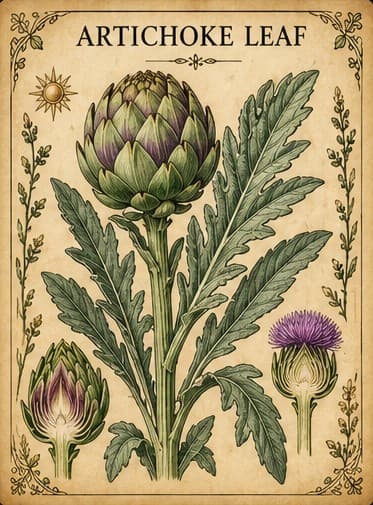
Artichoke Leaf
Cynara cardunculus
Leaves of the artichoke plant, recognized in Europe for indigestion, fullness and bloating. Several small trials suggest it may lower liver enzyme levels in fatty liver disease.
What is Artichoke Leaf?
- Plant family
- Asteraceae, the daisy family
- Parts used
- The leaves
- Genus
- Cynara
- Species
- cardunculus
Also called
Artichoke
Older scientific names
Cynara scolymus
Traditionally used for
- Indigestion
- Bloating
- Fatty liver
Traditionally described as
- May ease indigestion
Health topics
Where Artichoke Leaf appears in symptom search, and why. Being listed doesn't mean it's a proven treatment.
- Bloating
Recognized in Europe as a traditional medicine for bloating and gas.
- Fatty Liver (NAFLD)
A 2022 review of 5 trials found artichoke leaf extract lowered liver enzymes in people with fatty liver disease.
- Gallbladder, Gallstones and Bile Flow
Not for people with gallstones, a blocked bile duct or other bile problems (European Medicines Agency).
- High Cholesterol
In trials in people with fatty liver disease, artichoke leaf extract lowered total and LDL cholesterol and triglycerides.
- Indigestion
Recognized in Europe as a traditional medicine for indigestion with fullness. Small studies suggest it may help.
Traditions that use it
European Folk Medicine
Recognized in Europe as a traditional herbal medicine for indigestion, based on at least 30 years of use, including 15 in the EU.
Safety
Who should avoid it
Don't use artichoke leaf medicines if you have:
- A blocked or inflamed bile duct (cholangitis)
- Gallstones or any other bile problem that needs medical care
- Liver disease
- An allergy to daisy-family plants
Side effects
Side effects include mild diarrhea with belly cramps, nausea, heartburn and allergic reactions. How often they happen isn't known.[2]
Pregnancy
Its safety during pregnancy and breastfeeding hasn't been established, so European guidance doesn't recommend it at these times.[1]
How much to use
Artichoke leaf medicines are for adults and teens over 12. See a doctor if symptoms last longer than 2 weeks.[2]
What does the research say?
Traditional use
These are traditional uses, not proven treatments.
Based on long-standing use, the European Medicines Agency recognizes artichoke leaf as a traditional herbal medicine for indigestion with a feeling of fullness, bloating and gas. It is for adults and teens over 12, and is taken as a tea or in liquid or solid forms by mouth.[2]
Artichoke leaf extract is well known in folk medicine for protecting the liver.[3]
Research in people
Studies in people with digestive problems suggest artichoke leaf may improve indigestion. No firm conclusions could be drawn, because the studies were small, short and poorly designed.[2]
A 2022 review combined 5 randomized controlled trials with 333 people with non-alcoholic fatty liver disease. Artichoke leaf extract lowered liver enzymes more than the comparison groups did. It also lowered total cholesterol, LDL cholesterol and triglycerides (blood fats). The authors say these trials support its use in fatty liver disease.[3]
Technical detail: ALT SMD 1.1 (95% CI 0.79 to 1.73); AST SMD 1.01 (0.52 to 1.51); total cholesterol SMD 0.98; LDL SMD 0.96; triglycerides SMD 0.95; PROSPERO CRD42020182502.
In short
Don't use it if you have gallstones, a blocked bile duct or liver disease, or are allergic to daisy-family plants.
Sources
- [1] European Union herbal monograph on Cynara cardunculus L. (syn. Cynara scolymus L.), folium (EMA/HMPC/194014/2017) — European Medicines Agency, Committee on Herbal Medicinal Products (HMPC)Government health agency
- [2] Artichoke leaf (Cynara cardunculus L. (syn. Cynara scolymus L.), folium): summary of the HMPC conclusions (EMA/268161/2018) — European Medicines Agency, Committee on Herbal Medicinal Products (HMPC)Government health agency
- [3] Therapeutic Potential of Artichoke in the Treatment of Fatty Liver: A Systematic Review and Meta-Analysis — Journal of Medicinal Food · DOI: 10.1089/jmf.2022.0025Review or clinical trial
This information is educational and traditional in nature, and is not a substitute for professional medical advice.