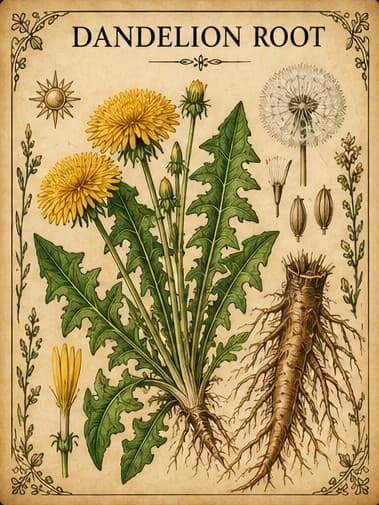
Dandelion
Taraxacum officinale
A plant whose root and leaves have long been used for indigestion and, historically, for problems with bile flow. There is very little research on it in people.
Dandelion may interact with some medicines. If you take any medicine, read Interactions with medicines below and talk to your doctor or pharmacist before using it.
What is Dandelion?
- Plant family
- Asteraceae, the daisy family
- Parts used
- The root, leaves and flowers
- Where it grows
- Originally from Europe; now grows throughout the cooler (temperate) parts of the Northern Hemisphere
- Genus
- Taraxacum
- Species
- officinale
Also called
Dandelion Root, Lion's Tooth, Blowball
Traditionally used for
- Indigestion
- Bile flow
- Liver and gallbladder (traditional)
- Appetite
- Urinary complaints
Traditionally described as
- May increase urination
Health topics
Where Dandelion appears in symptom search, and why. Being listed doesn't mean it's a proven treatment.
- Bloating
Recognized in Europe as a traditional medicine for a feeling of fullness and gas.
- Gallbladder, Gallstones and Bile Flow
Historically used in Europe for poor bile flow. Dandelion medicines shouldn't be used if you have gallstones or a blocked bile duct.
- Indigestion
Recognized in Europe as a traditional medicine for fullness, gas and slow digestion. Not proven in trials.
- Loss of Appetite
Recognized in Europe as a traditional medicine for short-term loss of appetite.
Traditions that use it
European Folk Medicine
Used in Europe for mild digestive complaints historically linked to bile flow, and to increase urination. Some German dandelion medicines have been sold since 1976.
Safety
Interactions with medicines
In theory, dandelion might interact with diabetes medicines, blood thinners and water pills.[1]
Who should avoid it
Don't use dandelion medicines if you have:
- A blocked or inflamed bile duct (cholangitis), gallstones or any other bile problem
- Liver disease
- An active stomach ulcer
- An allergy to dandelion or other daisy-family plants
Avoid dandelion medicines if you have kidney failure, diabetes or heart failure, because of a possible risk of high potassium levels. They aren't recommended for children under 12.[2]
Allergies
Dandelion put on the skin may cause an allergic reaction in people with eczema. Evidence is mixed on whether people allergic to ragweed, chrysanthemums, marigolds or daisies also react to dandelion.[1]
Side effects
Upper stomach pain, excess stomach acid and allergic reactions may occur. See a doctor if you get fever, painful urination, cramps or blood in the urine while using it, or if symptoms last more than 2 weeks.[2]
Pregnancy
Little is known about whether it's safe to use more dandelion than is found in food during pregnancy or breastfeeding. European guidance doesn't recommend dandelion medicines at these times.[2]
How much to use
Dandelion in the amounts found in food is considered likely safe. Less is known about larger amounts.[1]
What does the research say?
Traditional use
These are traditional uses, not proven treatments.
The flowers, leaves and root have traditionally been used in Mexican and other North American medicine. Today, dandelion products are promoted for indigestion (taken by mouth) and joint pain (taken by mouth or put on the skin).[1]
In Europe, dandelion root and leaves have long been used to relieve mild digestive complaints that were historically linked to bile flow, and to increase urination. Some German products have been sold since 1976 for poor bile flow with fullness and gas.[3]
Based on long-standing use, the European Medicines Agency recognizes dandelion root with leaves as a traditional herbal medicine for:
- Mild digestive problems, such as a feeling of fullness, gas and slow digestion
- Short-term loss of appetite
- Increasing urine to flush the urinary tract in minor urinary complaints
Laboratory & animal research
Lab and animal results show what might be worth studying in people. They don't show that the herb has these effects in humans.
In rats, a water-based dandelion leaf extract increased the amount of bile produced by up to 40% per hour. In rats with chemical liver damage, a dandelion extract lowered liver enzymes in the blood, suggesting it may protect the liver.[3]
Technical detail: intraduodenal decoction (Böhm 1959); whole-plant hot water extract against CCl4-induced injury in Sprague-Dawley rats lowered serum ALT and AST (Park et al. 2007).
Early lab studies have looked at dandelion extracts for effects on inflammation, antioxidant activity and viruses.[1]
Research in people
Very little research has been done on dandelion in people. There's no strong scientific evidence that it helps any health condition.[1]
In short
Don't use dandelion medicines if you have gallstones, a blocked bile duct or liver disease.
Sources
- [1] Dandelion: Usefulness and Safety — National Center for Complementary and Integrative Health (NIH)Government health agency
- [2] Community herbal monograph on Taraxacum officinale Weber ex Wigg., radix cum herba (EMA/HMPC/212895/2008) — European Medicines Agency, Committee on Herbal Medicinal Products (HMPC)Government health agency
- [3] Assessment report on Taraxacum officinale Weber ex Wigg., radix cum herba (EMA/HMPC/212897/2008) — European Medicines Agency, Committee on Herbal Medicinal Products (HMPC)Government health agency
This information is educational and traditional in nature, and is not a substitute for professional medical advice.