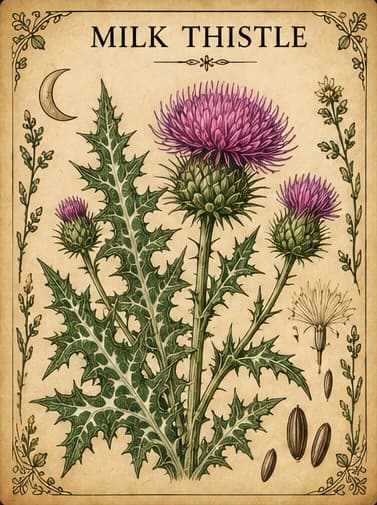
Milk Thistle
Silybum marianum
A tall, purple-flowered thistle from Europe, long used for liver problems. Studies of it and its extract silymarin in liver disease have been conflicting or too limited to show a clear benefit.
Milk Thistle may interact with some medicines. If you take any medicine, read Interactions with medicines below and talk to your doctor or pharmacist before using it.
What is Milk Thistle?
- Plant family
- Asteraceae, the daisy family
- Parts used
- The fruit
- Where it grows
- Native to Europe; brought to North America by early colonists
- Genus
- Silybum
- Species
- marianum
Also called
Mary Thistle, Holy Thistle, Marian Thistle, Our Lady's Thistle, St. Mary Thistle, Wild Artichoke
Older scientific names
Carduus marianus
Traditionally used for
- Liver support
- Indigestion
- Breast milk
- Cancer research (not enough evidence yet)
Traditionally described as
- Traditionally used to support the liver
Health topics
Where Milk Thistle appears in symptom search, and why. Being listed doesn't mean it's a proven treatment.
- Breast Milk Supply
Traditionally used to increase breast milk. It's unclear whether it works.
- Fatty Liver (NAFLD)
Studies in fatty liver disease have had conflicting results, and an NIH-funded trial in a more serious form (NASH) found no benefit.
- High Blood Sugar
Research suggests extracts may help control blood sugar in type 2 diabetes, though most studies were done in the Middle East.
- Indigestion
Recognized in Europe as a traditional medicine for indigestion and a feeling of fullness.
- Liver Disease (Hepatitis, Cirrhosis)
Traditionally used for liver problems. A Cochrane review found no clear benefit in alcohol-related liver disease or hepatitis B or C.
Traditions that use it
European Folk Medicine
Recognized in Europe as a traditional herbal medicine for indigestion and to support liver function, based on long-standing use.
Natural compounds
Safety
Interactions with medicines
If you take any medicine, talk with your health care provider before using milk thistle. Some herbs and medicines interact in harmful ways.[1]
It isn't known whether milk thistle weakens, strengthens or has no effect on chemotherapy. Lab tests suggest it could slow the body's clearing of some cancer drugs, but only at doses higher than you'd get by mouth. One study found normal doses didn't change how the body handled the cancer drug irinotecan.[2]
Who should avoid it
Milk thistle medicines are for adults only. Don't use them if you're allergic to milk thistle or other daisy-family plants. See a doctor if symptoms last longer than 2 weeks or get worse.[3]
Allergies
Milk thistle may cause allergic reactions, especially in people allergic to related plants such as ragweed, chrysanthemum, marigold and daisy.[1]
Side effects
Milk thistle taken by mouth appears to be well tolerated. The most common side effects are digestive: bloating, nausea and gas.[1]
Other reported side effects include dry mouth, upset stomach, diarrhea and headache. Allergic reactions can also happen, including skin rashes, itching, hives, asthma and sudden severe reactions. How often these happen isn't known.[3]
Large human studies have found few side effects. A mild laxative effect is rare, and mild allergic reactions have been seen at high doses (over 1,500 mg a day).[2]
Pregnancy
Little is known about whether milk thistle is safe during pregnancy or breastfeeding.[1]
Contamination
Some milk thistle supplements have contained much more or less silymarin than the label says. Others have been contaminated with pesticides, germs or mold toxins.[1]
What does the research say?
Traditional use
These are traditional uses, not proven treatments.
Milk thistle has historically been used for liver problems and to increase breast milk.[1]
Based on long-standing use, the European Medicines Agency recognizes milk thistle fruit as a traditional herbal medicine for adults. It can be used to relieve indigestion and a feeling of fullness, and to support liver function after a doctor has ruled out serious conditions. This rests on at least 30 years of safe use, not on proof from clinical trials.[3]
Milk thistle has been used for more than 2,000 years, mainly for the liver:
- The ancient Greek physician Dioscorides recommended it for snake bites
- The Roman writer Pliny the Elder said the plant's juice mixed with honey helped carry off bile
- In the Middle Ages it was valued as an antidote to substances that poison the liver
- American Indian or Alaska Native people use it for boils and other skin problems
The leaves have also been eaten in salads, and the roasted fruit used as a coffee substitute.[2]
Laboratory & animal research
Lab and animal results show what might be worth studying in people. They don't show that the herb has these effects in humans.
In lab and animal studies, silymarin (the main active mix in milk thistle) protected liver cells from toxic chemicals and helped the liver regrow. It also slowed the growth of some cancer cells, including prostate, breast, colon and skin cancer cells, and in some tests made certain chemotherapy drugs work better. None of these findings have been repeated in human trials.[2]
Technical detail: silybin potentiated cisplatin and doxorubicin in ovarian (A2780) and breast (MCF-7) cancer cells and etoposide in LN229 glioma cells; animal models included tongue, skin, bladder, colon and small-intestine tumors.
Research in people
The European Medicines Agency reviewed several studies in people with liver problems. They suggested milk thistle may improve liver function and symptoms. No firm conclusions could be drawn, because the studies were poorly designed, small, and used different doses and lengths of treatment.[3]
A 2007 Cochrane review looked at 18 trials with 1,088 people with alcohol-related liver disease or hepatitis B or C. Compared with placebo or no treatment, milk thistle didn't significantly reduce deaths, liver complications or liver damage seen in biopsies. Fewer people died of liver causes when all trials were combined, but not in the better-quality trials. Most trials were of low quality, and the reviewers concluded that the benefits of milk thistle are questionable.[4]
Technical detail: all-cause mortality RR 0.78 (95% CI 0.53 to 1.15); complications RR 0.95 (0.83 to 1.09); liver-related mortality RR 0.50 (0.29 to 0.88) in all trials, RR 0.57 (0.28 to 1.19) in high-quality trials; adverse events RR 0.83 (0.46 to 1.50).
Trials of milk thistle for alcohol-related liver disease, hepatitis B and C, non-alcoholic fatty liver disease and liver damage from chemotherapy have had conflicting or too limited results. Two NIH-funded studies, one in hepatitis C and one in a more serious form of fatty liver disease (NASH), found no benefit from the milk thistle extract silymarin.[1]
Research suggests milk thistle extracts may help control blood sugar in people with type 2 diabetes. Most of these studies were done in Middle Eastern countries, so it's unclear whether the results apply to other people. It's also unclear whether milk thistle affects breast milk production.[1]
The US National Cancer Institute says there's too little human research to recommend milk thistle for people with cancer outside of well-designed clinical trials. Small studies have found:
- Children with leukemia whose chemotherapy was harming their liver: 50 children took silymarin or a dummy pill for 4 weeks, and the silymarin group had better results on one liver blood test
- Head and neck cancer: in 30 people, silymarin lowered and delayed mouth sores caused by radiation
- Breast cancer: in 101 women having radiation, a silymarin cream delayed skin damage and fewer women had moderate or severe skin reactions than with the usual cream
- Advanced liver cancer: all 3 people in a small safety study died within 23 to 69 days, likely from liver failure, though the study product couldn't be ruled out
In Europe, a form of silymarin is given into a vein as an antidote to death cap mushroom poisoning.[2]
Technical detail: acute lymphoblastic leukemia trial, AST significantly lower (P = .05), trend for ALT (P = .07); breast trial (Leviaderm vs panthenol cream), median time to skin toxicity 45 vs 29 days, grade 2 toxicity in week 5 9.8% vs 52%; hepatocellular carcinoma phase I study of silybin phosphatidylcholine 2 g/day; Amanita phalloides antidote is intravenous silybin.
In short
May cause allergic reactions in people allergic to ragweed, daisies or related plants.
Sources
- [1] Milk Thistle: Usefulness and Safety — National Center for Complementary and Integrative Health (NIH)Government health agency
- [2] Milk Thistle (PDQ®)–Health Professional Version — National Cancer Institute (NIH)Government health agency
- [3] Milkthistle fruit (Silybum marianum (L.) Gaertn., fructus): summary of the HMPC conclusions (EMA/415131/2018) — European Medicines Agency, Committee on Herbal Medicinal Products (HMPC)Government health agency
- [4] Milk thistle for alcoholic and/or hepatitis B or C virus liver diseases — Cochrane Database of Systematic Reviews · DOI: 10.1002/14651858.CD003620.pub3Review or clinical trial
This information is educational and traditional in nature, and is not a substitute for professional medical advice.