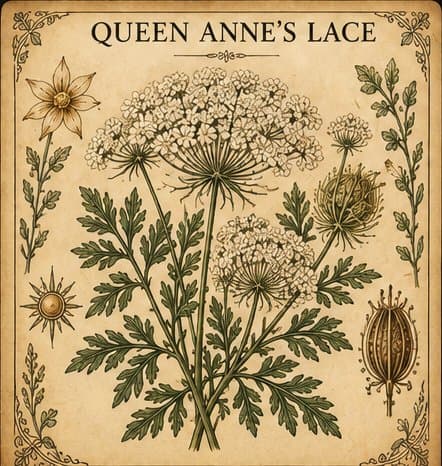
Queen Anne's Lace
Daucus carota
Wild carrot, whose seeds have long been used in folk medicine to prevent pregnancy. It hasn't been proven safe or effective, and it looks like deadly poison hemlock.
What is Queen Anne's Lace?
- Plant family
- Apiaceae, the carrot and parsley family
- Parts used
- Mainly the seeds. Unlike garden carrots, the wild plant has a thin root.
- Genus
- Daucus
- Species
- carota
Also called
Wild Carrot, Bird's Nest, Bishop's Lace
Traditionally used for
- Traditional birth control
- Urinary complaints
Traditionally described as
- Traditionally used to prevent pregnancy
Health topics
Where Queen Anne's Lace appears in symptom search, and why. Being listed doesn't mean it's a proven treatment.
- Fertility
Traditionally used to prevent pregnancy. It's not a reliable form of birth control, it hasn't been shown to be safe, and it should be avoided by anyone pregnant or trying to conceive.
Traditions that use it
Mediterranean Folk Medicine
The ancient Greeks recommended the seeds to prevent pregnancy and bring on periods, and the Romans used wild carrot in contraceptive preparations.
Safety
Who should avoid it
Wild carrot seed is not a reliable form of birth control. Its safety and effectiveness in people haven't been established, and it has traditionally been used to cause abortion.[1]
Pregnancy
Avoid wild carrot seed if you are pregnant or trying to become pregnant: it has traditionally been used to prevent pregnancy and to cause abortion.[1]
Toxicity testing
Wild carrot has been mistaken for poison hemlock (Conium maculatum), a deadly plant. One difference: wild carrot stems and leaves are hairy, while poison hemlock stems are smooth. Never pick and use wild plants unless you're certain what they are.[1]
What does the research say?
Traditional use
These are traditional uses, not proven treatments.
Wild carrot seeds have long been used to control women's fertility. The ancient Greeks recommended them to prevent pregnancy and bring on periods, the Romans used wild carrot in contraceptive preparations, and it was known as a traditional "morning after" remedy. The seeds have also been used to bring about abortion.[1]
Technical detail: anti-fertility, emmenagogue, implantation inhibitor.
Wild carrot has also traditionally been used to increase urination, relieve gas and fight infection, and for kidney and bladder stones, bladder infections, gout, prostate inflammation and cancer.[1]
Technical detail: antilithic, diuretic, carminative, antiseptic; urinary calculus, cystitis, prostatitis.
Laboratory & animal research
Lab and animal results show what might be worth studying in people. They don't show that the herb has these effects in humans.
Animal studies suggest wild carrot may reduce fertility by affecting the reproductive cycle and blocking the hormone progesterone. In lab and animal studies, it has also shown antioxidant, anticancer, pain-relieving, germ-fighting and liver-protecting effects.[1]
Technical detail: effects on the estrous cycle and anti-progestogenic activity.
Research in people
Wild carrot hasn't been properly tested in people. The review's authors say well-designed lab, animal and clinical studies are still needed before it can be considered safe or effective for human use.[1]
In short
Not reliable birth control; avoid if pregnant or trying to conceive; easily confused with poison hemlock.
Sources
- [1] The Wild Carrot (Daucus carota): A Phytochemical and Pharmacological Review — Plants (Basel) · DOI: 10.3390/plants13010093Peer-reviewed study
This information is educational and traditional in nature, and is not a substitute for professional medical advice.