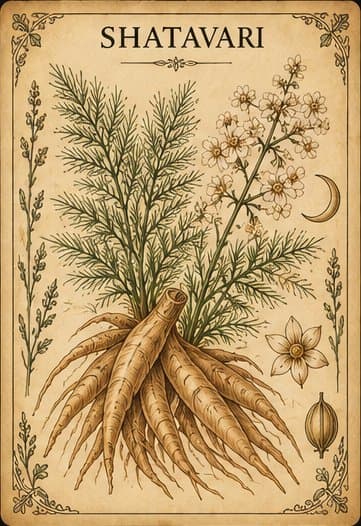
Shatavari
Asparagus racemosus
A root used in Ayurveda as a tonic and to increase breast milk. Research on it is limited.
What is Shatavari?
- Plant family
- Asparagaceae, the asparagus family
- Parts used
- The dried roots
- Where it grows
- Found at low altitudes throughout India
- Genus
- Asparagus
- Species
- racemosus
Regional names
Satawar, Satamuli
Traditionally used for
- Breast milk
- Menopause
- Women's health
Traditionally described as
- Tonic
- May increase breast milk (traditional)
Health topics
Where Shatavari appears in symptom search, and why. Being listed doesn't mean it's a proven treatment.
- Breast Milk Supply
Traditionally used in Ayurveda to increase breast milk. A Cochrane review found the evidence for herbal milk boosters is very uncertain.
- Menopause Symptoms
In one trial, shatavari combined with ashwagandha eased menopause symptoms more than placebo; shatavari alone was less clear.
Traditions that use it
Ayurveda
Used in Ayurveda as a tonic, to increase urination and to increase breast milk, and by some practitioners for nervous disorders, inflammation and some infections. Traditionally used for hormonal balance.
Safety
Side effects
In the 8-week menopause trial, side effects were mild and uncommon: one person taking shatavari had nausea. Liver, kidney and thyroid tests stayed normal.[1]
Pregnancy
Researchers have studied whether shatavari can harm unborn babies, and its safety in pregnancy is uncertain. Talk to your doctor or midwife before using it while pregnant.[2]
What does the research say?
Traditional use
These are traditional uses, not proven treatments.
Shatavari's dried roots are used as medicine. They are traditionally described as a tonic that increases urination and breast milk, and some Ayurvedic practitioners have used them for nervous disorders, inflammation and certain infections. The review notes there's no scientific proof for these uses.[2]
Technical detail: tonic, diuretic, galactagogue.
Shatavari is an Ayurvedic herb traditionally used for hormonal balance and to help the body adapt to stress.[1]
Laboratory & animal research
Lab and animal results show what might be worth studying in people. They don't show that the herb has these effects in humans.
Reports on shatavari root extracts in experimental studies describe effects on milk production, protecting the liver and the immune system, and preventing kidney stones. Researchers have also studied whether it can harm unborn babies.[2]
Technical detail: galactogogue, antihepatotoxic, immunomodulatory, immunoadjuvant and antilithiatic effects, and teratogenicity.
Research in people
A 2020 Cochrane review of herbs and medicines to boost breast milk included shatavari among 27 studies of natural remedies. The evidence overall was of very low certainty, so the reviewers were very uncertain whether natural remedies like these increase milk or help babies gain weight. Reported side effects were minor.[3]
In an 8-week trial, 135 women aged 45–65 with menopausal symptoms took shatavari root extract, shatavari combined with ashwagandha, or a placebo. The combination improved menopause symptom scores significantly more than placebo or shatavari alone. Hormone levels stayed normal. The authors called for longer and larger studies.[1]
Technical detail: randomized, double-blind, three-arm, placebo-controlled, multicentric; Menopause Rating Scale; NCT06716554.
In short
Its safety in pregnancy is uncertain; ask your doctor or midwife first.
Sources
- [1] Efficacy and safety of Shatavari root extract (Asparagus racemosus) for menopausal symptoms: a randomized, double-blind, three-arm, placebo-controlled study — Frontiers in Reproductive Health · DOI: 10.3389/frph.2025.1654503Peer-reviewed study
- [2] Plant profile, phytochemistry and pharmacology of Asparagus racemosus (Shatavari): A review — Asian Pacific Journal of Tropical Disease · DOI: 10.1016/S2222-1808(13)60049-3Peer-reviewed study
- [3] Oral galactagogues (natural therapies or drugs) for increasing breast milk production in mothers of non-hospitalised term infants — Cochrane Database of Systematic Reviews · DOI: 10.1002/14651858.CD011505.pub2Review or clinical trial
This information is educational and traditional in nature, and is not a substitute for professional medical advice.