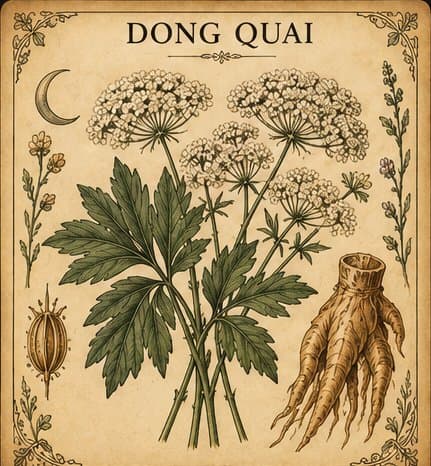
Dong Quai
Angelica sinensis
A root that is one of the most widely used herbs in traditional Chinese medicine for women's health, including period pain and menopause.
Dong Quai may interact with some medicines. If you take any medicine, read Interactions with medicines below and talk to your doctor or pharmacist before using it.
What is Dong Quai?
- Plant family
- Apiaceae, the carrot and parsley family
- Parts used
- The root
- Genus
- Angelica
- Species
- sinensis
Also called
Chinese Angelica, Tang Kuei, Female Ginseng
Traditional names
Danggui
Traditionally used for
- Period pain
- Menopause
- Women's health
Traditionally described as
- Women's tonic (traditional)
Health topics
Where Dong Quai appears in symptom search, and why. Being listed doesn't mean it's a proven treatment.
- Menopause Symptoms
Traditionally used for hot flashes, but studies of it for menopausal symptoms are inconclusive.
- Menstrual Discomfort
A traditional Chinese remedy for period pain. Some research supports it, but formal trials are limited.
- PMS (Premenstrual Syndrome)
Some research supports its use for PMS, but formal trials are limited.
Traditions that use it
Traditional Chinese Medicine
One of the herbs most commonly used by Traditional Chinese Medicine practitioners, with a long history in China, Korea and Japan, mainly for women's reproductive problems such as period pain, missing periods and menopause.
Safety
Interactions with medicines
Dong quai may increase the risk of bleeding with blood thinners such as warfarin. It may also affect how the body handles several other medicines, including anti-platelet medicines and clozapine, and long-term use may make some medicines less effective.[1]
Technical detail: CYP3A4 substrates; dual antiplatelet therapy (altered pharmacokinetics); clozapine (induces metabolism); lisinopril worsened anemia in animal models.
Who should avoid it
If you have a hormone-sensitive cancer, talk to your doctor before using dong quai, because it can act like estrogen.[1]
Side effects
Side effects include skin sensitivity to sunlight and sun-related rashes, loss of appetite, bloating, diarrhea and fever. Breast enlargement in men and high blood pressure have also been reported.[1]
Pregnancy
Avoid dong quai during pregnancy because of the risk of miscarriage.[1]
Breastfeeding
Avoid dong quai while breastfeeding.[1]
What does the research say?
Traditional use
These are traditional uses, not proven treatments.
Dong quai (danggui) has a long history of use in China, Korea and Japan, and is still one of the herbs most commonly used by Traditional Chinese Medicine practitioners in China and Europe. It is mainly used for women's reproductive problems, such as period pain, missing periods and menopause.[2]
Technical detail: dysmenorrhea, amenorrhoea.
In traditional Chinese medicine, dong quai is used for menstrual cramps and for menopausal symptoms such as hot flashes.[1]
Laboratory & animal research
Lab and animal results show what might be worth studying in people. They don't show that the herb has these effects in humans.
In lab studies, dong quai showed anti-tumor effects, and in animals it protected against damage from chemotherapy and radiation. But it also acted like estrogen in the lab, and it promoted the growth of estrogen-sensitive breast tumors in mice.[1]
Technical detail: estrogen receptor-positive breast tumors in a murine model.
Research in people
Studies of dong quai for menopausal symptoms are inconclusive. Some research supports its use for PMS and period pain, but formal clinical trials are limited.[1]
Well-designed trials using standardized dong quai are in short supply, though research on its extracts and compounds suggests many of its traditional uses have some scientific basis.[2]
In a small trial of 22 men with hot flashes caused by prostate cancer hormone treatment, dong quai taken daily for 3 months made no difference to how often, how badly or how long they had hot flashes, compared with placebo.[3]
Technical detail: randomized, double-blind, placebo-controlled pilot; 17 of 22 completed.
In short
May increase bleeding with blood thinners; avoid during pregnancy and breastfeeding.
Sources
- [1] Dong Quai — Memorial Sloan Kettering Cancer Center, About HerbsGeneral reference
- [2] Danggui to Angelica sinensis root: are potential benefits to European women lost in translation? A review — Journal of Ethnopharmacology · DOI: 10.1016/j.jep.2013.12.018Peer-reviewed study
- [3] Dong Quai (angelica sinensis) in the treatment of hot flashes for men on androgen deprivation therapy: results of a randomized double-blind placebo controlled trial — Canadian Urological Association Journal · DOI: 10.5489/cuaj.775Peer-reviewed study
This information is educational and traditional in nature, and is not a substitute for professional medical advice.