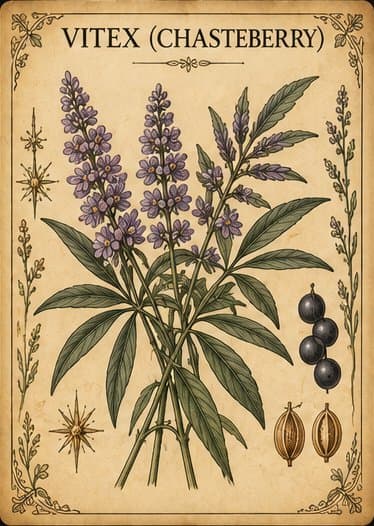
Chasteberry
Vitex agnus-castus
The berries of the chaste tree (vitex), recognized in Europe for easing PMS (premenstrual syndrome).
What is Chasteberry?
- Plant family
- Lamiaceae, the mint family
- Parts used
- The fruits (berries). The leaves, stems and flowers have also been used.
- Genus
- Vitex
- Species
- agnus-castus
Also called
Vitex, Chaste Tree, Monk's Pepper, Agnus Castus
Traditionally used for
- PMS
- Breast tenderness
- Women's health
Traditionally described as
- May ease PMS
Health topics
Where Chasteberry appears in symptom search, and why. Being listed doesn't mean it's a proven treatment.
- Fertility
There's little evidence that it helps infertility.
- PMS (Premenstrual Syndrome)
Recognized in Europe for PMS, and the best-quality trials found it helped. Some evidence for breast tenderness.
Traditions that use it
European Folk Medicine
Once believed to promote chastity and used by monks in the Middle Ages. Recognized by the European Medicines Agency as a traditional remedy for minor symptoms in the days before a period.
Safety
Who should avoid it
Side effects
Reported side effects include severe allergic reactions (face swelling, trouble breathing or swallowing), rash and acne, headache, dizziness, nausea, belly pain and changes to periods. How often these happen is unknown.[2]
Short-term use seems well tolerated. Mild side effects include nausea, stomach upset, diarrhea, headache and itching.[1]
Pregnancy
Chasteberry may be unsafe during pregnancy or while breastfeeding.[1]
What does the research say?
Traditional use
These are traditional uses, not proven treatments.
Chasteberry was once believed to promote chastity and was used by monks in the Middle Ages. It has traditionally been used for mental health conditions, women's health (gynecological) problems and hormone-related skin problems.[1]
Based on long-standing use, the European Medicines Agency recognizes agnus castus fruit preparations for relief of minor symptoms in the days before a period.[2]
Laboratory & animal research
Lab and animal results show what might be worth studying in people. They don't show that the herb has these effects in humans.
Lab studies suggest chasteberry may act on hormone-producing areas of the brain, lowering the hormone prolactin, which is thought to play a role in PMS.[2]
Research in people
Based on clinical evidence, the European Medicines Agency concluded that one particular dry extract can treat premenstrual syndrome (PMS) when taken continuously for 3 months. In a study of 178 women, it improved symptoms such as irritability, mood changes, anger, headache and breast fullness compared with placebo. For other chasteberry preparations, studies were too poorly designed to draw firm conclusions.[2]
Technical detail: "well-established use" for the specific dry extract.
A 2019 review included only well-reported, double-blind trials of properly described chasteberry extracts. In 3 trials with 520 women, those taking chasteberry were about 2.6 times more likely to have their PMS symptoms go away than those taking placebo. Most other trials couldn't be used as evidence because they didn't describe the product properly.[3]
Technical detail: extracts Ze 440 and BNO 1095; RR 2.57 (95% CI 1.52 to 4.35).
Some studies suggest chasteberry might reduce PMS symptoms such as breast pain or tenderness, but higher-quality evidence is needed. There's little evidence for infertility, sexual problems or menopause symptoms.[1]
In short
Not for use during pregnancy or breastfeeding, or with hormone-sensitive cancers.
Sources
- [1] Chasteberry: Usefulness and Safety — National Center for Complementary and Integrative Health (NIH)Government health agency
- [2] Agnus castus fruit (Vitex agnus-castus L., fructus): summary of the HMPC conclusions (EMA/266692/2018) — European Medicines Agency, Committee on Herbal Medicinal Products (HMPC)Government health agency
- [3] Vitex agnus-castus in premenstrual syndrome: A meta-analysis of double-blind randomised controlled trials — Complementary Therapies in Medicine · DOI: 10.1016/j.ctim.2019.08.024Review or clinical trial
This information is educational and traditional in nature, and is not a substitute for professional medical advice.