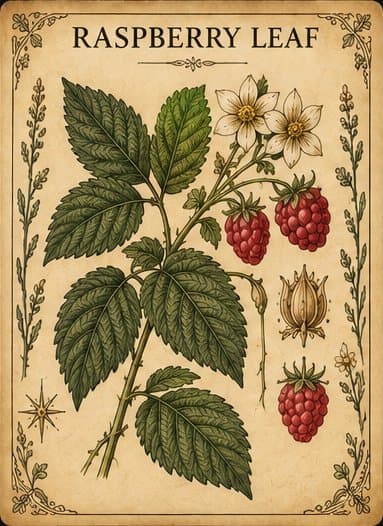
Raspberry Leaf
Rubus idaeus
Leaves of the raspberry plant, made into tea. Traditionally used for period cramps and widely used in pregnancy, though its safety in pregnancy hasn't been proven.
What is Raspberry Leaf?
- Plant family
- Rosaceae, the rose family
- Parts used
- The leaves, dried for tea
- Genus
- Rubus
- Species
- idaeus
Traditionally used for
- Tea
- Period cramps
- Pregnancy (traditional)
Traditionally described as
- May ease period cramps
Health topics
Where Raspberry Leaf appears in symptom search, and why. Being listed doesn't mean it's a proven treatment.
- Menstrual Discomfort
Recognized in Europe as a traditional remedy for minor cramps during periods.
- Pregnancy and Childbirth
Widely used in pregnancy in the hope of an easier labor, but it hasn't been properly tested and isn't proven safe.
Traditions that use it
European Folk Medicine
Recognized by the European Medicines Agency as a traditional herbal medicine for minor period cramps, mild mouth or throat inflammation and mild diarrhea.
Safety
Who should avoid it
Raspberry leaf medicines are for adults only. For period cramps or mouth and throat inflammation, see a doctor if symptoms last more than a week or get worse. For diarrhea, see a doctor if it lasts more than 3 days or gets worse.[1]
Side effects
At the time of the European assessment, no side effects had been reported with raspberry leaf medicines.[1]
Pregnancy
Raspberry leaf hasn't been shown to be safe in pregnancy: the studies so far are too small and weak to tell. Talk to your midwife or doctor before using it while pregnant.[2]
What does the research say?
Traditional use
These are traditional uses, not proven treatments.
Based on long-standing use, the European Medicines Agency recognizes raspberry leaf as a traditional herbal medicine for:
- Relief of minor cramps during menstrual periods
- Mild inflammation of the mouth or throat
- Mild diarrhea
Pregnant women have used herbs to help with pregnancy, labor and birth for centuries, and raspberry leaf is one of the most common. Many women use it in the hope of an easier labor and birth.[3]
Laboratory & animal research
Lab and animal results show what might be worth studying in people. They don't show that the herb has these effects in humans.
In lab and animal studies, raspberry leaf affected smooth muscle, including the muscle of the womb. It was toxic when very high doses were injected into animals.[3]
Technical detail: toxicity with intravenous or intraperitoneal administration.
Research in people
The European Medicines Agency noted there are no clinical studies of raspberry leaf for its traditional uses, and very little lab data.[1]
A 2021 review of 13 studies on raspberry leaf in pregnancy found that studies in people have shown neither harm nor benefit. One study found a meaningful but not statistically significant shortening of the pushing stage of labor. The reviewers concluded the evidence for using raspberry leaf in pregnancy is weak.[3]
Technical detail: studies published 1941–2016; 5 laboratory, 2 animal and 6 human studies; the one study showed reduced length of second stage and less augmentation of labour.
In a small observational study of 91 women in Australia, those who drank raspberry leaf were less likely to have their labor medically sped up, and had shorter labors. The authors say these results can't be relied on or applied to all pregnant women, that finding no safety problems doesn't prove it is safe, and that a randomized trial is urgently needed.[2]
Technical detail: 44 exposed, 47 not exposed; Bayesian regression.
In short
Not proven safe in pregnancy; ask your midwife or doctor first.
Sources
- [1] Raspberry leaf (Rubus idaeus L., folium): summary of the HMPC conclusions (EMA/237849/2017) — European Medicines Agency, Committee on Herbal Medicinal Products (HMPC)Government health agency
- [2] Raspberry leaf (Rubus idaeus) use in pregnancy: a prospective observational study — BMC Complementary Medicine and Therapies · DOI: 10.1186/s12906-024-04465-7Peer-reviewed study
- [3] Biophysical effects, safety and efficacy of raspberry leaf use in pregnancy: a systematic integrative review — BMC Complementary Medicine and Therapies · DOI: 10.1186/s12906-021-03230-4Review or clinical trial
This information is educational and traditional in nature, and is not a substitute for professional medical advice.