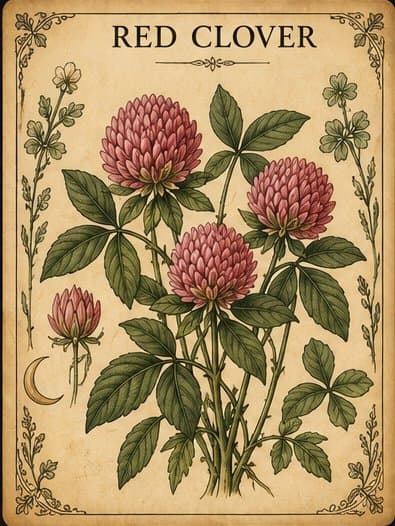
Red Clover
Trifolium pratense
A pink-flowered clover traditionally used for skin problems and whooping cough. It has been studied for menopausal hot flashes, with inconsistent results.
Red Clover may interact with some medicines. If you take any medicine, read Interactions with medicines below and talk to your doctor or pharmacist before using it.
What is Red Clover?
- Plant family
- Fabaceae, the pea and bean family
- Genus
- Trifolium
- Species
- pratense
Also called
Cow Clover, Meadow Clover, Wild Clover
Traditionally used for
- Menopause
- Skin care
Traditionally described as
- Plant estrogens (isoflavones)
Health topics
Where Red Clover appears in symptom search, and why. Being listed doesn't mean it's a proven treatment.
- Menopause Symptoms
Studied for hot flashes with inconsistent results. A Cochrane review found no clear benefit of a red clover extract over placebo.
Safety
Interactions with medicines
Red clover may increase the risk of bleeding with blood thinners such as warfarin, may affect medicines that are broken down by liver enzymes, and has been linked to toxicity with methotrexate.[1]
Technical detail: inhibits multiple cytochrome P450 enzymes.
Who should avoid it
People with hormone-sensitive cancers, and people taking blood thinners, should avoid red clover.[1]
Side effects
Pregnancy
Red clover supplements may be unsafe during pregnancy or while breastfeeding.[2]
What does the research say?
Traditional use
These are traditional uses, not proven treatments.
Red clover has been used in traditional medicine for many health problems, including skin disorders, whooping cough and mastitis (inflammation of the breast).[1]
Laboratory & animal research
Lab and animal results show what might be worth studying in people. They don't show that the herb has these effects in humans.
Lab studies give conflicting results on breast cancer. Some suggest red clover acts like estrogen in ways that could stimulate breast cancer cells, while other compounds in it blocked aromatase, an enzyme the body uses to make estrogen.[1]
Research in people
Studies of red clover for menopausal hot flashes have had inconsistent results, and some had a high risk of bias. Research on bone density in women after menopause is limited and mixed. Red clover may help cholesterol levels in women after menopause, but more research is needed. Overall, research hasn't shown clear benefits for any health condition.[2]
A 2013 Cochrane review of plant estrogens (phytoestrogens) for hot flashes and night sweats included 43 trials. Combining the 5 trials of a red clover extract (Promensil), there was no significant difference in how often women had hot flashes compared with placebo. The reviewers found no conclusive evidence that phytoestrogen supplements reduce hot flashes or night sweats, and noted a strong placebo effect in most trials. No harmful effects on the lining of the womb or vagina were seen with use for up to 2 years.[3]
Technical detail: 43 RCTs, 4,364 participants; Promensil vs placebo, daily hot flush frequency MD −0.93 (95% CI −1.95 to 0.10), I² = 31%.
Some trials found red clover isoflavones (plant estrogens) improved menopausal symptoms compared with placebo, but systematic reviews remain inconclusive. One study found an isoflavone-rich red clover extract slowed bone loss.[1]
In short
May increase bleeding risk; avoid with hormone-sensitive cancers, blood thinners, or during pregnancy.
Sources
- [1] Red Clover — Memorial Sloan Kettering Cancer Center, About HerbsGeneral reference
- [2] Red Clover: Usefulness and Safety — National Center for Complementary and Integrative Health (NIH)Government health agency
- [3] Phytoestrogens for menopausal vasomotor symptoms — Cochrane Database of Systematic Reviews · DOI: 10.1002/14651858.CD001395.pub4Review or clinical trial
This information is educational and traditional in nature, and is not a substitute for professional medical advice.