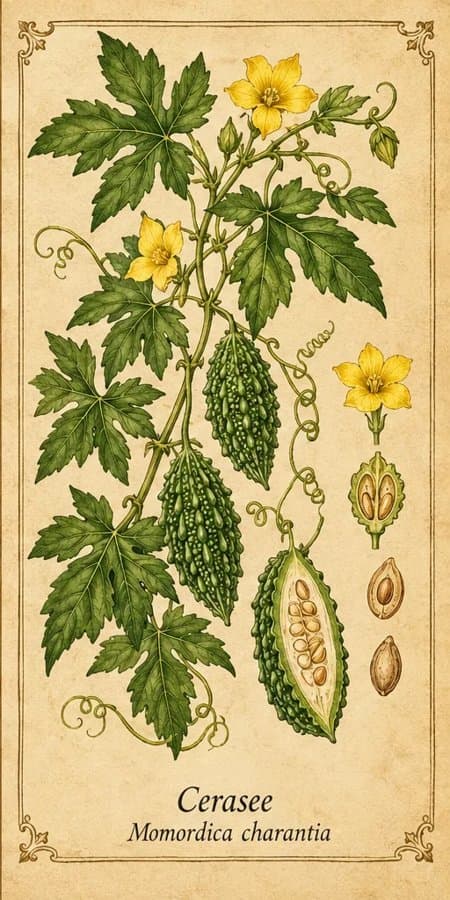
Cerasee
Momordica charantia
A bitter plant known in Jamaica as cerasee and elsewhere as bitter melon, widely used as a folk remedy for diabetes and high blood pressure.
Cerasee may interact with some medicines. If you take any medicine, read Interactions with medicines below and talk to your doctor or pharmacist before using it.
What is Cerasee?
- Plant family
- Cucurbitaceae, the gourd and cucumber family
- Parts used
- Different parts of the plant are used in herbal preparations. In Jamaica, cerasee tea is made from the leaves and stems. The fruit is known as bitter melon; its seeds are toxic.
- Where it grows
- Native to Africa and the Middle East; cultivated in Jamaica
- Genus
- Momordica
- Species
- charantia
Also called
Bitter Melon, Bitter Gourd, Karela, Balsam Pear, Bitter Cucumber
Traditionally used for
- Blood sugar
- High blood pressure
Traditionally described as
- May lower blood sugar
Health topics
Where Cerasee appears in symptom search, and why. Being listed doesn't mean it's a proven treatment.
- Fertility
Not a fertility herb. In animal studies, bitter melon leaf juice reduced fertility in female mice.
- High Blood Pressure
A common traditional remedy for high blood pressure in Jamaica. This use hasn't been confirmed by research.
- High Blood Sugar
Widely used traditionally for diabetes, but a Cochrane review found too little evidence that it works. It may add to the effects of diabetes medicines.
- Pregnancy and Childbirth
Avoid during pregnancy: in animal studies it caused bleeding from the womb, and it may cause birth defects.
Traditions that use it
Caribbean Folk Medicine
In western Jamaica, cerasee is among the most commonly reported herbal remedies for both high blood pressure and type 2 diabetes.
African Traditional Medicine
Used to lower blood sugar by indigenous communities in East Africa, as well as in Asia, India and South America.
Natural compounds
Safety
Interactions with medicines
Bitter melon may add to the effects of insulin and other diabetes medicines. It may also make some medicines more toxic by interfering with the proteins that clear them from the body.[1]
Technical detail: P-glycoprotein substrates (increased toxicity); inhibits CYP2C9.
Side effects
Bitter melon can cause stomach and gut problems. Case reports describe irregular heartbeat, stomach ulcers and severe kidney injury.[1]
Pregnancy
Toxicity testing
The seeds contain vicine, which has caused headache, fever, stomach pain and coma.[1]
What does the research say?
Traditional use
These are traditional uses, not proven treatments.
In a 2017 survey of clinic patients in western Jamaica who had high blood pressure or type 2 diabetes, cerasee was among the most commonly reported herbal remedies for both conditions.[3]
Bitter melon is used to lower blood sugar, and to treat diabetes and related conditions, by indigenous communities in Asia, South America, India and East Africa.[4]
It has traditionally been used for diabetes, cancer, viral infections and immune disorders.[1]
In Jamaica, cerasee is also an anecdotal remedy for colds and flu: a handful of leaves and stems is steeped in a cup of water for about 10 minutes and sweetened as desired.[5]
Laboratory & animal research
Lab and animal results show what might be worth studying in people. They don't show that the herb has these effects in humans.
Lab and animal studies suggest natural compounds in bitter melon may lower blood sugar and increase insulin release. More studies are needed to show whether this happens in people.[4]
Lab studies suggest bitter melon has anticancer and antiviral effects, but studies of its effects on cancer in people are lacking.[1]
In animal studies, fresh bitter melon leaf juice reduced fertility in female mice, and fresh fruit juice caused bleeding from the womb in pregnant rats and rabbits. Some of its natural compounds (triterpenoids) act like the hormone estrogen.[2]
Research in people
A 2012 Cochrane review of 4 trials with 479 people with type 2 diabetes found bitter melon preparations didn't improve blood sugar control compared with placebo, or compared with the diabetes medicines metformin or glibenclamide. The trials lasted up to 3 months and were at high risk of bias. The reviewers concluded there isn't enough evidence, and that better-standardized preparations need to be studied. No serious side effects were reported.[6]
Limited data suggest bitter melon may help lower blood sugar, but a review concluded the evidence is low quality with little safety data. One study found it had no effect on the immune system of women with cervical cancer.[1]
In short
May add to the effects of diabetes medicines; avoid during pregnancy.
Sources
- [1] Bitter Melon — Memorial Sloan Kettering Cancer Center, About HerbsGeneral reference
- [2] Momordica charantia L.—Diabetes-Related Bioactivities, Quality Control, and Safety Considerations — Frontiers in Pharmacology · DOI: 10.3389/fphar.2022.904643Peer-reviewed study
- [3] Factors associated with the use of complementary and alternative therapies among patients with hypertension and type 2 diabetes mellitus in Western Jamaica: a cross-sectional study — BMC Complementary Medicine and Therapies · DOI: 10.1186/s12906-020-03109-wPeer-reviewed study
- [4] The Effects of Momordica charantia on Type 2 Diabetes Mellitus and Alzheimer's Disease — International Journal of Molecular Sciences · DOI: 10.3390/ijms24054643Peer-reviewed study
- [5] Antiviral Activity of Jamaican Medicinal Plants and Isolated Bioactive Compounds — Molecules · DOI: 10.3390/molecules26030607Peer-reviewed study
- [6] Momordica charantia for type 2 diabetes mellitus — Cochrane Database of Systematic Reviews · DOI: 10.1002/14651858.CD007845.pub3Review or clinical trial
This information is educational and traditional in nature, and is not a substitute for professional medical advice.