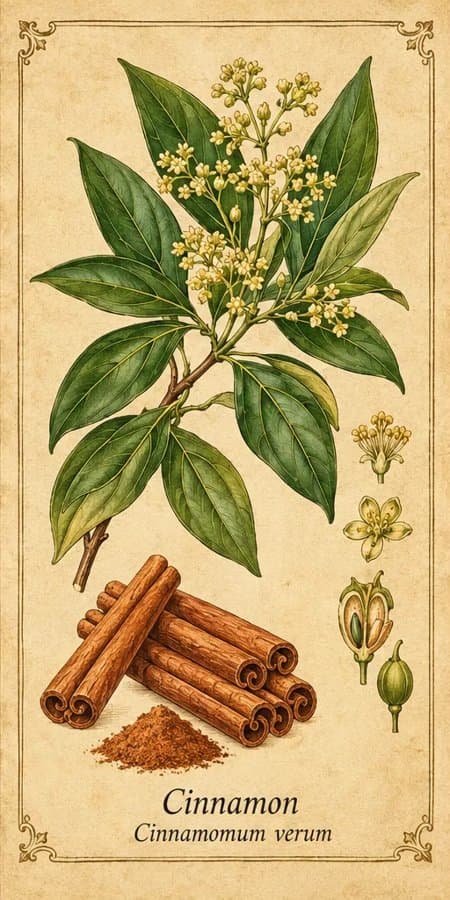
Cinnamon
Cinnamomum verum
A warm kitchen spice made from tree bark, traditionally used for digestive complaints. Research on its effects on blood sugar and cholesterol is mixed.
Cinnamon may interact with some medicines. If you take any medicine, read Interactions with medicines below and talk to your doctor or pharmacist before using it.
What is Cinnamon?
- Plant family
- Lauraceae, the laurel family
- Parts used
- The dried bark. The leaves, flowers, fruits and roots have also been used in traditional medicine.
- Where it grows
- Ceylon ("true") cinnamon comes from Sri Lanka
- Genus
- Cinnamomum
- Species
- verum
Also called
Ceylon Cinnamon, True Cinnamon
Older scientific names
Cinnamomum zeylanicum Nees
Traditionally used for
- Baking and cooking
- Digestion
- Blood sugar
Traditionally described as
- May relieve gas and bloating
Health topics
Where Cinnamon appears in symptom search, and why. Being listed doesn't mean it's a proven treatment.
- High Blood Sugar
In people with type 2 diabetes, a review found lower fasting blood sugar but no significant change in long-term blood sugar (HbA1c); results varied widely.
- High Cholesterol
A review in people with type 2 diabetes found small drops in total and LDL cholesterol and triglycerides.
- Liver Safety Warnings
Cassia cinnamon, the most common kind in North America, contains coumarin, which has been linked to liver problems.
Traditions that use it
Traditional Chinese Medicine
The bark, leaves, flowers, fruits and roots have long been used in traditional medicine and cooking in China.
Ayurveda
Long used in traditional medicine and cooking in India.
European Folk Medicine
Recognized by the European Medicines Agency as a traditional herbal medicine for mild digestive cramps, bloating and gas, and for mild diarrhea.
Safety
Interactions with medicines
Cinnamon may interact with some cancer medicines and with nicotine. Talk to your health care provider before using cinnamon supplements.[1]
Who should avoid it
Don't use cinnamon medicines if you're allergic to cinnamon or to Peru balsam. They're not recommended for anyone under 18. For diarrhea, drink plenty of fluids first, and see a doctor if it lasts more than 2 days, keeps coming back or there's blood in the stool.[2]
Side effects
Cinnamon is likely safe in the amounts normally used in food as a spice or flavoring.[1]
Pregnancy
Toxicity testing
Cassia cinnamon, the most common kind in North America, contains coumarin, a compound that has been linked to liver problems.[1]
How much to use
European guidance for adults: as a tea, 0.5–1 g of cinnamon bark as an infusion, up to 4 times a day. See a doctor if digestive symptoms last more than 2 weeks or get worse.[2]
Depends on how it's prepared
Don't try the "cinnamon challenge" (trying to swallow a spoonful of dry ground cinnamon). It can cause serious harm.[1]
What does the research say?
Traditional use
These are traditional uses, not proven treatments.
Cinnamon's bark, leaves, flowers, fruits and roots have a long history of use in traditional medicine and cooking in many parts of the world, including China, India and Persia (Iran).[1]
The European Medicines Agency recognizes cinnamon bark as a traditional herbal medicine, based only on long-standing use, for:
- Mild digestive cramps, including bloating and gas
- Mild diarrhea
Research in people
Research doesn't clearly support using cinnamon for any health condition. It's unclear whether cinnamon supplements help with diabetes or weight loss. Early research suggests a nasal spray with Ceylon cinnamon extract might ease hay fever symptoms, but more reliable evidence is needed.[1]
A 2013 review of 10 trials with 543 people with type 2 diabetes found that cinnamon (120 mg to 6 g a day for 4 to 18 weeks) lowered fasting blood sugar, total and LDL ("bad") cholesterol and triglycerides, and raised HDL ("good") cholesterol slightly. It didn't significantly change HbA1c, a measure of long-term blood sugar. Results varied a lot between studies, so the best dose and length of use are unclear.[3]
Technical detail: fasting plasma glucose −24.59 mg/dL (95% CI −40.52 to −8.67); total cholesterol −15.60 mg/dL; LDL-C −9.42 mg/dL; triglycerides −29.59 mg/dL; HDL-C +1.66 mg/dL; HbA1c −0.16% (95% CI −0.39 to 0.02); I² 66.5–94.72%.
In short
Cassia cinnamon contains coumarin, which has been linked to liver problems; avoid large amounts during pregnancy.
Sources
- [1] Cinnamon: Usefulness and Safety — National Center for Complementary and Integrative Health (NIH)Government health agency
- [2] Community herbal monograph on Cinnamomum verum J.S. Presl, cortex (EMA/HMPC/246774/2009) — European Medicines Agency, Committee on Herbal Medicinal Products (HMPC)Government health agency
- [3] Cinnamon use in type 2 diabetes: an updated systematic review and meta-analysis — Annals of Family Medicine · DOI: 10.1370/afm.1517Review or clinical trial
This information is educational and traditional in nature, and is not a substitute for professional medical advice.