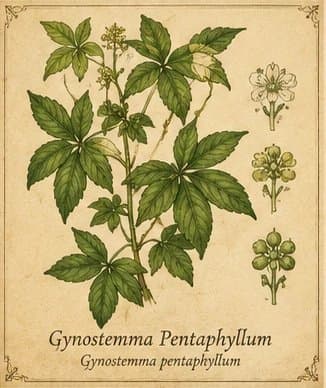
Gynostemma
Gynostemma pentaphyllum
A plant from the cucumber family, known in China as jiaogulan and used in traditional medicine and teas. It has been studied for lowering cholesterol.
What is Gynostemma?
- Plant family
- Cucurbitaceae, the gourd and cucumber family
- Where it grows
- Grows in China, India, Nepal, Bangladesh, Sri Lanka, Myanmar, Laos, Vietnam, Malaysia, Indonesia, New Guinea, North Korea and Japan
- Genus
- Gynostemma
- Species
- pentaphyllum
Also called
Jiaogulan
Traditionally used for
- Tea
- Cholesterol
Traditionally described as
- May lower cholesterol
Health topics
Where Gynostemma appears in symptom search, and why. Being listed doesn't mean it's a proven treatment.
- High Cholesterol
A review of trials found it may lower cholesterol and triglycerides, but the evidence is low quality.
Traditions that use it
Traditional Chinese Medicine
Known as jiaogulan, a traditional Chinese medicinal herb that is also widely used in foods, teas and supplements.
Natural compounds
Safety
Side effects
In the trials reviewed, no serious side effects were reported, and gynostemma caused fewer side effects than cholesterol medicines. Side effects reported across the trials included bloating, stomach pain, headache, muscle pain, dizziness, nausea, rash, diarrhea, hard stools and heartburn. Use for more than 8 weeks appeared safe.[1]
What does the research say?
Traditional use
These are traditional uses, not proven treatments.
Jiaogulan is a traditional Chinese medicinal herb. It is widely used in foods and supplements, and products such as jiaogulan tea, drinks, bread and noodles are sold in the United States, China and other Asian countries.[2]
In China, gynostemma has been used as a traditional herbal remedy to lower blood fats, though its use has declined as statins have become common.[1]
Laboratory & animal research
Lab and animal results show what might be worth studying in people. They don't show that the herb has these effects in humans.
Researchers have isolated more than 200 natural compounds from jiaogulan. In research, mostly outside the human body, these have shown anticancer, anti-obesity and antioxidant properties and reduced inflammation.[2]
Research in people
A 2022 review of 22 trials with 2,407 people with unhealthy blood fat levels found:
- Gynostemma lowered cholesterol and triglycerides about as much as standard cholesterol medicines, but the certainty of this evidence was very low.
- Red yeast rice worked better than gynostemma.
- Adding gynostemma to standard cholesterol medicines improved results more than the medicines alone (low to moderate certainty).
Most trials had some risk of bias.[1]
Technical detail: comparators were statins, fibrates and n-3 fatty acids; gynostemma plus lipid-lowering agents vs agents alone: TG MD −0.65 mmol/L, LDL-C MD −0.57 mmol/L, HDL-C MD +0.15 mmol/L; risk of bias: 14 trials some concerns, 7 high, 1 low.
In short
Research on its safety is limited, though no serious side effects were reported in trials.
Sources
- [1] Gynostemma pentaphyllum for dyslipidemia: A systematic review of randomized controlled trials — Frontiers in Pharmacology · DOI: 10.3389/fphar.2022.917521Review or clinical trial
- [2] Prebiotic properties of jiaogulan in the context of gut microbiome — Food Science & Nutrition · DOI: 10.1002/fsn3.2701Peer-reviewed study
This information is educational and traditional in nature, and is not a substitute for professional medical advice.