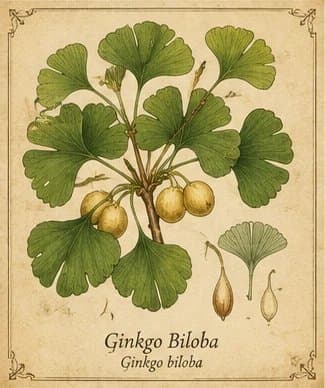
Ginkgo
Ginkgo biloba
Leaves of the ginkgo tree, sometimes called the fossil tree, traditionally used in Europe for minor circulation problems and in Chinese medicine for cough.
Ginkgo may interact with some medicines. If you take any medicine, read Interactions with medicines below and talk to your doctor or pharmacist before using it.
What is Ginkgo?
- Plant family
- Ginkgoaceae, the ginkgo family
- Parts used
- The leaves, usually as an extract. The seeds are poisonous.
- Where it grows
- Native to China, where wild trees survive in Guizhou and Zhejiang; now planted widely around the world
- Genus
- Ginkgo
- Species
- biloba
Also called
Fossil Tree, Maidenhair Tree, Japanese Silver Apricot
Traditionally used for
- Circulation
- Cold hands and feet
- Memory
Traditionally described as
- Circulation support
- Memory support
Health topics
Where Ginkgo appears in symptom search, and why. Being listed doesn't mean it's a proven treatment.
- Poor Circulation
Traditionally used in Europe for heavy legs and cold hands and feet from minor circulation problems. A Cochrane review found no meaningful benefit for leg pain caused by narrowed arteries.
Traditions that use it
Traditional Chinese Medicine
Long used in Chinese medicine for cough, diarrhea and other conditions.
European Folk Medicine
Recognized by the European Medicines Agency as a traditional herbal medicine for heavy legs and cold hands and feet linked to minor circulation problems.
Safety
Interactions with medicines
Ginkgo may increase the risk of bleeding with blood thinners such as warfarin, and may interact with other medicines.[1]
Bleeding in the eye, nose, brain or gut has been reported with ginkgo leaf medicines. If you tend to bleed easily or take blood-thinning medicines, only use the extract after talking to a doctor.[2]
Who should avoid it
Ginkgo leaf medicines should only be used by adults. For circulation problems, see a doctor if symptoms last more than 2 weeks.[2]
Side effects
Pregnancy
Ginkgo may be unsafe during pregnancy.[1]
Toxicity testing
Fresh ginkgo seeds are poisonous if eaten. Roasted seeds and crude plant material have also caused serious effects.[1]
What does the research say?
Traditional use
These are traditional uses, not proven treatments.
Ginkgo has a long history in Chinese medicine for cough, diarrhea and other conditions. Today the leaf extract is promoted for anxiety, heart disease, memory and thinking problems, diabetes, PMS, schizophrenia and ringing in the ears (tinnitus).[1]
Based on long-standing use, the European Medicines Agency recognizes powdered ginkgo leaf for heaviness in the legs and cold hands and feet that can come with minor circulation problems, once a doctor has ruled out serious conditions. It said the clinical studies on circulation were too limited to count as evidence.[2]
Research in people
Based on clinical studies in adults aged 50 and over, the European Medicines Agency concluded that a specific ginkgo leaf extract can improve age-related decline in thinking, and quality of life, in adults with mild dementia.[2]
Technical detail: "well-established use" for the dry extract (acetone extraction).
Ginkgo has not been shown to prevent dementia or slow it down. A large study of more than 3,000 older adults over about 6 years found no difference from placebo. Ginkgo may modestly help dementia symptoms, especially at high doses, but the results are inconsistent. Evidence is limited or lacking for preventing heart disease, lowering high blood pressure, tinnitus and multiple sclerosis. A small amount of evidence suggests possible benefit for anxiety, PMS, schizophrenia and vertigo, but the findings are inconclusive.[1]
A 2013 Cochrane review looked at ginkgo for leg pain when walking caused by narrowed leg arteries (intermittent claudication). Across 14 trials with 739 people, ginkgo increased walking distance by only about 65 meters compared with placebo, which wasn't statistically significant. The reviewers concluded there's no evidence of a meaningful benefit for peripheral artery disease.[3]
Technical detail: 11 trials (477 participants) measured absolute claudication distance; effect size 3.57 kcal (95% CI −0.10 to 7.23, P = 0.06); publication bias likely inflated the effect.
In short
May increase bleeding risk, especially with blood thinners; fresh seeds are poisonous.
Sources
- [1] Ginkgo: Usefulness and Safety — National Center for Complementary and Integrative Health (NIH)Government health agency
- [2] Ginkgo leaf: Herbal medicine summary for the public (EMA/324406/2015) — European Medicines Agency, Committee on Herbal Medicinal Products (HMPC)Government health agency
- [3] Ginkgo biloba for intermittent claudication — Cochrane Database of Systematic Reviews · DOI: 10.1002/14651858.CD006888.pub3Review or clinical trial
This information is educational and traditional in nature, and is not a substitute for professional medical advice.