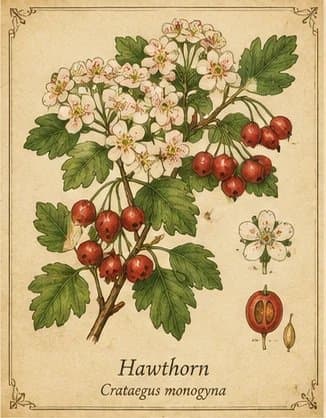
Hawthorn
Crataegus monogyna
A flowering shrub of the rose family, traditionally used for the heart. Recognized in Europe for nervous heart complaints such as palpitations.
Hawthorn may interact with some medicines. If you take any medicine, read Interactions with medicines below and talk to your doctor or pharmacist before using it.
What is Hawthorn?
- Plant family
- Rosaceae, the rose family
- Parts used
- The leaves and flowers
- Where it grows
- Hawthorns grow in temperate regions around the world.
- Genus
- Crataegus
- Species
- monogyna
Also called
English Hawthorn, Mexican Hawthorn, Tejocote, Shanzha
Traditionally used for
- Palpitations
- Heart health
- Circulation
- Stress
Traditionally described as
- Heart support (traditional)
- Calming
Health topics
Where Hawthorn appears in symptom search, and why. Being listed doesn't mean it's a proven treatment.
- Heart Failure
Studied as an add-on to standard heart failure treatment, with conflicting results. Only use under a doctor's care.
- Heart Palpitations
Traditionally used in Europe for heart complaints linked to nervousness, such as palpitations, once a doctor has ruled out serious conditions.
- Poor Circulation
Traditionally used for circulation problems.
Traditions that use it
European Folk Medicine
Recognized by the European Medicines Agency as a traditional herbal medicine for heart complaints linked to nervousness, such as palpitations, and for mild stress and sleep.
Safety
Interactions with medicines
Who should avoid it
Only use hawthorn for heart symptoms after a doctor has ruled out serious conditions, and not in anyone under 18. Get medical help straight away if your ankles or legs swell, if you have pain around the heart that may spread to the arms, upper belly or neck, or if you're short of breath.[2]
Side effects
Side effects can include dizziness, nausea, vomiting, diarrhea and muscle pain. No studies have tested hawthorn's safety for longer than 16 weeks.[1]
Pregnancy
How much to use
European guidance for adults with heart complaints: as a tea, 1–2 g of dried leaf and flower in 150 ml of boiling water, up to 4 times a day (no more than 6 g a day). See a doctor if symptoms last more than 2 weeks or get worse.[2]
Contamination
In January 2024 the US Food and Drug Administration warned that some supplements sold as "tejocote root" (a type of hawthorn) actually contained yellow oleander, a poisonous plant that can cause severe harm or death.[1]
What does the research say?
Traditional use
These are traditional uses, not proven treatments.
Hawthorn is a flowering shrub or tree of the rose family. It has traditionally been used for heart disease, digestion, circulation, and kidney and bladder problems, and on the skin for sores and frostbite. Today it is promoted for heart and blood vessel health, weight loss and anxiety.[1]
The European Medicines Agency recognizes hawthorn leaf and flower as a traditional herbal medicine, based only on long-standing use, for:
- Temporary heart complaints linked to nervousness, such as palpitations or feeling an extra heartbeat from mild anxiety, once a doctor has ruled out serious conditions
- Mild symptoms of mental stress, and to help sleep
Research in people
A 2008 Cochrane review included 14 high-quality trials in people with long-term heart failure, most taking hawthorn extract alongside their usual heart medicines. Pooling 10 trials with 855 people, hawthorn improved how much exercise people could do and eased symptoms such as shortness of breath and tiredness compared with placebo. The trials gave almost no useful information on heart attacks or deaths. Side effects were uncommon, mild and short-lived.[3]
Technical detail: double-blind, randomized, placebo-controlled trials of hawthorn leaf and flower extract; NYHA classes I–III; maximal workload WMD 5.35 W (95% CI 0.71 to 10.00); symptom score WMD −5.47 (95% CI −8.68 to −2.26); one trial reported 3 deaths with hawthorn and 1 with placebo without further details.
The evidence on hawthorn for heart failure is conflicting. There isn't enough evidence to know whether it helps chest pain from heart disease (angina), irregular heartbeat or plaque buildup in the arteries. There's no evidence it helps weight loss, and its effects on anxiety are unclear.[1]
In short
Heart symptoms need a doctor's diagnosis first; may interact with heart medicines.
Sources
- [1] Hawthorn: Usefulness and Safety — National Center for Complementary and Integrative Health (NIH)Government health agency
- [2] European Union herbal monograph on Crataegus spp., folium cum flore (EMA/HMPC/159075/2014) — European Medicines Agency, Committee on Herbal Medicinal Products (HMPC)Government health agency
- [3] Hawthorn extract for treating chronic heart failure — Cochrane Database of Systematic Reviews · DOI: 10.1002/14651858.CD005312.pub2Review or clinical trial
This information is educational and traditional in nature, and is not a substitute for professional medical advice.