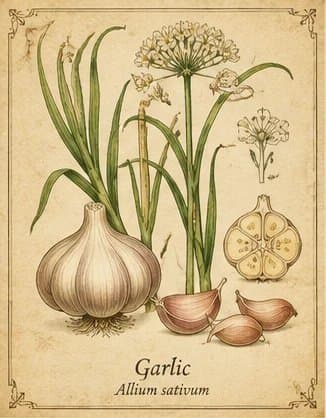
Garlic
Allium sativum
A pungent kitchen bulb traditionally used for heart and circulation health. Research suggests garlic supplements may lower blood pressure and cholesterol a little.
Garlic may interact with some medicines. If you take any medicine, read Interactions with medicines below and talk to your doctor or pharmacist before using it.
What is Garlic?
- Plant family
- Amaryllidaceae, the amaryllis and onion family
- Parts used
- The bulb (the cloves), used fresh, dried or powdered
- Genus
- Allium
- Species
- sativum
Traditionally used for
- Cooking
- High blood pressure
- Cholesterol
- Colds
- Lower stomach and bowel cancer risk (diet studies)
Traditionally described as
- May lower blood pressure slightly
- May lower cholesterol slightly
Health topics
Where Garlic appears in symptom search, and why. Being listed doesn't mean it's a proven treatment.
- Colds and Nasal Congestion
Recognized in Europe as a traditional medicine to relieve cold symptoms.
- High Blood Pressure
Research suggests garlic supplements may lower blood pressure a little in people with high blood pressure. Also a common traditional remedy for high blood pressure in Jamaica.
- High Blood Sugar
Garlic supplements may slightly lower blood sugar in people with diabetes.
- High Cholesterol
Garlic supplements may lower total and LDL cholesterol a little in people with high cholesterol.
Traditions that use it
Mediterranean Folk Medicine
Used historically in ancient Egypt and Greece for headaches, pneumonia, throat conditions and digestive problems.
Ayurveda
Used historically in India for headaches, pneumonia, throat conditions and digestive problems.
European Folk Medicine
Recognized by the European Medicines Agency as a traditional herbal medicine to help prevent hardening of the arteries (atherosclerosis), alongside other measures, and to relieve cold symptoms.
Caribbean Folk Medicine
One of the most commonly reported herbal remedies for high blood pressure among clinic patients in western Jamaica.
Safety
Interactions with medicines
Garlic supplements may raise the risk of bleeding. Talk to your health care provider before taking them if you take a blood thinner (anticoagulant), aspirin or other medicines.[1]
Don't take garlic medicines with the HIV medicines saquinavir and ritonavir. Garlic can lower the amount of saquinavir in the blood, so the HIV treatment may stop working and the virus may become resistant. Use garlic medicines with caution if you take blood thinners or anti-platelet medicines, because they may make bleeding last longer.[2]
Side effects
Garlic can cause bad breath and body odor, stomach pain, gas, nausea and allergic reactions.[1]
Reported side effects of garlic medicines include:
- Bad breath or body odor, stomach pain, bloating, gas, feeling full and loss of appetite
- Allergic reactions such as skin rash, eye or nose irritation, or breathing problems, sometimes severe
- Headache, dizziness and heavy sweating
- Bleeding
How often these happen is not known.[2]
Pregnancy
Taking garlic by mouth in amounts larger than those in food is not considered safe during pregnancy or while breastfeeding.[1]
European guidance doesn't recommend garlic medicines during pregnancy or breastfeeding, because their safety hasn't been established. Animal studies have shown effects on fertility.[2]
Before surgery
Avoid garlic medicines for 7 days before surgery because of the risk of bleeding afterwards.[2]
How much to use
European guidance for adults using garlic powder to help prevent atherosclerosis: 300–750 mg per dose, 900–1,380 mg a day split into 3 to 5 doses. Not recommended for anyone under 18 for this use.[2]
Depends on how it's prepared
Don't put fresh raw garlic on the skin. It can cause severe skin irritation and chemical burns.[1]
What does the research say?
Traditional use
These are traditional uses, not proven treatments.
In a 2017 survey of clinic patients in western Jamaica who had high blood pressure or type 2 diabetes, garlic was one of the most commonly reported herbal remedies used for high blood pressure.[3]
Garlic has been used historically in Egypt, Greece and India for headaches, pneumonia, throat conditions and digestive problems. Today it is promoted as a supplement for cholesterol, blood pressure, diabetes, cancer prevention and the immune system.[1]
The European Medicines Agency recognizes garlic as a traditional herbal medicine, based only on its long history of use, for two purposes:
- Alongside other measures, to help prevent atherosclerosis (fatty buildup that narrows and hardens the arteries)
- Relief of common cold symptoms
Research in people
Garlic supplements may lower total and LDL ("bad") cholesterol a little in people with high cholesterol. Limited evidence suggests they may lower blood pressure a little in people with high blood pressure, and may slightly lower blood sugar in people with diabetes. Eating garlic doesn't seem to lower the risk of stomach cancer, and it's unclear whether it affects the risk of colorectal cancer. Very little research has looked at garlic and the immune system.[1]
A 2016 review combined 20 trials with 970 people. Garlic supplements lowered systolic blood pressure (the top number) by about 5 mm Hg compared with placebo, and by about 9 mm Hg in people who started with high blood pressure. An earlier review cited in the same paper found garlic lowered total and LDL cholesterol by about 10% when taken for more than 2 months by people with slightly high cholesterol. The author calls for longer trials to find out whether garlic reduces heart attacks, strokes or deaths.[4]
Technical detail: SBP −5.1 ± 2.2 mm Hg and DBP −2.5 ± 1.6 mm Hg vs placebo; hypertensive subgroup (≥140/90 mm Hg) SBP −8.7 ± 2.2 and DBP −6.1 ± 1.3 mm Hg; lipid meta-analysis of 39 RCTs with 2,300 adults, total cholesterol >200 mg/dL (>5.5 mmol/L).
A 2022 review of studies comparing people's diets found that people who ate more garlic were less likely to get stomach cancer or bowel cancer. These studies show a link, not proof that garlic prevents cancer.[5]
Technical detail: gastric cancer OR 0.65 (95% CI 0.49 to 0.87); colorectal cancer OR 0.75 (95% CI 0.65 to 0.87; 9 studies).
In short
Garlic supplements may raise bleeding risk; stop 7 days before surgery and check with a doctor if you take blood thinners.
Sources
- [1] Garlic: Usefulness and Safety — National Center for Complementary and Integrative Health (NIH)Government health agency
- [2] European Union herbal monograph on Allium sativum L., bulbus (EMA/HMPC/7685/2013) — European Medicines Agency, Committee on Herbal Medicinal Products (HMPC)Government health agency
- [3] Factors associated with the use of complementary and alternative therapies among patients with hypertension and type 2 diabetes mellitus in Western Jamaica: a cross-sectional study — BMC Complementary Medicine and Therapies · DOI: 10.1186/s12906-020-03109-wPeer-reviewed study
- [4] Garlic Lowers Blood Pressure in Hypertensive Individuals, Regulates Serum Cholesterol, and Stimulates Immunity: An Updated Meta-analysis and Review — The Journal of Nutrition · DOI: 10.3945/jn.114.202192Review or clinical trial
- [5] Association and mechanism of garlic consumption with gastrointestinal cancer risk: A systematic review and meta-analysis — Oncology Letters · DOI: 10.3892/ol.2022.13245Review or clinical trial
This information is educational and traditional in nature, and is not a substitute for professional medical advice.