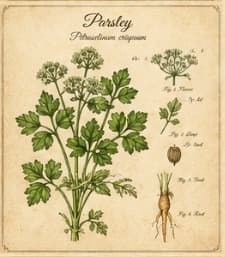
Parsley
Petroselinum crispum
A versatile, mild kitchen herb used as both a garnish and a flavor base.
Parsley may interact with some medicines. If you take any medicine, read Interactions with medicines below and talk to your doctor or pharmacist before using it.
What is Parsley?
- Plant family
- Apiaceae, the carrot and parsley family
- Parts used
- Mainly the fresh or dried leaves and the dried root, used in cooking and as medicine. The seeds (botanically small fruits) and their concentrated essential oil have a separate history of medicinal use, including to cause miscarriage, and carry their own serious safety concerns.
- Where it grows
- Native to Algeria, Greece, Morocco and the northwestern Balkans; now grown and growing wild around the world
- Genus
- Petroselinum
- Species
- crispum
Also called
Garden Parsley, Curly Parsley, Persil
Older scientific names
Apium crispum Mill., Petroselinum sativum L.
Traditionally used for
- Garnish
- Tabbouleh
- Stocks and sauces
Traditionally described as
- May increase urination
- Rich in vitamins K and C
Health topics
Where Parsley appears in symptom search, and why. Being listed doesn't mean it's a proven treatment.
- High Blood Pressure
A traditional use. Not tested in trials.
Traditions that use it
Mediterranean Folk Medicine
Native to the central and eastern Mediterranean (Algeria, Greece, Morocco and the northwestern Balkans, according to Kew). The ancient Greeks and Romans used it for urinary complaints and to prevent kidney stones, and its medical use is recorded as far back as the Ebers Papyrus, an ancient Egyptian medical text.
European Folk Medicine
In European herbal medicine, parsley has long been used to flush the urinary tract, increase urination, and prevent or treat kidney gravel (small kidney stones). Germany's Commission E formally recognized this use for parsley leaf and root on March 2, 1989.
Technical detail: diuretic.
Natural compounds
Safety
Interactions with medicines
In one reported case, a transplant patient who ate large amounts of parsley had higher blood levels of the anti-rejection medicine sirolimus. Parsley may have slowed a liver enzyme that breaks down many medicines.[1]
Technical detail: possible CYP3A4 inhibition.
Who should avoid it
Don't use parsley medicines if you have an inflammatory kidney condition. Parsley flushing therapy should not be used for swelling (edema) caused by heart or kidney problems, and it requires drinking large amounts of fluid at the same time.[2]
Side effects
Pregnancy
Commission E says parsley leaf and root medicines should not be used during pregnancy. Separately, concentrated parsley products and apiol-rich essential oil have a history of being used to cause miscarriage (especially in South America and Italy), which sometimes ended in death from severe bleeding. In pregnant rabbits, oral doses of 5–14 g caused severe bleeding and miscarriage.[2]
Technical detail: abortifacient; apiole.
Apiol seems to cause miscarriage mainly at doses that also damage the mother's liver, partly by causing bleeding in the placenta. Because no safe level has been established for people, the review authors recommend avoiding apiol-rich parsley oil in any form throughout pregnancy and breastfeeding.[3]
Technical detail: maternally hepatotoxic doses; indirect induction of placental hemorrhage.
Breastfeeding
Apiol-rich parsley essential oil and concentrated parsley products should be avoided while breastfeeding as well as during pregnancy, because no safe level has been established for people.[3]
Toxicity testing
In large amounts, apiol (a major compound in parsley essential oil) damages the nerves, liver and kidneys, and has caused deaths in the past. Signs of poisoning include confusion, vision problems, dizziness, ringing in the ears, clumsiness, headache and loss of balance, and at higher doses seizures, paralysis and death. In mice, a single dose of the oil killed all the animals within 60 hours from liver and kidney damage.[3]
Technical detail: neurotoxic, hepatotoxic, nephrotoxic; vertigo, tinnitus, ataxia; mouse gavage dose 10 mL/kg.
How much to use
Daily amount referenced by Commission E (unless a professional advises otherwise): 6 g of prepared parsley leaf or root, crushed for tea or used in other preparations that contain only a small amount of essential oil, taken by mouth. For flushing therapy, you must drink large amounts of fluid at the same time.[2]
Technical detail: galenical preparations.
Depends on how it's prepared
The serious safety concerns about parsley, including miscarriage, apply mainly to concentrated seed extracts and pure essential oil, which are rich in a compound called apiol. Normal cooking with fresh or dried parsley leaf involves much smaller amounts. Commission E itself warns that "the essential oil should not be used in isolation because of its toxicity."[2]
What does the research say?
Traditional use
These are traditional uses, not proven treatments.
Germany's Commission E, an official expert panel on herbal medicines, recognizes parsley leaf and root for flushing the urinary tract and for preventing and treating kidney gravel (small kidney stones). This reflects long-standing European use rather than clinical trials.[2]
In traditional and folk medicine, parsley has been used to relieve gas, strengthen the stomach, increase urination, fight urinary infections, prevent kidney stones, counter poisons and reduce inflammation. It has also been used for missing or painful periods, digestive problems, high blood pressure, heart disease, urinary disease, ear infections, sniffles, diabetes and various skin conditions.[4]
Technical detail: carminative, gastric tonic, diuretic, urinary-tract antiseptic, anti-urolithiasis, antidote; amenorrhea, dysmenorrhea, otitis.
The ancient Greeks and Romans used parsley for urinary infections and to prevent kidney stones, and its medical use is also recorded in the Ebers Papyrus, an ancient Egyptian medical text. A research review also notes its traditional use in Chinese and Ayurvedic medicine for high blood pressure and inflammation.[1]
Laboratory & animal research
Lab and animal results show what might be worth studying in people. They don't show that the herb has these effects in humans.
In several rodent studies, parsley extracts reduced oxidative stress (a type of cell damage) and helped protect the kidneys, including from reduced blood flow, damage caused by drugs, and kidney problems linked to high uric acid. These are animal findings, not established effects in people.[1]
Technical detail: ischemia/reperfusion injury, drug-induced nephrotoxicity, hyperuricemia-induced renal dysfunction; improved renal biomarkers.
A research review lists many effects of parsley extracts and compounds in lab and animal studies:
- Antioxidant activity
- Protecting the liver, brain and stomach
- Lowering blood sugar and blood pressure
- Relieving pain and cramps
- Calming the immune system and making blood less likely to clot
- Acting as a laxative, increasing urination and estrogen-like effects
- Fighting bacteria and fungi These are lab and animal findings, not established effects in people.
Technical detail: hepatoprotective, anti-diabetic, analgesic, spasmolytic, immunosuppressant, anti-platelet, gastroprotective, cytoprotective, laxative, estrogenic, diuretic, hypotensive, antibacterial, antifungal.
Research in people
Studies in people have had mixed results:
- Eating parsley increased the antioxidant activity of certain body enzymes (Nielsen et al., 1999).
- Obese women who ate bread with added parsley seed had better kidney health markers (Essa et al., 2024).
- Another study found no difference in urine measurements compared with a control group (Alyami and Rabah, 2011).
Overall, the review describes the evidence for parsley's effects on the kidneys in people as limited and mixed.[1]
Technical detail: Nielsen et al. also documented increased urinary apigenin excretion.
In short
Avoid medicinal doses (not cooking amounts) during pregnancy.
Sources
- [1] Renal health benefits and therapeutic effects of parsley (Petroselinum crispum): a review — Frontiers in Medicine · DOI: 10.3389/fmed.2024.1494740Peer-reviewed study
- [2] Parsley herb and root (Petroselini herba/radix) — German Commission E Monograph — German Commission E, reproduced by the American Botanical CouncilGovernment health agency
- [3] Maternal Reproductive Toxicity of Some Essential Oils and Their Constituents — International Journal of Molecular Sciences · DOI: 10.3390/ijms22052380Peer-reviewed study
- [4] Parsley: a review of ethnopharmacology, phytochemistry and biological activities — Journal of Traditional Chinese Medicine · DOI: 10.1016/s0254-6272(14)60018-2Peer-reviewed study
This information is educational and traditional in nature, and is not a substitute for professional medical advice.