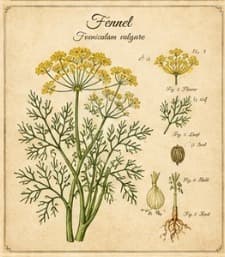
Fennel
Foeniculum vulgare
An anise-flavored plant whose seeds and bulb are both widely eaten. The seeds are traditionally used for digestion.
What is Fennel?
- Plant family
- Apiaceae, the carrot and parsley family
- Parts used
- The dried ripe seeds (botanically small fruits, called "Foeniculi fructus" in herbal references), which are the official medicinal part in the European monograph. The leaves, stems, root and bulb are eaten as food.
- Where it grows
- From the Mediterranean region east to Ethiopia and western Nepal; now grown and growing wild worldwide, including across Asia, Europe and North America
- Genus
- Foeniculum
- Species
- vulgare
Also called
Sweet Fennel, Bitter Fennel, Fenouil, Finocchio, Hui Xiang, Saunf
Traditional names
Madhurika
Older scientific names
Anethum foeniculum L., Foeniculum officinale All., Meum foeniculum (L.) Spreng.
Traditionally used for
- Digestive tea
- Salads
- Roasted bulb dishes
Traditionally described as
- May relieve gas
- Mild estrogen-like effects
- May ease cramps
Traditions that use it
Ayurveda
Fennel seed is listed in the Ayurvedic Pharmacopoeia of India as an important ingredient in multi-herb formulas. Its Sanskrit names include Madhurika and Shatapushpa, and in Hindi it is widely known as saunf or badi saunf.
Mediterranean Folk Medicine
Fennel is native to the Mediterranean region (from the Mediterranean to Ethiopia and western Nepal, according to Kew and GBIF). Mediterranean and European folk medicine has long used it to aid digestion and relieve gas, for stomach upsets and constipation, for breathing problems, to reduce inflammation, and to increase breast milk in nursing mothers.
Technical detail: carminative, galactagogue.
Natural compounds
Safety
Who should avoid it
European guidance does not recommend fennel tea products for children under 4, because there isn't enough data. Its use for period cramps in children under 12 has not been established either. This official guidance differs from the traditional use of fennel for baby colic (see the infant trial under research in people, which was medically supervised). Don't give fennel to babies or young children without medical advice.[1]
In animal studies, fennel acted like the hormone estrogen (from forms of anethole, its main flavor compound). This comes from animals, not from studies in people, but it is the traditional reason for caution about fennel for people with hormone-sensitive conditions.[2]
Technical detail: acetone extracts induced vaginal cornification and increased mammary gland weight; attributed to dianethole and photoanethole.
Don't use fennel if you are allergic to it, to anethole (its main flavor compound), or to other plants in the carrot family (Apiaceae), such as aniseed, caraway, celery, coriander or dill. People allergic to mugwort pollen should also avoid it, because the allergies can overlap.[1]
Technical detail: the Apiaceae family is also called Umbelliferae.
Side effects
Allergic reactions to fennel, affecting the skin or breathing, can happen. How often is not known.[1]
Pregnancy
Fennel has not been shown to be safe during pregnancy, so using it as a medicine while pregnant is not recommended. There is no data on its effects on fertility. In a study in pregnant mice, a water-based fennel seed extract caused birth defects and harm to the developing embryos, and the effect grew with the dose. Proper reproductive-safety testing has not been done in people.[1]
Technical detail: BALB/c mice, days 6–15 of gestation; dose-dependent teratogenic/embryotoxic effects (morphological changes, skeletal disorders, cellular alterations).
Breastfeeding
Fennel has not been shown to be safe while breastfeeding, so using it as a medicine while breastfeeding is not recommended. There is evidence that trans-anethole, fennel's main flavor compound, passes into breast milk.[1]
Toxicity testing
Fennel essential oil contains estragole, a natural compound that caused liver tumors in mice and damages DNA in rodents. Anethole, fennel's main flavor compound, showed weak DNA-damaging activity in lab animals, although a water-based fennel extract tested negative in a standard lab test for DNA damage. Suggested limits for estragole:
- Everyone: keep exposure as low as practically possible.
- Pregnant or breastfeeding women: under 0.05 mg a day.
- Children under 12: under 1 microgram per kg of body weight a day.
Technical detail: estragole is considered a genotoxic carcinogen in rodents, with suggestive but indirect evidence of carcinogenicity in rats; fennel aqueous extract was negative in the Ames test (Salmonella typhimurium TA98, TA100).
How much to use
How much to use, according to the European Medicines Agency (as a tea):
- Adults and teens: 1.5 g of fennel seed in 250 ml of boiling water, steeped for 15 minutes, 3 times a day (4.5 g a day). Don't use for more than 2 weeks.
- Children 4–12: 1.0 g in 100 ml of boiling water, 3 times a day (3.0 g a day), only for mild, short-lived symptoms and for less than a week.
If symptoms last or get worse, see a doctor or qualified health professional.[1]
What does the research say?
Traditional use
These are traditional uses, not proven treatments.
A research review found fennel has been used traditionally for more than 40 kinds of health problems in Ayurvedic, Unani, Siddha and Mediterranean/European folk medicine. These include aiding digestion and relieving gas, stomach pain, diarrhea, breathing problems, eye problems, kidney problems, fever and arthritis, and increasing breast milk. It is also widely used as a cooking spice.[2]
Technical detail: carminative, galactagogue.
The European Medicines Agency recognizes fennel tea for three uses, based only on its long history of traditional use:
- Mild digestive cramps, including bloating and gas
- Minor cramps during menstrual periods
- To help loosen mucus in a cough that comes with a cold
The agency did not recognize any use as proven by clinical studies.[1]
Technical detail: "traditional-use" registration; expectorant; no "well-established use" recognized.
Laboratory & animal research
Lab and animal results show what might be worth studying in people. They don't show that the herb has these effects in humans.
A research review describes these lab and animal findings:
- In animals, a fennel extract reduced inflammation.
- The essential oil protected the liver in rats with chemical liver damage, bringing liver enzyme levels down.
- The essential oil lowered high blood sugar in diabetic rats.
- A water-based extract improved memory in rodents with drug-induced memory loss.
- In lab tests, the oil and extracts slowed the growth of bacteria such as Staphylococcus aureus, E. coli and Bacillus.
- In mice, the essential oil helped prevent blood clots.
These are animal and lab findings, not established effects in people.[2]
Technical detail: methanolic extract 200 mg/kg oral (acute and subacute inflammation); reduced AST, ALT, ALP and bilirubin in carbon-tetrachloride-induced liver injury (hepatoprotective); 30 mg/kg in streptozotocin-induced diabetic rats; aqueous extract 50–200 mg/kg in scopolamine-induced amnesia; antithrombotic activity in mice.
In animal studies, fennel acted like the hormone estrogen, causing estrogen-like changes in the reproductive tissues and breast glands. The compounds responsible are forms of anethole, the main flavor compound in fennel. This is cited as a possible reason for fennel's traditional use to increase breast milk and for menstrual and menopausal complaints, but it has not been shown to work this way in people.[2]
Technical detail: acetone extracts induced vaginal cornification, increased mammary gland weight and raised nucleic acid levels; active components identified as the anethole polymers dianethole and photoanethole.
Research in people
In one trial, 125 babies aged 2–12 weeks with colic were given either a fennel seed oil emulsion or a placebo. Colic went away in 65% of babies given fennel, compared with about 24% given placebo. No side effects were reported in either group. The authors concluded fennel seed oil worked better than placebo for reducing colic. This was a supervised clinical trial; see the safety section about giving fennel to young children.[3]
Technical detail: randomized, placebo-controlled; infants met Wessel's criteria for colic; 40/62 vs. 14/59 (p<0.01); absolute risk reduction 41% (95% CI 25–57); number needed to treat 2 (95% CI 2–4).
A review that combined 12 trials found fennel reduced period pain (primary dysmenorrhea) more than placebo. In 7 trials comparing fennel with standard pain relievers such as mefenamic acid or ibuprofen, fennel worked about as well. Only 3 of the 12 trials looked at side effects; one reported minor nausea and vomiting, equally common with fennel and placebo. The authors noted that there is a big gap in safety data for fennel.[4]
Technical detail: systematic review and meta-analysis of randomized controlled trials. Fennel vs. placebo: n=468, SMD −3.27 (95% CI −5.28 to −1.26), p=0.001. Fennel vs. conventional drugs: n=502, SMD 0.07 (95% CI −0.08 to 0.21), p=0.37.
In short
Avoid concentrated forms during pregnancy.
Sources
- [1] European Union herbal monograph on Foeniculum vulgare Miller subsp. vulgare var. dulce (Mill.) Batt. & Trab., fructus — Final, Revision 1 (EMEA/HMPC/372839/2016) — European Medicines Agency (EMA), Committee on Herbal Medicinal Products (HMPC)Government health agency
- [2] Foeniculum vulgare Mill: A Review of Its Botany, Phytochemistry, Pharmacology, Contemporary Application, and Toxicology — BioMed Research International · DOI: 10.1155/2014/842674Peer-reviewed study
- [3] The effect of fennel (Foeniculum vulgare) seed oil emulsion in infantile colic: a randomized, placebo-controlled study — Alternative Therapies in Health and MedicineReview or clinical trial
- [4] Fennel for Reducing Pain in Primary Dysmenorrhea: A Systematic Review and Meta-Analysis of Randomized Controlled Trials — Nutrients · DOI: 10.3390/nu12113438Review or clinical trial
This information is educational and traditional in nature, and is not a substitute for professional medical advice.