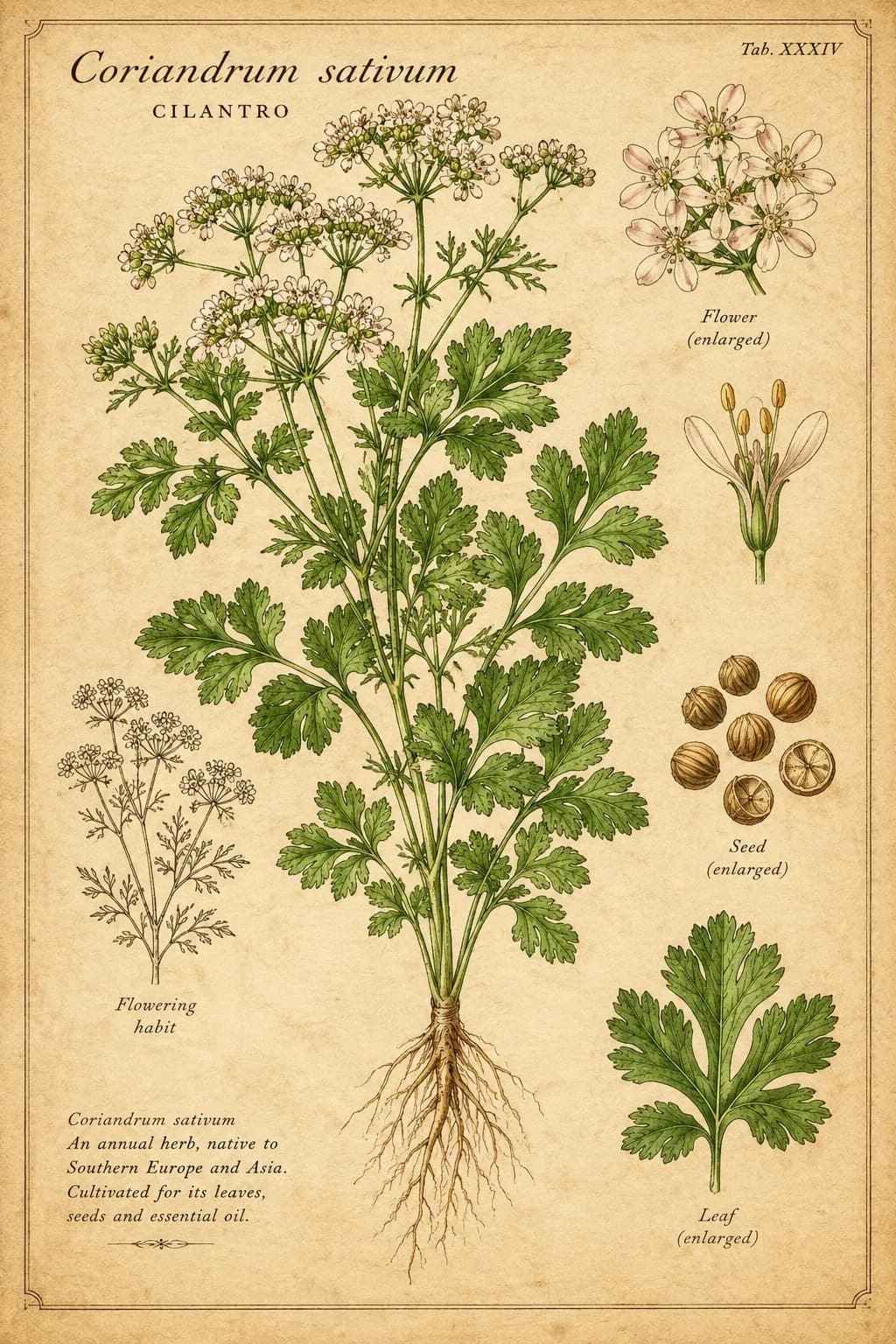
Cilantro
Coriandrum sativum
A fresh, citrusy kitchen herb. Its seeds, sold as coriander, are traditionally used to support digestion.
What is Cilantro?
- Plant family
- Apiaceae, the carrot and parsley family
- Parts used
- The fresh leaves (cilantro) and the dried seeds (coriander). Botanically, the "seeds" are tiny fruits.
- Where it grows
- Originally from the eastern Mediterranean, the Middle East and the North Caucasus (according to Kew's Plants of the World Online). It has long been grown, and now grows wild, around the world.
- Genus
- Coriandrum
- Species
- sativum
Also called
Coriander, Chinese Parsley
Regional names
Dhania
Older scientific names
Coriandrum diversifolium Gilib., Bifora loureiroi Kostel.
Traditionally used for
- Salsas
- Curries
- Garnish
Traditionally described as
- Antioxidant
- Mild digestive aid
Health topics
Where Cilantro appears in symptom search, and why. Being listed doesn't mean it's a proven treatment.
- High Blood Pressure
One human study linked 2 g of coriander seed powder a day to lower blood pressure and cholesterol.
Traditions that use it
Ayurveda
Traditionally used in India for digestive discomfort, rheumatoid arthritis, inflammation and joint pain.
Traditional Chinese Medicine
Traditionally used in Chinese medicine for flu and bad breath.
Mediterranean Folk Medicine
Native to the eastern Mediterranean. Traditionally used in Turkey to aid digestion and boost appetite.
European Folk Medicine
Coriander seed is a minor ingredient (about 13–40% by weight) in traditional German and Spanish herbal tea blends for digestive complaints such as fullness and gas, alongside fennel, caraway, chamomile, peppermint or yarrow. This is documented in a European Medicines Agency report. Coriander has no official European herbal profile of its own.
African Traditional Medicine
Traditionally used in Morocco to increase urination, and for diabetes and poor appetite.
Natural compounds
Safety
Allergies
Coriander can cause food or skin allergies. People allergic to mugwort pollen are more likely to react to coriander and its relatives: celery, carrot, parsley, fennel and cumin. Reactions include nausea, stomach pain, vomiting and diarrhea. In rare reported cases, people have had a severe whole-body allergic reaction (anaphylaxis).[1]
Technical detail: "celery-birch-mugwort-spice syndrome"; shared allergens are Bet v 1 homologues and profilins.
Pregnancy
In rats, a strong water-based seed extract made it harder for a fertilized egg to implant early in pregnancy, but did not cause complete infertility. Given later in pregnancy, it did not cause miscarriage or affect how the babies developed. These were concentrated doses in animals, not the amounts used in cooking, and there is no human data.[2]
Technical detail: 250–500 mg/kg orally; dose-dependent anti-implantation effect linked to lower serum progesterone on day 5; no abortifacient activity on days 8–12 or 12–20; no abnormalities in fetal weight, length or organ development.
Toxicity testing
A food-safety review judged coriander essential oil safe as a food ingredient, based on its long history in cooking with no recorded problems and on lab testing. It irritated skin in rabbit tests but did not cause skin allergies in human testing.[3]
Technical detail: no-observed-effect level about 160 mg/kg/day (28-day rat study); linalool (about 70% of the oil) is not mutagenic; no evidence of clastogenicity.
What does the research say?
Traditional use
These are traditional uses, not proven treatments.
People in many parts of the world have used coriander in folk medicine:
- India: digestive discomfort, rheumatoid arthritis and joint pain
- Pakistan: gas, dysentery, diarrhea and vomiting
- Iran: trouble sleeping, anxiety, seizures and liver disease
- Turkey: to aid digestion
- Morocco: to increase urination, and for diabetes and poor appetite
- Traditional Chinese Medicine: flu and bad breath
Coriander seed doesn't have its own official European herbal profile. But it appears as a minor ingredient (about 20–40 g per blend) in traditional German and Spanish herbal teas for digestive complaints such as fullness and gas, as documented in a European Medicines Agency report on digestive tea blends.[5]
Technical detail: Coriandri fructus; EMA/HMPC assessment report on Species digestivae.
Laboratory & animal research
Lab and animal results show what might be worth studying in people. They don't show that the herb has these effects in humans.
In lab tests, coriander leaf extract blocked an enzyme (ACE) that raises blood pressure, and coriander blocked enzymes that turn starch into sugar and showed antioxidant activity. In rats and rabbits, coriander lowered blood fats (triglycerides and total cholesterol), relaxed arteries, helped keep heart rhythm normal and protected the heart from drug-induced injury.[4]
Technical detail: hypolipidemic, anti-atherogenic (inhibited foam-cell formation and oxidized-LDL accumulation), antihypertensive (ACE inhibition, IC50 = 28.91 µg/mL for a leaf extract; arterial relaxation), antiarrhythmic (normalized ECG, reduced cardiac injury biomarkers), cardioprotective against isoproterenol-induced myocardial injury; alpha-amylase and alpha-glucosidase inhibition.
In lab tests, coriander essential oil slowed or killed many kinds of bacteria and fungi, including Candida yeast, and showed antioxidant activity. In animals, it protected rat livers from chemical damage, reduced seizures and anxious behavior in rodents, and acted against a parasitic worm. The review found no human trials for any of these effects.[6]
Technical detail: linalool-rich oil; gram-positive and gram-negative bacteria; DPPH/FRAP assays; anthelmintic against Haemonchus contortus; hepatoprotective in CCl4-induced liver injury; anticonvulsant and anxiolytic in rodent seizure and elevated-plus-maze models.
Research in people
In one trial, 86 university students took either 500 mg of coriander seed or a placebo (a dummy pill). Compared with placebo, the coriander group reported better memory, less anxiety, less depression and better sleep on standard questionnaires.[7]
Technical detail: randomized, placebo-controlled; memory (PRMQ) p=0.006; anxiety p=0.04; depression (HADS) p=0.002; sleep (PSQI) p=0.03.
Only two small studies have looked at coriander seed and heart health in people. One linked 2 g of seed powder a day to lower blood pressure and cholesterol. The other, in people with type 2 diabetes, found 5 g a day lowered blood fats and had antioxidant effects. The reviewers call this evidence sparse and say more trials are needed.[4]
In short
Some people find it tastes soapy because of their genes.
Sources
- [1] Spices, herbs and allergic reactions in children: myth or reality — a narrative review with scoping elements — Frontiers in Allergy · DOI: 10.3389/falgy.2025.1698559Peer-reviewed study
- [2] Post-coital antifertility activity of the seeds of Coriandrum sativum in rats — Journal of Ethnopharmacology · DOI: 10.1016/0378-8741(87)90126-7Peer-reviewed study
- [3] Safety assessment of coriander (Coriandrum sativum L.) essential oil as a food ingredient — Food and Chemical Toxicology · DOI: 10.1016/j.fct.2008.11.006Peer-reviewed study
- [4] Coriandrum sativum L.: A Review on Ethnopharmacology, Phytochemistry, and Cardiovascular Benefits — Molecules · DOI: 10.3390/molecules27010209Peer-reviewed study
- [5] Assessment report on Species digestivae (herbal tea combinations for digestive complaints) — European Medicines Agency, Committee on Herbal Medicinal Products (HMPC)Government health agency
- [6] Essential Oil from Coriandrum sativum: A Review on Its Phytochemistry and Biological Activity — Molecules · DOI: 10.3390/molecules28020696Peer-reviewed study
- [7] Effects of Coriandrum sativum seeds on memory, anxiety, depression, and sleep quality in students: a randomized controlled study — Nutrition & Food Science · DOI: 10.1108/NFS-08-2023-0193Review or clinical trial
This information is educational and traditional in nature, and is not a substitute for professional medical advice.