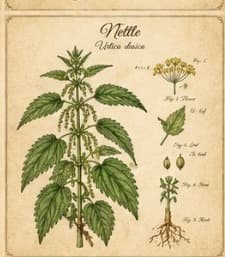
Nettle
Urtica dioica
A stinging plant eaten as a spring vegetable and traditionally used for joint pain and urinary complaints.
Nettle may interact with some medicines. If you take any medicine, read Interactions with medicines below and talk to your doctor or pharmacist before using it.
What is Nettle?
- Plant family
- Urticaceae, the nettle family
- Parts used
- Leaf (Urticae folium): traditionally used for minor joint pain, and alongside other care to increase urination for minor urinary complaints. Root (Urticae radix): traditionally used for urinary symptoms caused by an enlarged prostate (benign prostatic hyperplasia, or BPH). The leaf and root contain different natural compounds and have separate official European herbal profiles.
- Genus
- Urtica
- Species
- dioica
Also called
Stinging Nettle, Common Nettle
Traditionally used for
- Allergy tea
- Nourishing infusions
Traditionally described as
- May help reduce inflammation
- May increase urination
- Nourishing
Health topics
Where Nettle appears in symptom search, and why. Being listed doesn't mean it's a proven treatment.
- Cuts, Wounds, Burns and Skin Ulcers
Traditionally used in Europe, Asia and Africa for cuts and wounds. This hasn't been tested in people.
- Skin Irritation, Rashes and Itching
Touching the fresh plant causes a stinging rash, and nettle taken by mouth can cause itching, rash or hives. Dried or cooked nettle doesn't sting.
Traditions that use it
European Folk Medicine
Nettle has long been used across Europe as food (a spring vegetable eaten cooked or dried) and in folk medicine: the leaf for joint and muscle pain and to increase urination, and the root for urinary complaints. The official European herbal profiles list local names for nettle root in more than 20 European languages, a sign of how widely it has been used.
Natural compounds
Safety
Interactions with medicines
Nettle contains tannins, which can reduce how well your body absorbs iron. This can make iron supplements less effective for people who need them.[1]
Who should avoid it
Don't use nettle leaf if you have been told to limit how much fluid you drink, for example because of severe heart or kidney disease. This matters because nettle leaf is traditionally used to increase urination.[2]
Allergies
Side effects
Taken by mouth, nettle leaf may cause mild stomach upset (nausea, vomiting, diarrhea) and skin reactions (itching, rash, hives). How often is not known.[2]
Taken by mouth, nettle root may cause stomach problems (nausea, heartburn, feeling full, gas, diarrhea) and allergic reactions (itching, rash, hives). How often is not known.[3]
Pregnancy
Nettle leaf has not been shown to be safe during pregnancy, so using it as a medicine while pregnant is not recommended.[2]
The European herbal profile for nettle root says pregnancy and breastfeeding don't apply, because the product is meant for prostate symptoms in men. There is no data on fertility.[3]
Breastfeeding
Nettle leaf has not been shown to be safe while breastfeeding, so using it as a medicine while breastfeeding is not recommended.[2]
Toxicity testing
Nettle root products have not been properly tested for DNA damage, harm to reproduction, or cancer risk.[3]
How much to use
Nettle leaf is not recommended for children under 12, because there isn't enough data. Traditional use should last no more than 4 weeks for joint pain, or 2–4 weeks for urinary complaints. See a doctor if joint pain comes with swelling, redness or fever, or if urinary symptoms get worse or come with fever, painful urination, cramps or blood in the urine.[2]
Nettle root is not used in children or teenagers under 18. See a doctor if symptoms get worse, or if you get a fever, cramps, blood in the urine, painful urination, or can't pass urine.[3]
Depends on how it's prepared
Touching the fresh, raw plant causes an immediate stinging rash. Its hollow hairs inject a mix of histamine, serotonin, acetylcholine and formic acid into the skin, causing burning pain, redness and welts. Dried, cooked or otherwise processed nettle doesn't sting.[4]
Technical detail: stinging contact dermatitis from trichomes.
What does the research say?
Traditional use
These are traditional uses, not proven treatments.
The European Medicines Agency recognizes nettle leaf as a traditional herbal medicine, based only on its long history of use, for two purposes:
- Relief of minor joint pain
- Increasing urination to help flush the urinary tract, alongside other care for minor urinary complaints
The European Medicines Agency recognizes nettle root as a traditional herbal medicine, based only on its long history of use, for relieving urinary symptoms caused by an enlarged prostate (benign prostatic hyperplasia, or BPH), once a doctor has ruled out serious conditions.[3]
Historically, nettle has been widely eaten, as a cooked vegetable or dried and stored as food during shortages. In traditional medicine across Europe, Asia and Africa it has been used to increase urination and for coughs, colds, cuts and wounds. Fresh leaves were traditionally applied to the skin to relieve joint pain.[5]
Laboratory & animal research
Lab and animal results show what might be worth studying in people. They don't show that the herb has these effects in humans.
Lab studies of nettle root and its natural compounds report:
- Several compounds, including plant sterols (mainly beta-sitosterol), lignans, polysaccharides and a protein called UDA, are thought to be behind the root's effects on prostate symptoms, though how much each contributes isn't fully shown.
- UDA acted against fungi and bacteria, and against several viruses that have an outer envelope (including SARS-CoV-2, flu, dengue and HIV) but not viruses without one.
- UDA slowed or killed several types of cancer cells in the lab, including leukemia cells.
These are lab findings, not established effects in people.[6]
Technical detail: main lignan is pinoresinol; UDA is Urtica dioica agglutinin, a lectin that binds chitin in fungal and bacterial cell walls; antiproliferative, cytotoxic and apoptotic effects including against acute myeloid leukemia cells.
Research in people
In a trial of 27 people with arthritis pain at the base of the thumb or index finger, people rubbed fresh stinging nettle leaf on the painful area every day for a week, and a look-alike non-stinging plant (white deadnettle) for another week. Pain and disability dropped significantly more with the stinging nettle. This was the first controlled trial of this long-standing folk remedy.[7]
Technical detail: randomized, double-blind, placebo-controlled crossover with a five-week washout; osteoarthritis; visual analogue scale P = 0.026; health assessment questionnaire P = 0.0027; placebo was Lamium album.
There is some limited evidence from trials that nettle root may improve urinary symptoms of an enlarged prostate (BPH). A 2005 trial of 620 men found better symptom scores and urine flow than placebo over 6 months, with the benefit lasting to 18 months. Trials combining nettle root with saw palmetto also did better than placebo, and one found the combination worked about as well as the prostate drug tamsulosin. Nettle root was generally well tolerated, with occasional mild stomach upset.[1]
Technical detail: International Prostate Symptom Score (IPSS) and maximum urinary flow rate; combination trials showed benefit for inflammatory and obstructive symptoms.
In short
The fresh plant stings the skin; cook or dry it before use.
Sources
- [1] Benign Prostatic Hyperplasia and Complementary and Integrative Approaches: What the Science Says — National Center for Complementary and Integrative Health (NIH)Government health agency
- [2] Community herbal monograph on Urtica dioica L.; Urtica urens L., folium — European Medicines Agency (EMA), Committee on Herbal Medicinal Products (HMPC)Government health agency
- [3] European Union herbal monograph on Urtica dioica L.; Urtica urens L., radix - Revision 1 — European Medicines Agency (EMA), Committee on Herbal Medicinal Products (HMPC)Government health agency
- [4] Mechanism of action of stinging nettles — Wilderness & Environmental Medicine · DOI: 10.1016/j.wem.2011.01.001Peer-reviewed study
- [5] Stinging Nettle (Urtica dioica L.): Nutritional Composition, Bioactive Compounds, and Food Functional Properties — Molecules · DOI: 10.3390/molecules27165219Peer-reviewed study
- [6] Stinging Nettle (Urtica dioica) Roots: The Power Underground—A Review — Plants (Basel) · DOI: 10.3390/plants14020279Peer-reviewed study
- [7] Randomized controlled trial of nettle sting for treatment of base-of-thumb pain — Journal of the Royal Society of MedicineReview or clinical trial
This information is educational and traditional in nature, and is not a substitute for professional medical advice.