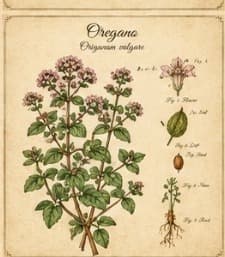
Oregano
Origanum vulgare
A pungent Mediterranean kitchen herb central to pizza and pasta sauces.
What is Oregano?
- Plant family
- Lamiaceae, the mint family
- Parts used
- The dried leaves and flowering tops
- Where it grows
- Europe, the Mediterranean region, North Africa and temperate Asia (from the Atlantic islands off Africa east to China); introduced and growing wild in North America
- Genus
- Origanum
- Species
- vulgare
Also called
Wild Marjoram, Pot Marjoram, Winter Marjoram
Older scientific names
Origanum floridum Salisb., Thymus origanum Kuntze
Traditionally used for
- Italian and Greek cooking
- Oregano oil
Traditionally described as
- May fight germs
- Antioxidant
Traditions that use it
Mediterranean Folk Medicine
Native to the Mediterranean region. It has long been used in Mediterranean and Iranian folk medicine, both as a cooking spice and as a traditional remedy for breathing problems, digestive complaints and infections.
Natural compounds
Safety
Allergies
Rare allergic reactions have been reported. In one case, a 45-year-old man with asthma had a sudden whole-body allergic reaction (rash, swollen lips, noisy breathing and a drop in blood pressure that needed an epinephrine injection) after eating foods with oregano and then thyme. Tests showed he was allergic to several plants in the mint family (Lamiaceae). People allergic to other mint-family herbs may also react to oregano.[1]
Technical detail: stridor, mild hypotension; positive skin-prick and in-vitro tests; cross-reactivity.
Side effects
Oregano oil is usually well tolerated, but higher doses can cause stomach discomfort, heartburn, constipation or diarrhea, nausea and vomiting, dizziness and headache.[1]
Pregnancy
At the doses used in supplements, oregano can cause miscarriage. It should not be used as a supplement during pregnancy, or by women who could become pregnant and aren't using effective birth control.[1]
Technical detail: abortifacient.
Toxicity testing
Although oregano is widely used in food and supplements, there are no published reports of oregano oil causing liver damage. The NIH's LiverTox database rates it as an unlikely cause of liver injury. However, there is little data from careful studies of people taking it.[1]
Technical detail: no reports of serum aminotransferase elevations or clinically apparent liver injury; LiverTox hepatotoxicity likelihood score E; mechanism of any potential liver injury is unknown.
How much to use
Oregano oil is not approved to treat any disease or medical condition in the United States. It is sold over the counter as a supplement, as capsules or oil. The usual recommended dose varies a lot, partly because products contain different amounts of essential oil.[1]
What does the research say?
Traditional use
These are traditional uses, not proven treatments.
Oregano has a long history of traditional use for:
- Breathing problems: colds, fever, cough and bronchitis
- Stomach ache and digestive upset
- Painful periods
- Rheumatoid arthritis
- Urinary problems
- Parasites and bacterial infections
In Iranian traditional medicine, it has been used to restore strength, loosen mucus, relieve gas and stimulate the body. It has also long been used as a cooking spice, and oregano oil has been applied for bacterial and fungal infections.[2]
Technical detail: tonic, expectorant, carminative, stimulant; antiparasitic and antibacterial.
Laboratory & animal research
Lab and animal results show what might be worth studying in people. They don't show that the herb has these effects in humans.
In lab tests, an oregano extract rich in natural plant compounds (mainly rosmarinic acid) showed strong antioxidant activity and slowed the growth of bacteria and of a common mold (Aspergillus niger). In mice with chemically damaged livers, the extract reduced signs of liver damage and restored the liver's own protective enzymes. Oregano's essential oil is rich in carvacrol and thymol, which can make up about 70% of the oil in some types. Research on how these compounds fight germs comes from lab and food studies. These are lab and animal findings, not established effects in people.[3]
Technical detail: Origanum vulgare ssp. vulgare hydroalcoholic extract: rosmarinic acid 12.83 mg/g, plus chlorogenic acid, hyperoside, isoquercitrin, rutin, quercitrin and luteolin; total polyphenols 94.69 mg/g. CUPRAC, FRAP and superoxide-scavenging assays; bacterial inhibition zones 16–19 mm; Aspergillus niger MIC 19.53 µg/mL. Carbon-tetrachloride hepatotoxicity model: restored catalase, superoxide dismutase and glutathione peroxidase and reduced lipid peroxidation. Other volatiles: gamma-terpinene, p-cymene. Proposed antimicrobial mechanisms: enzyme inhibition, efflux-pump inhibition, biofilm disruption, membrane damage.
Research in people
In a small study, 14 adults with gut parasites found in stool tests took 600 mg of oregano oil a day for 6 weeks. One parasite (Entamoeba hartmanni) cleared in all 4 people who had it, another (Endolimax nana) cleared in the 1 person who had it, and a third (Blastocystis hominis) cleared in 8 of 11 people, with levels falling in 3 more. Digestive symptoms improved in 7 of the 11 people with Blastocystis. The study was small, had no comparison group and everyone knew what they were taking, so it is early evidence, not proof.[4]
Technical detail: open-label, not blinded, not placebo-controlled; emulsified oil of Mediterranean oregano (Origanum vulgare).
In short
Oregano oil is strong and should be diluted.
Sources
- [1] Oregano — LiverTox: Clinical and Research Information on Drug-Induced Liver Injury, National Institute of Diabetes and Digestive and Kidney Diseases (NIDDK), National Institutes of Health (NIH)Government health agency
- [2] A Review of the Phytochemistry and Antimicrobial Properties of Origanum vulgare L. and Subspecies — Iranian Journal of Pharmaceutical Research · DOI: 10.22037/ijpr.2020.113874.14539Peer-reviewed study
- [3] Origanum vulgare ssp. vulgare: Chemical Composition and Biological Studies — Molecules · DOI: 10.3390/molecules23082077Peer-reviewed study
- [4] Inhibition of enteric parasites by emulsified oil of oregano in vivo — Phytotherapy Research · DOI: 10.1002/(SICI)1099-1573(200005)14:3<213::AID-PTR583>3.0.CO;2-UPeer-reviewed study
This information is educational and traditional in nature, and is not a substitute for professional medical advice.