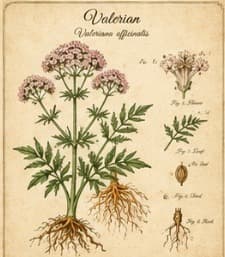
Valerian
Valeriana officinalis
A root traditionally used to help with sleep.
Valerian may interact with some medicines. If you take any medicine, read Interactions with medicines below and talk to your doctor or pharmacist before using it.
What is Valerian?
- Plant family
- Caprifoliaceae, the honeysuckle family
- Parts used
- The root and rhizome (underground stem)
- Where it grows
- Europe and Asia (from Iceland to Iran); now grows wild in North America
- Genus
- Valeriana
- Species
- officinalis
Also called
All-Heal, Garden Heliotrope, Garden Valerian
Older scientific names
Valeriana exaltata J.C.Mikan ex Pohl, Valeriana sylvestris Garsault
Traditionally used for
- Sleep
- Anxiety
Traditionally described as
- May make you sleepy
- May ease anxiety
Health topics
Where Valerian appears in symptom search, and why. Being listed doesn't mean it's a proven treatment.
- Anxiety
Traditionally used in Europe for anxiety and restlessness. A review found a modest, inconsistent effect.
- Liver Safety Warnings
In very rare cases, liver damage has been reported with valerian.
- Sleep Problems (Insomnia)
Traditionally used for sleep. A review of 60 studies found a modest, inconsistent improvement; US sleep experts advise against it for long-term insomnia.
Traditions that use it
Western Herbalism
Valerian root has been part of official Western medicine for more than 240 years. It is traditionally seen as mildly calming, anxiety-easing and cramp-relieving. In Europe it has mainly been used for anxiety and restlessness, and in the United States mainly to help with sleep.
Technical detail: traditionally described as a mild sedative, anxiolytic and antispasmodic.
Natural compounds
Safety
Interactions with medicines
Don't combine valerian with alcohol or with sedatives (medicines that make you sleepy).[1]
Side effects
Reported side effects include headache, stomach upset, feeling mentally dull, feeling excitable or uneasy, and vivid dreams.[1]
If you stop valerian suddenly after taking it for a long time, you may get withdrawal symptoms such as anxiety, irritability, heart problems and trouble sleeping, and rarely hallucinations.[1]
Across 60 studies in people aged 7 to 80, valerian caused no serious side effects. The side effects reported were mild and uncommon.[2]
Pregnancy
Little is known about whether valerian is safe during pregnancy or while breastfeeding.[1]
Toxicity testing
In very rare cases, liver damage has been reported with valerian. Its long-term effects on the liver are unknown.[1]
How much to use
Research suggests valerian is generally safe for most healthy adults at 300 to 600 mg a day for up to 6 weeks. Whether longer use is safe is unknown.[1]
What does the research say?
Traditional use
These are traditional uses, not proven treatments.
Valerian root has been part of official medicine for more than 240 years. It is traditionally seen as mildly calming, anxiety-easing and cramp-relieving. Its use differs by region: in Europe mainly for anxiety and restlessness, in the United States mainly to help with sleep, and in Brazilian traditional medicine to bring on sleep, prevent seizures and ease anxiety.[3]
Technical detail: traditionally described as a mild sedative, anxiolytic and antispasmodic; in Brazil, hypnotic, anticonvulsant and anxiolytic.
Laboratory & animal research
Lab and animal results show what might be worth studying in people. They don't show that the herb has these effects in humans.
Lab and animal studies suggest valerian and its natural compounds (such as valerenic acid) raise levels of GABA, a brain chemical that calms nerve activity, and act on GABA receptors. Separately, valerian acts on adenosine receptors, which help make us sleepy. In animals, valerian reduced anxious behavior without relaxing the muscles, reduced seizures, protected the brain after blocked blood flow, and changed stress-related brain chemicals. Researchers still disagree about which compounds are responsible, and some types of valerian with little valerenic acid have similar effects.[3]
Technical detail: valerenic acid and valepotriates; GABA-transaminase inhibition; allosteric modulation of GABA-A receptors; adenosine A1 receptor activation; elevated plus-maze; no myorelaxant effect; neuroprotection against ischemic hippocampal damage; modulation of norepinephrine, serotonin and corticosterone in the amygdala and hippocampus.
Research in people
Research on whether valerian helps sleep problems is inconsistent. In 2017, the American Academy of Sleep Medicine recommended against using valerian for long-term insomnia in adults. Overall, there isn't enough evidence to say whether valerian helps any health condition. Three small studies suggest it might help menopause symptoms, but that isn't certain. There isn't enough evidence to draw conclusions about anxiety, depression, PMS, period cramps or stress.[1]
A 2020 review of 60 studies with 6,894 people found valerian gave a modest and inconsistent improvement in how well people felt they slept, and in anxiety. The effect on sleep was much stronger with the whole dried root than with extracts, which the authors put down to the uneven quality of extracts. They concluded the whole root is likely to give more reliable results. The review also reported possible benefits for obsessive-compulsive disorder, problems with thinking and memory, menopausal hot flashes and menstrual problems, but evidence in people for these is limited.[2]
Technical detail: systematic review and meta-analysis; sleep quality 10 studies, n=1,065, effect size 0.36; anxiety 8 studies, n=535, effect size 0.36; whole root/rhizome effect size 0.83 vs. extracts 0.10.
In short
Can cause drowsiness; don't combine with alcohol or sedatives.
Sources
- [1] Valerian: Usefulness and Safety — National Center for Complementary and Integrative Health (NIH)Government health agency
- [2] Valerian Root in Treating Sleep Problems and Associated Disorders—A Systematic Review and Meta-Analysis — Journal of Evidence-Based Integrative Medicine · DOI: 10.1177/2515690X20967323Review or clinical trial
- [3] Plant Species of Sub-Family Valerianaceae—A Review on Its Effect on the Central Nervous System — Plants (Basel) · DOI: 10.3390/plants10050846Peer-reviewed study
This information is educational and traditional in nature, and is not a substitute for professional medical advice.