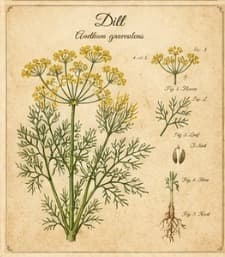
Dill
Anethum graveolens
A feathery, tangy kitchen herb often paired with fish and pickles. Its seeds are traditionally used for gas and upset stomach.
What is Dill?
- Plant family
- Apiaceae, the carrot and parsley family
- Parts used
- The dried ripe seeds (botanically small fruits, called "Fructus Anethi" in herbal references) and the fresh or dried leaves ("dill weed")
- Where it grows
- Originally from southern Europe; now grown around the world
- Genus
- Anethum
- Species
- graveolens
Also called
Garden Dill, Aneth, Sowa
Older scientific names
Pastinaca anethum Spreng., Peucedanum graveolens Benth. & Hook., Selinum anethum Roth
Traditionally used for
- Pickling
- Fish dishes
- Digestive tea
Traditionally described as
- May relieve gas
- May ease mild cramps
Traditions that use it
European Folk Medicine
Dill comes from southern Europe and has a long history of folk use there. Egyptian physicians used it about 5,000 years ago, and traces have been found in Roman ruins in Britain. Dill is the classic ingredient in gripe water, a traditional European remedy given to babies for colic and gas.
Ayurveda
In Ayurvedic medicine, where dill is known as "sowa", it is traditionally used to relieve gas, settle the stomach and increase urination. Dill seed (Fructus Anethi) is included in the Ayurvedic Pharmacopoeia of India.
Technical detail: carminative, stomachic, diuretic.
Natural compounds
Safety
Who should avoid it
Dill seed extracts have traditionally been used to prevent pregnancy and to bring on labor.[1]
Side effects
One person with hay fever had an allergic reaction to dill seed, including an itchy mouth, a swollen tongue and throat, hives, vomiting and diarrhea.[1]
In the 2-month trial for high blood fats, people taking dill tablets (six a day) reported no side effects. By comparison, 21.4% of people taking gemfibrozil reported digestive problems.[2]
Pregnancy
In animal studies, dill seed extracts may cause birth defects. Using dill seed as a medicine during pregnancy is not recommended.[1]
Technical detail: possible teratogenic effects.
Breastfeeding
Using dill seed as a medicine while breastfeeding is not recommended. The WHO applies the same caution as for pregnancy, because of its traditional use to prevent pregnancy and bring on labor, and possible birth defects seen in animals.[1]
Toxicity testing
Lab tests on alcohol-based dill seed extracts found no DNA damage. However, dill seed essential oil damaged human white blood cells and their chromosomes in the lab, though it caused no DNA damage in a fruit-fly test. In 1976, a national regulator classed dill seed as "generally regarded as safe" (GRAS) for use as a food flavoring.[1]
Technical detail: not mutagenic in the Salmonella/microsome (Ames) assay; essential oil was cytotoxic to human lymphocytes in vitro and produced chromosome aberrations and sister chromatid exchange; inactive in an in vivo Drosophila melanogaster genotoxicity assay.
How much to use
Typical daily amount referenced by the WHO: 3 g of dried dill seed, or 0.1–0.3 g of essential oil, or an equivalent amount of another preparation.[1]
What does the research say?
Traditional use
These are traditional uses, not proven treatments.
Dill has been used for about 5,000 years. Ancient Egyptian physicians used it, and traces have been found in Roman ruins in Britain. In Ayurvedic medicine, the seed and leaf are used to relieve gas, settle the stomach and increase urination. Dill is a traditional ingredient in gripe water, given for colic in babies and gas in young children.[3]
The World Health Organization's profile of dill seed lists these traditional uses:
- Documented in official herbal references: indigestion, stomach inflammation (gastritis), gas and stomach ache.
- In wider traditional medicine: to boost sex drive, relieve pain, lower fever, increase urination, bring on periods, increase breast milk and stimulate appetite; and for diarrhea, asthma, nerve pain, painful urination, period pain, gallbladder disease, trouble sleeping, hiatus hernia and kidney stones.
The WHO states that none of these uses is supported by clinical data (studies in people).[1]
Technical detail: WHO terms: dyspepsia, gastritis, flatulence; aphrodisiac, analgesic, antipyretic, diuretic, emmenagogue, galactagogue; neuralgia, dysuria, dysmenorrhoea.
Laboratory & animal research
Lab and animal results show what might be worth studying in people. They don't show that the herb has these effects in humans.
A research review reports that, in lab and animal testing, dill acted against several kinds of bacteria, showed antioxidant activity from natural plant compounds, relaxed gut muscle, and protected the stomach lining against acid- and alcohol-induced damage and ulcers. These are lab and animal findings, not established effects in people.[3]
Technical detail: antioxidant flavonoids include quercetin and isorhamnetin; mucosal-protective, antisecretory and anti-ulcer activity against HCl- and ethanol-induced lesions.
The World Health Organization summarizes these lab and animal findings:
- In lab tests, a dill seed extract relaxed gut muscle, and the essential oil reduced gut contractions and helped break up gas bubbles. This fits dill's traditional use for cramps and gas.
- Applied to the skin of mice, a seed extract reduced inflammation by 60%.
- In mice, a water-based seed extract and the essential oil reduced pain about as well as aspirin.
- Given by injection to dogs and cats, extracts increased urination and lowered blood pressure.
- One dose of extract lowered blood sugar by 30% in fasting rats.
These results come from animals and lab tests. They are not established effects in people.[1]
Technical detail: 50% ethanol extract inhibited acetylcholine- and histamine-induced contractions of guinea-pig ileum; essential oil reduced rabbit intestine contractions with carminative, antifoaming activity; TPA-induced mouse ear inflammation; hot-plate and acetic-acid writhing tests, comparable to acetylsalicylic acid; intravenous administration in dogs and cats; single intragastric dose in fasted rats.
Research in people
In one trial, 91 people with high blood fats (cholesterol or triglycerides) took either dill tablets or the cholesterol drug gemfibrozil for 2 months. Among those who completed it, dill lowered total cholesterol more (18% vs. about 9%), while gemfibrozil lowered triglycerides more (about 33% vs. 7%) and raised "good" HDL cholesterol slightly (dill didn't change HDL). The authors said dill may help people with high cholesterol and triglycerides, but more research is needed.[2]
Technical detail: randomized, single-blind; gemfibrozil 900 mg/day vs. six dill tablets daily; 42 completed the gemfibrozil arm and 35 the dill arm; total cholesterol −18% vs. −9.41%; triglycerides −32.7% vs. −7.38%; HDL +3.91% with gemfibrozil.
In short
Generally safe in cooking amounts.
Sources
- [1] WHO monographs on selected medicinal plants, Volume 3 — "Fructus Anethi" monograph (pp. 33-41) — World Health Organization (WHO)Government health agency
- [2] Anethum graveolens and hyperlipidemia: A randomized clinical trial — Journal of Research in Medical SciencesReview or clinical trial
- [3] Anethum graveolens: An Indian traditional medicinal herb and spice — Pharmacognosy Reviews · DOI: 10.4103/0973-7847.70915Peer-reviewed study
This information is educational and traditional in nature, and is not a substitute for professional medical advice.