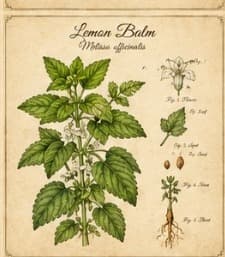
Lemon Balm
Melissa officinalis
A lemon-scented relative of mint, traditionally used to ease stress and help with sleep.
Lemon Balm may interact with some medicines. If you take any medicine, read Interactions with medicines below and talk to your doctor or pharmacist before using it.
What is Lemon Balm?
- Plant family
- Lamiaceae, the mint family
- Parts used
- The leaves and other above-ground parts
- Where it grows
- Southern Europe, the Mediterranean region, and Central Asia and Iran; now grows wild around the world
- Genus
- Melissa
- Species
- officinalis
Also called
Bee Balm, Honey Balm
Older scientific names
Faucibarba officinalis (L.) Dulac, Mutelia officinalis (L.) Gren. ex Mutel, Thymus melissa E.H.L.Krause
Traditionally used for
- Calming tea
- Stress
- Cold sores (on the skin)
Traditionally described as
- Mildly relaxing
- May fight viruses
- May relieve gas
Health topics
Where Lemon Balm appears in symptom search, and why. Being listed doesn't mean it's a proven treatment.
- Anxiety
A review of trials found it reduced anxiety in several age groups.
- Memory and Thinking
Results for memory and thinking have been mixed.
- Sleep Problems (Insomnia)
Traditionally used to help sleep. In one study, sleep improved after 6 weeks in adults with moderate sleep problems.
- Stress
Traditionally used to help people relax.
Traditions that use it
Western Herbalism
Lemon balm has been written about for about 2,000 years. It appears in the Historia Plantarum (around 300 BC) and in Dioscorides' De Materia Medica (around 50–80 AD). It is still listed in the British Herbal Pharmacopoeia and the European Pharmacopoeia for anxiety, sleep, memory and thinking, viral infections and digestion.
Natural compounds
Safety
Interactions with medicines
Reported as unsafe to combine with sedatives (medicines that make you sleepy).[1]
Who should avoid it
Reported as unsafe for children and for people with thyroid conditions.[1]
Side effects
Across the trials reviewed, lemon balm appeared safe and well tolerated, including in more vulnerable groups such as babies and hospital patients. There were no serious side effects at doses up to 5000 mg a day, and very few people stopped because of side effects.[2]
In healthy adults, no side effects have generally been reported when lemon balm is used on the skin or by mouth at recommended doses for up to 30 days. In the United States, lemon balm is classed as "Generally Recognized as Safe" (GRAS), with a maximum level of 0.5% in baked goods.[1]
Pregnancy
Reported as unsafe to use during pregnancy.[1]
Breastfeeding
Reported as unsafe to use while breastfeeding.[1]
Toxicity testing
Animal studies found no harmful effects at doses up to 2000 mg per kg of body weight. However, in lab tests the essential oil damaged nerve cells at a concentration of 0.1 mg/mL.[3]
What does the research say?
Traditional use
These are traditional uses, not proven treatments.
In Iranian folk medicine, lemon balm leaves are used to relieve gas, ease cramps, calm, relieve pain, restore strength and increase urination, including for ongoing digestive problems with no clear physical cause.[1]
Technical detail: carminative, antispasmodic, sedative, analgesic, tonic, diuretic; functional gastrointestinal disorders.
Lemon balm has been written about for about 2,000 years, appearing in the Historia Plantarum (around 300 BC) and in Dioscorides' De Materia Medica (around 50–80 AD). Herbalists have traditionally used it to ease digestive complaints, help people relax and sleep, lift mood, soothe irritated skin and help wounds heal. It is still listed in the British, European and Iranian herbal pharmacopoeias (official herbal reference books).[2]
Laboratory & animal research
Lab and animal results show what might be worth studying in people. They don't show that the herb has these effects in humans.
Lab and animal studies suggest lemon balm's calming effect may come from raising levels of GABA, a brain chemical that quiets nerve activity, and from compounds in the oil acting on GABA receptors. Water-based extracts lowered a stress hormone in animals. In lab tests, lemon balm extracts and oil stopped the cold-sore virus (herpes simplex type 1) and flu A virus. Animal safety tests found no harm at high doses, but in the lab the essential oil damaged nerve cells at a certain concentration.[3]
Technical detail: inhibition of GABA transaminase; trans-ocimene binding to GABA-A receptors; lowered plasma corticosterone; no adverse effects up to 2000 mg/kg; neurotoxic effect in primary cell cultures at 0.1 mg/mL.
Research in people
A review of trials in people found:
- Anxiety: lemon balm reduced anxiety in several age groups, including teenagers with PMS (1200 mg a day over three menstrual cycles), young adults (who felt calmer after a single dose) and older adults with heart conditions.
- Memory and thinking: results were mixed; one study found better attention accuracy with a 600 mg dose.
- Sleep: sleep improved after 6 weeks of 80 mg a day in middle-aged adults with moderate sleep problems.
- Mood: depression scores improved with 2000 mg a day for 8 weeks, and with 1500 mg for 10 days in women who had recently given birth.
Doses up to 5000 mg a day were well tolerated, with no serious side effects in the trials reviewed.[2]
In a trial of 60 people with repeated cold sores, a 1% lemon balm gel used three times a day for 7 days was compared with 5% acyclovir cream, a standard antiviral treatment. The lemon balm gel relieved pain better on days 2 and 4 and reduced redness more on day 4. But cold sore size and healing time were the same with both. The authors concluded lemon balm gel was not more effective than acyclovir overall, despite better pain relief.[4]
Technical detail: double-blind randomized trial; herpes labialis; Melissa officinalis gel.
In short
May interact with thyroid medicines.
Sources
- [1] Melissa officinalis L: A Review Study With an Antioxidant Prospective — Journal of Evidence-Based Complementary & Alternative Medicine · DOI: 10.1177/2156587216663433Peer-reviewed study
- [2] Clinical Efficacy and Tolerability of Lemon Balm (Melissa officinalis L.) in Psychological Well-Being: A Review — Nutrients · DOI: 10.3390/nu16203545Peer-reviewed study
- [3] Bioactive Compounds, Medicinal Benefits, and Contemporary Extraction Methods for Lemon Balm (Melissa officinalis) — Food Science & Nutrition · DOI: 10.1002/fsn3.70864Peer-reviewed study
- [4] Therapeutic Effect of Melissa Gel and 5% Acyclovir Cream in Recurrent Herpes labialis: A Double-Blind Randomized Clinical Trial — Jundishapur Journal of Natural Pharmaceutical Products · DOI: 10.17795/jjnpp-26160Review or clinical trial
This information is educational and traditional in nature, and is not a substitute for professional medical advice.