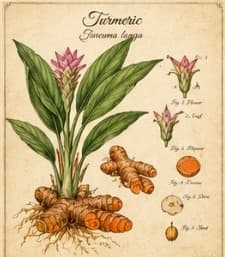
Turmeric
Curcuma longa
A golden root used in curries, known for its natural compound curcumin and traditionally used for inflammation.
Turmeric may interact with some medicines. If you take any medicine, read Interactions with medicines below and talk to your doctor or pharmacist before using it.
What is Turmeric?
- Plant family
- Zingiberaceae, the ginger family
- Parts used
- The rhizome, the underground stem usually called turmeric root
- Where it grows
- Southwestern India. Turmeric is known only as a cultivated plant and isn't found growing in the wild.
- Genus
- Curcuma
- Species
- longa
Also called
Indian Saffron
Regional names
Haldi
Traditional names
Haridra, Jiang Huang (姜黄)
Older scientific names
Curcuma domestica Valeton, Amomum curcuma Jacq.
Traditionally used for
- Curries
- Golden milk
- Joints
- Cancer research (not enough evidence yet)
Traditionally described as
- May help reduce inflammation
- Antioxidant
Health topics
Where Turmeric appears in symptom search, and why. Being listed doesn't mean it's a proven treatment.
- Liver Disease (Hepatitis, Cirrhosis)
Traditionally used in Chinese, Indian, Islamic and Thai medicine for liver disease.
- Liver Safety Warnings
Liver injury has been reported with turmeric, especially curcumin products made to be absorbed better.
- Menstrual Discomfort
A 2025 review found curcumin reduced period pain in several trials; more research is needed.
- PMS (Premenstrual Syndrome)
A 2025 review found 6 of 10 trials reported fewer PMS symptoms with curcumin; more research is needed.
Traditions that use it
Ayurveda
Known as Haridra in Sanskrit and Haldi in Hindi. Traditionally used for digestive problems, arthritis, skin diseases and inflammation, and valued for easing inflammation and pain.
Traditional Chinese Medicine
Known as Jiang Huang (姜黄). Traditionally used to "promote blood circulation", "resolve blood stasis" (poor blood flow, in Chinese medicine terms) and relieve pain, and prescribed for conditions involving "stagnation" and swelling.
Natural compounds
Safety
Interactions with medicines
If you take any medicine, talk with your health care provider before using turmeric or curcumin products, because some herbs and medicines interact in harmful ways.[1]
Side effects
Regular turmeric or curcumin taken by mouth (not specially made to be absorbed better) is likely safe in recommended amounts for up to 2–3 months. By mouth, it can cause nausea and vomiting, acid reflux, stomach upset, diarrhea or constipation. On the skin, curcumin can cause hives or itching.[1]
Few side effects have been reported in cancer studies; stomach and gut problems are the most common. In one small study of people taking curcumin with a cancer drug, 1 in 3 stopped the curcumin because of constant bloating. The amount of curcumin varies between products, and batches and brands may differ.[2]
Pregnancy
Turmeric supplements may be unsafe during pregnancy.[1]
Breastfeeding
Little is known about whether turmeric is safe while breastfeeding in amounts larger than those normally found in food.[1]
Toxicity testing
Curcumin products specially made to be absorbed better ("highly bioavailable" formulas) may harm the liver. Liver damage has been reported in some people who took them. Warning signs include tiredness, nausea, poor appetite, dark urine and yellowing of the skin or eyes (jaundice).[1]
A US network that tracks drug-related liver damage identified 10 cases of liver injury linked to turmeric between 2011 and 2022 (6 of them since 2017). Five people were hospitalized, and one died of sudden liver failure. The damage appeared 1 to 4 months after starting turmeric and was strongly linked to a particular inherited gene variant. Three of the 7 products tested also contained piperine (from black pepper), which is added to help the body absorb curcumin. The authors concluded that turmeric-related liver injury appears to be increasing in the United States.[3]
Technical detail: Drug-Induced Liver Injury Network (DILIN) case series; hepatocellular injury in 9 of 10 cases; HLA-B*35:01 allele.
What does the research say?
Traditional use
These are traditional uses, not proven treatments.
Turmeric has historically been used in Chinese, Indian (including Ayurvedic), Islamic and Thai traditional medicine for indigestion, the common cold, skin infections, arthritis, stomach pain and liver disease. It has also been used in some Indian religious ceremonies.[1]
In Ayurvedic practice, turmeric (Haridra) has been used for digestive problems, arthritis, skin diseases and inflammation. In Traditional Chinese Medicine, turmeric (Jiang Huang) has been used to "promote blood circulation", "resolve blood stasis" and relieve pain, often for conditions involving "stagnation" and swelling.[4]
Laboratory & animal research
Lab and animal results show what might be worth studying in people. They don't show that the herb has these effects in humans.
In lab tests on cartilage cells and tissue, curcumin (turmeric's best-known natural compound) reduced chemical signals that drive inflammation, slowed the enzymes that break down cartilage, and helped protect cartilage cells from damage.[5]
Technical detail: inhibits NF-κB activation; reduces COX-2, IL-6, IL-8 and PGE2; suppresses matrix metalloproteinase synthesis; counteracts IL-1β cytotoxicity in chondrocytes; stimulates anti-apoptotic factors; in vitro on chondrocytes and cartilage explants.
In lab research, curcumin switched on the body's own antioxidant defenses and affected genetic signals linked to cancer.[4]
Technical detail: activates Nrf2, inducing heme oxygenase-1 (HO-1), superoxide dismutase (SOD), catalase and glutathione peroxidase (GPx); modulates microRNAs and long noncoding RNAs in cancer-related signaling pathways.
Research in people
Several research reviews show early positive evidence that turmeric or curcumin taken by mouth may help knee arthritis (pain, stiffness, strength and movement), but better-quality studies are needed. It's unclear whether curcumin ointment on the skin helps knee pain. Early research suggests turmeric or curcumin by mouth might improve some measures of fatty liver disease not caused by alcohol (NAFLD), and, by mouth or as a mouthwash, mouth sores caused by cancer treatment. Overall, there isn't enough evidence to say for certain that turmeric or curcumin helps with any health condition.[1]
Technical detail: oral mucositis.
A review that combined 15 trials with 1,670 people found curcumin-type compounds reduced knee arthritis pain more than placebo, by an amount large enough to matter to patients, and improved scores for pain, stiffness and function. Side effects were no more common than with placebo, and less common than with standard painkillers such as ibuprofen (NSAIDs). The authors concluded these compounds help pain and function in the short term, but advised cautious use until better-quality evidence is available.[6]
Technical detail: randomized controlled trials of curcuminoids; VAS pain WMD −1.77 (95% CI −2.44 to −1.09); WOMAC total WMD −10.47 (95% CI −15.65 to −5.3).
A 2025 review of 10 trials of curcumin (turmeric's best-known compound) for PMS and period pain found that 6 reported significantly fewer symptoms. The authors say curcumin shows promise, but more research is needed to find the right dose and length of use, and to check possible effects on iron levels.[7]
Technical detail: randomized controlled trials using the Premenstrual Syndrome Screening Tool (PSST) and visual analog scales; associations with inflammatory markers and vitamin D status.
The US National Cancer Institute says there isn't enough evidence to know whether curcumin products can prevent or treat cancer. Early, small trials have found:
- Possible early signs of bowel polyps: fewer in people taking curcumin, but not clearly different from people who didn't take it
- White patches inside the mouth (oral leukoplakia): in a trial of 223 people, a curcumin product improved the patches more than a dummy pill, and the improvement lasted at 6 months
- Fatty liver disease not caused by alcohol: in a trial of 102 people, curcumin lowered weight measures and improved liver scans and blood tests
- Alongside cancer treatment: mixed results in adrenal gland, breast, prostate, pancreatic and bowel cancers
- Side effects of cancer treatment: a curcumin mouthwash or capsule delayed and eased mouth sores, and a small study found a turmeric cream reduced skin damage from radiation
The US Food and Drug Administration hasn't approved curcumin to treat cancer or any other condition.[2]
Technical detail: aberrant crypt foci; adrenocortical carcinoma; oral mucositis; radiation dermatitis; NAFLD (body mass index and waist circumference fell). A pooled analysis of 4 randomized controlled trials (228 people) found similar liver results.
In a 2008 trial, 25 people with advanced pancreatic cancer took 8 g of curcumin by mouth every day. Of the 21 who could be assessed, 2 showed some response: one person's cancer stayed stable for more than 18 months, and another had a brief but large tumour shrinkage. No side effects were seen, but very little curcumin reached the blood, suggesting it's poorly absorbed.[8]
Technical detail: phase II; one patient had a 73% tumour regression; plasma curcumin peaked at 22–41 ng/mL.
In a 2019 trial, 28 people with bowel cancer that had spread were randomly given standard chemotherapy (FOLFOX) alone or with 2 g of curcumin a day. Adding curcumin was safe, with similar side effects in both groups. People taking curcumin lived longer on average (502 days versus 200), and the cancer took longer to grow, though that difference wasn't clear. Quality of life and nerve damage didn't differ. This was a small, early-stage trial.[9]
Technical detail: randomized open-label phase IIa; overall survival HR 0.34 (95% CI 0.14 to 0.82); progression-free survival HR 0.57 (95% CI 0.24 to 1.36).
In short
May interact with blood thinners; high doses can upset the stomach.
Sources
- [1] Turmeric: Usefulness and Safety — National Center for Complementary and Integrative Health (NIH)Government health agency
- [2] Curcumin (Curcuma, Turmeric) and Cancer (PDQ®)–Patient Version — National Cancer Institute (NIH)Government health agency
- [3] Liver Injury Associated with Turmeric—A Growing Problem: Ten Cases from the Drug-Induced Liver Injury Network [DILIN] — The American Journal of Medicine · DOI: 10.1016/j.amjmed.2022.09.026Peer-reviewed study
- [4] Turmeric: A Comprehensive Review of Its Botany, Traditional Uses, Phytochemistry, and Mechanisms as a Functional Food — Nutrients · DOI: 10.3390/nu18081197Peer-reviewed study
- [5] Curcumin: a new paradigm and therapeutic opportunity for the treatment of osteoarthritis — SpringerPlus · DOI: 10.1186/2193-1801-2-56Peer-reviewed study
- [6] Efficacy and safety of curcuminoids alone in alleviating pain and dysfunction for knee osteoarthritis: a systematic review and meta-analysis of randomized controlled trials — BMC Complementary Medicine and Therapies · DOI: 10.1186/s12906-022-03740-9Review or clinical trial
- [7] Curcumin, a bioactive supplement for premenstrual syndrome and dysmenorrhea: A systematic review of randomised clinical trials — European Journal of Obstetrics & Gynecology and Reproductive Biology: X · DOI: 10.1016/j.eurox.2025.100432Review or clinical trial
- [8] Phase II trial of curcumin in patients with advanced pancreatic cancer — Clinical Cancer Research · DOI: 10.1158/1078-0432.CCR-08-0024Peer-reviewed study
- [9] Curcumin Combined with FOLFOX Chemotherapy Is Safe and Tolerable in Patients with Metastatic Colorectal Cancer in a Randomized Phase IIa Trial — The Journal of Nutrition · DOI: 10.1093/jn/nxz029Peer-reviewed study
This information is educational and traditional in nature, and is not a substitute for professional medical advice.