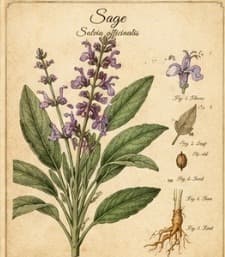
Sage
Salvia officinalis
A silvery-leaved kitchen herb with a savory, slightly peppery flavor, traditionally used for sore throats and indigestion.
What is Sage?
- Plant family
- Lamiaceae, the mint family
- Parts used
- The leaves
- Genus
- Salvia
- Species
- officinalis
Also called
Garden Sage, Common Sage, Kitchen Sage
Traditionally used for
- Stuffing and sausages
- Sore throat gargle
- Memory
Traditionally described as
- Antioxidant
- May fight germs
- Astringent (tightens tissues)
Health topics
Where Sage appears in symptom search, and why. Being listed doesn't mean it's a proven treatment.
- Menopause Symptoms
Early studies suggest common sage may reduce how often menopausal women have hot flashes.
- Sore Throat
Long used in European folk medicine for inflammation of the mouth and throat.
Traditions that use it
Mediterranean Folk Medicine
In European folk medicine, sage leaf has long been used for indigestion, heavy sweating, memory and thinking complaints, and inflammation of the mouth, throat and skin. Germany's Commission E approved it for indigestion and heavy sweating. In parts of Asia and Latin America, folk use has also included seizures, ulcers, gout, rheumatism, dizziness, tremor, paralysis, diarrhea and high blood sugar.
Technical detail: dyspepsia, excessive perspiration, hyperglycemia.
Natural compounds
Safety
Interactions with medicines
No interactions between sage leaf and medicines had been described in the research at the time of this assessment.[1]
Who should avoid it
Sage medicines are not recommended for anyone under 18, because there isn't enough data to show they are safe and effective.[1]
Allergies
Don't use sage leaf if you are allergic to it or to any of its components.[1]
Pregnancy
Sage has not been shown to be safe during pregnancy, so using it as a medicine while pregnant is not recommended.[1]
Breastfeeding
Sage has not been shown to be safe while breastfeeding, so using it as a medicine while breastfeeding is not recommended.[1]
Toxicity testing
No overdose from sage leaf itself has been reported. But taking sage oil in an amount equal to more than 15 g of sage leaf is reported to cause a feeling of heat, a racing heart, dizziness and seizures.[1]
Technical detail: tachycardia, vertigo, epileptiform convulsions.
Common sage (Salvia officinalis) contains thujone, which can be toxic in large amounts and has caused seizures in animals. Sage is likely safe in normal food amounts, and larger amounts have been used safely for up to 8 weeks in research studies.[2]
How much to use
Sage contains thujone, a compound reported to harm the nerves. Products must state how much thujone they contain, and daily intake must stay below 6.0 mg. Types of sage low in thujone should be preferred. Sage has not been properly tested for DNA damage, cancer risk or harm to reproduction.[1]
Technical detail: neurotoxic; low-thujone chemotypes; genotoxicity, carcinogenicity and reproductive-toxicity testing.
What does the research say?
Traditional use
These are traditional uses, not proven treatments.
Sage leaf has long been used in European folk medicine for indigestion, heavy sweating, and inflammation of the mouth, throat and skin. These uses are reflected in the European Medicines Agency's traditional-use profile, and Germany's Commission E approved sage for indigestion and heavy sweating. Elsewhere, traditional uses have also included seizures, ulcers, gout, rheumatism, dizziness, tremor, paralysis, diarrhea and high blood sugar.[3]
Technical detail: dyspepsia, excessive perspiration, hyperglycemia.
Laboratory & animal research
Lab and animal results show what might be worth studying in people. They don't show that the herb has these effects in humans.
Lab and animal studies of sage and its natural compounds report:
- Reduced inflammation and pain in mice.
- Antioxidant activity; in diabetic rats, rosmarinic acid boosted the body's own protective enzymes in the pancreas.
- Slowed growth or death of several kinds of human cancer cells in the lab, and effects on tumors in mice.
- Lower blood sugar in normal and diabetic animals.
- Action on the same brain receptors as anti-anxiety medicines (benzodiazepines), and fewer seizures in animals.
These are lab and animal findings, not established effects in people.[3]
Technical detail: anti-inflammatory and analgesic effects from flavonoid extracts (mouse carrageenan model), manool, carnosol and ursolic acid; carnosol radical-scavenging comparable to alpha-tocopherol; rosmarinic acid increased pancreatic catalase, glutathione peroxidase and superoxide dismutase in streptozotocin-induced diabetic rats; pro-apoptotic and growth-inhibitory effects of extracts, rosmarinic acid, caryophyllene, alpha-humulene, manool and ursolic acid; hypoglycemic effects via inhibition of hepatocyte gluconeogenesis and PPAR-gamma-mediated reduction of insulin resistance; benzodiazepine receptor activation and inhibition of pentylenetetrazole-induced seizures.
Research in people
There is only a small amount of research on sage in people:
- Early studies suggest common sage may reduce how often menopausal women have hot flashes.
- A few studies suggest sage, Spanish sage or combinations may improve memory and thinking scores in healthy people, but the evidence is limited. Very little research has looked at sage for Alzheimer's disease.
- Some studies suggest possible benefits for cholesterol and other blood fats, but there isn't enough evidence on blood sugar.
- Sage has also been studied for sore throat.
A review of trials on sage and memory found:
- In healthy adults, a single dose of dried sage leaf or sage oil improved mood and performance on thinking tasks during testing, and a 333 mg dose improved memory.
- In a 16-week trial in people with mild to moderate Alzheimer's disease, 60 drops a day of a sage extract improved thinking and memory scores compared with placebo.
The reviewers noted the studies had weaknesses, including different, non-standardized preparations, so firm conclusions about how well sage works can't be drawn.[4]
Technical detail: single doses of 300–1,332 mg; 333 mg enhanced secondary memory across timepoints; Alzheimer's trial used a 1:1 Salvia officinalis extract in 45% alcohol, randomized, measured on the Clinical Dementia Rating and Alzheimer's Disease Assessment Scale.
In short
Avoid large medicinal doses during pregnancy.
Sources
- [1] European Union herbal monograph on Salvia officinalis L., folium — European Medicines Agency (EMA), Committee on Herbal Medicinal Products (HMPC)Government health agency
- [2] Sage: Usefulness and Safety — National Center for Complementary and Integrative Health (NIH)Government health agency
- [3] Pharmacological properties of Salvia officinalis and its components — Journal of Traditional and Complementary Medicine · DOI: 10.1016/j.jtcme.2016.12.014Peer-reviewed study
- [4] Systematic Review of Clinical Trials Assessing Pharmacological Properties of Salvia Species on Memory, Cognitive Impairment and Alzheimer's Disease — CNS Neuroscience & Therapeutics · DOI: 10.1111/cns.12270Review or clinical trial
This information is educational and traditional in nature, and is not a substitute for professional medical advice.