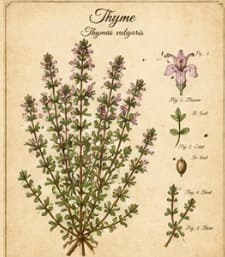
Thyme
Thymus vulgaris
A small-leaved, earthy herb used widely in savory cooking and traditionally in cough remedies.
What is Thyme?
- Plant family
- Lamiaceae, the mint family
- Parts used
- The leaves and flowering tops, dried or fresh
- Genus
- Thymus
- Species
- vulgaris
Also called
Common Thyme, Garden Thyme, German Thyme
Traditionally used for
- Soups and stews
- Coughs
- Germ-fighting gargle
- Mouth sores from cancer radiation (thyme honey)
Traditionally described as
- May fight germs
- May loosen mucus
- May ease cramps
Health topics
Where Thyme appears in symptom search, and why. Being listed doesn't mean it's a proven treatment.
- Chest Congestion and Bronchitis
In a trial of 361 adults with acute bronchitis, thyme combined with primrose root reduced coughing fits more than placebo.
- Cough
Traditionally used for bronchitis and whooping cough. In a trial, thyme with primrose root reduced coughing fits in acute bronchitis.
Traditions that use it
Mediterranean Folk Medicine
Native to the Mediterranean region. The ancient Egyptians, Greeks and Romans used thyme for embalming, purification and disinfection. It has a long history of folk use across the Mediterranean and Europe for breathing problems, upset stomach, intestinal worms and minor wounds.
Natural compounds
Safety
Interactions with medicines
No interactions between thyme medicines and other medicines have been reported.[1]
Who should avoid it
Don't use thyme medicines if you are allergic to thyme or to other plants in the mint family (Lamiaceae).[1]
Technical detail: Lamiaceae is also called Labiatae.
Side effects
Stomach upset can happen; how often is not known. If you get any other side effects, see a doctor or qualified health professional.[1]
Pregnancy
Thyme has not been shown to be safe during pregnancy, so using it as a medicine while pregnant is not recommended. There is no data on fertility.[1]
Breastfeeding
Thyme has not been shown to be safe while breastfeeding, so using it as a medicine while breastfeeding is not recommended.[1]
How much to use
Most thyme medicines taken by mouth (tinctures, extracts, and the chopped herb as tea) are not recommended for children under 12, because there isn't enough data. For some liquid extracts, use in children under 4 is not recommended and you should get medical advice. See a doctor or qualified health professional if symptoms last more than a week, or if you get short of breath, have a fever, or cough up pus-like mucus.[1]
Technical detail: dyspnoea, purulent sputum.
What does the research say?
Traditional use
These are traditional uses, not proven treatments.
Thyme's traditional use goes back to ancient Egypt, Greece and Rome, where it was used to heal wounds and disinfect (including burning bundles of it for purification), and for skin problems during plague outbreaks. Traditionally, it has been used for:
- Breathing problems, including bronchitis, asthma, whooping cough and sore throat
- Digestive complaints and intestinal worms
- Rheumatic aches, applied to the skin or used as aromatherapy
- Preserving food, because it helps fight germs
Technical detail: pharyngitis; ethnomedicinal use.
Laboratory & animal research
Lab and animal results show what might be worth studying in people. They don't show that the herb has these effects in humans.
In lab tests, thyme essential oil (rich in thymol) showed strong antioxidant activity and slowed the growth of many bacteria and yeasts, including ones that form protective films (biofilms). It worked best against Bacillus subtilis, Enterococcus faecalis and Staphylococcus aureus. Thyme oil vapor also stopped mold on bread and bacteria on stored carrots, and disrupted the biofilms of Salmonella and Pseudomonas bacteria. These are lab and food-testing findings, not established effects in people.[3]
Technical detail: Thymus vulgaris thymol chemotype: thymol 48.1%, p-cymene 11.7%, 1,8-cineole 6.7%, gamma-terpinene 6.1%, carvacrol 5.5%. DPPH assay 85.2% inhibition; inhibition zones 9.89–22.44 mm against gram-positive and gram-negative bacteria and yeasts; vapor-phase inhibition of Penicillium and Serratia marcescens; MALDI-TOF showed disrupted biofilm protein profiles in Salmonella Enteritidis and Pseudomonas fluorescens.
Research in people
In a trial of 361 adults with acute bronchitis and a wet (mucus-producing) cough, people took either tablets combining thyme and primrose root, or a placebo, three times a day for 11 days. On days 7–9, coughing fits dropped by about 67% with the thyme combination compared with about 51% with placebo. The thyme group reached half as many coughing fits about two days sooner, and more of them improved on a bronchitis severity score by the end (about 93% vs. 76%). Note that this tested thyme combined with primrose, not thyme alone.[4]
Technical detail: prospective, double-blind, placebo-controlled, multicentre phase IV trial; 183 active vs. 178 placebo; 67.1% vs. 51.3%, p < 0.0001; Bronchitis Severity Score responder rate 92.9% vs. 75.8%, p < 0.0001.
In a 2018 trial, 72 people having radiation for head and neck cancer rinsed their mouths with either thyme honey or salt water. Those using thyme honey had less severe mouth sores and better quality of life. This tested honey made by bees from thyme flowers, not thyme itself.[5]
Technical detail: radiation-induced oral mucositis graded by RTOG criteria; NCT01465308.
In short
The essential oil is strong; use it diluted.
Sources
- [1] Community herbal monograph on Thymus vulgaris L. and Thymus zygis L., herba — European Medicines Agency (EMA), Committee on Herbal Medicinal Products (HMPC)Government health agency
- [2] A systematic review on ethnopharmacology, phytochemistry and pharmacological aspects of Thymus vulgaris Linn. — Heliyon · DOI: 10.1016/j.heliyon.2021.e07054Peer-reviewed study
- [3] Thymus vulgaris Essential Oil and Its Biological Activity — Plants (Basel) · DOI: 10.3390/plants10091959Peer-reviewed study
- [4] Evaluation of efficacy and tolerability of a fixed combination of dry extracts of thyme herb and primrose root in adults suffering from acute bronchitis with productive cough. A prospective, double-blind, placebo-controlled multicentre clinical trial — Arzneimittelforschung · DOI: 10.1055/s-0031-1296656Review or clinical trial
- [5] The effect of the use of thyme honey in minimizing radiation - induced oral mucositis in head and neck cancer patients: A randomized controlled trial — European Journal of Oncology Nursing · DOI: 10.1016/j.ejon.2018.04.003Peer-reviewed study
This information is educational and traditional in nature, and is not a substitute for professional medical advice.