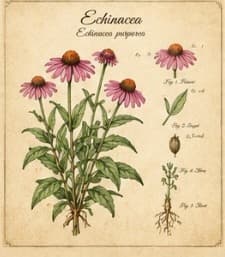
Echinacea
Echinacea purpurea
A purple coneflower traditionally used to support the immune system, especially for colds.
Echinacea may interact with some medicines. If you take any medicine, read Interactions with medicines below and talk to your doctor or pharmacist before using it.
What is Echinacea?
- Plant family
- Asteraceae, the daisy family
- Parts used
- The root and the above-ground parts (leaves, flowers and stems)
- Where it grows
- Central and eastern United States
- Genus
- Echinacea
- Species
- purpurea
Also called
Purple Coneflower, Eastern Purple Coneflower
Older scientific names
Rudbeckia purpurea L., Brauneria purpurea (L.) Britton
Traditionally used for
- Colds and flu
- Tinctures
- Teas
Traditionally described as
- May stimulate the immune system
- May help reduce inflammation
Health topics
Where Echinacea appears in symptom search, and why. Being listed doesn't mean it's a proven treatment.
- Colds and Nasal Congestion
It may slightly lower the chance of catching a cold, but a Cochrane review found no meaningful benefit for treating colds.
Traditions that use it
Native American Ethnobotany
Native American peoples used echinacea to relieve toothache, calm coughs and increase saliva, using preparations rich in natural compounds called alkamides. This use carried over into Eclectic medicine, a branch of American medicine in the early 1900s that relied heavily on plants.
Technical detail: antitussive, sialagogue.
Natural compounds
Safety
Interactions with medicines
It's unclear whether echinacea affects some medicines that are broken down by the liver; studies disagree. There are also theoretical reasons it might interact with medicines that suppress the immune system (immunosuppressants) or with caffeine.[1]
Allergies
Echinacea is closely related to sunflowers, daisies and ragweed. Some people are allergic to echinacea, and reactions can be severe.[1]
Side effects
The most common side effects are digestive, such as stomach pain, nausea and an upset stomach. Studies have reported few side effects overall, but one study in children linked echinacea to more rashes.[1]
Pregnancy
Some solid or liquid extracts of Echinacea purpurea, and some mixtures of E. purpurea and E. angustifolia, are possibly safe for up to 7 days during the first 3 months of pregnancy, but there is little data. Talk to a health care provider before using it while pregnant.[1]
How much to use
Products with extracts of Echinacea purpurea, and some mixtures of E. purpurea and E. angustifolia, are likely safe for most adults for short periods. Whether long-term use is safe is unknown.[1]
What does the research say?
Traditional use
These are traditional uses, not proven treatments.
Historically, Native American peoples used echinacea to relieve toothache, calm coughs and increase saliva. These uses were later taken up by Eclectic doctors in early-1900s America, who relied heavily on plant medicines.[2]
Technical detail: antitussive, sialagogue.
Laboratory & animal research
Lab and animal results show what might be worth studying in people. They don't show that the herb has these effects in humans.
In lab and animal studies, natural compounds in echinacea (Echinacea purpurea) made several types of immune cells more active, including cells that swallow germs and "natural killer" cells, and increased the chemical signals immune cells use to communicate. Some of these compounds also act on the same receptors (CB2) that respond to cannabis compounds.[2]
Technical detail: constituents: alkylamides, caffeic acid derivatives such as chicoric acid, polysaccharides and glycoproteins. Effects: activated phagocytosis and fibroblast stimulation; increased leukocyte motility; enhanced neutrophil, macrophage and natural killer cell activity; increased TNF-alpha, IL-1 and IFN-beta; alkylamides interact with cannabinoid CB2 receptors.
Research in people
A 2014 Cochrane review pooled 24 high-quality trials with 4,631 people. It found that echinacea products have not been shown to help treat colds in a meaningful way. Trials on preventing colds pointed toward a small benefit, but the results weren't statistically significant; one extra analysis suggested it might lower the risk of a cold by 10–20%, which may not matter much in practice. Side effects were no more common than with placebo (a dummy pill).[3]
Technical detail: 24 double-blind randomized controlled trials, 33 comparisons; the 10–20% relative risk reduction came from a post hoc analysis.
Taking echinacea may slightly lower your chances of catching a cold, but it's unclear whether it makes a cold go away faster. Research on whether some types of echinacea boost the immune system is inconclusive.[1]
In short
Not recommended for people with autoimmune conditions without medical advice.
Sources
- [1] Echinacea — National Center for Complementary and Integrative Health (NIH)Government health agency
- [2] Echinacea purpurea (L.) Moench: Biological and Pharmacological Properties. A Review — Plants (Basel) · DOI: 10.3390/plants11091244Peer-reviewed study
- [3] Echinacea for preventing and treating the common cold — Cochrane Database of Systematic Reviews · DOI: 10.1002/14651858.CD000530.pub3Review or clinical trial
This information is educational and traditional in nature, and is not a substitute for professional medical advice.