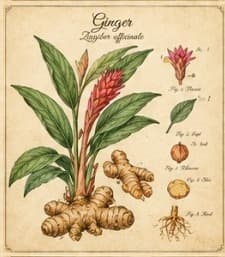
Ginger
Zingiber officinale
A spicy, warming root traditionally used for nausea and inflammation. Research suggests it may help with nausea during pregnancy.
Ginger may interact with some medicines. If you take any medicine, read Interactions with medicines below and talk to your doctor or pharmacist before using it.
What is Ginger?
- Plant family
- Zingiberaceae, the ginger family
- Parts used
- The rhizome, the knobbly underground stem usually called ginger root
- Where it grows
- From the eastern Himalayas to south-central China
- Genus
- Zingiber
- Species
- officinale
Also called
Common Ginger
Traditional names
Sheng Jiang (fresh ginger), Ardraka (fresh rhizome), Shunthi (dried rhizome)
Older scientific names
Amomum zingiber L., Zingiber officinale var. rubrum Theilade
Traditionally used for
- Nausea
- Teas
- Cooking
- Inflammation
Traditionally described as
- May ease nausea
- May help reduce inflammation
- Aids digestion
Health topics
Where Ginger appears in symptom search, and why. Being listed doesn't mean it's a proven treatment.
- High Blood Pressure
A traditional use. Not tested in trials.
Traditions that use it
Ayurveda
Known as Ardraka (fresh ginger) and Shunthi (dried ginger). Used since ancient times for digestion, breathing and circulation.
Traditional Chinese Medicine
Fresh ginger (Sheng Jiang) has been used since ancient times and appears in the Shen Nong Ben Cao Jing, one of the oldest Chinese herbal texts. The Chinese Pharmacopoeia lists it to ease the early stage of colds ("exterior syndrome"), to "disperse cold", and to stop vomiting.
Natural compounds
Safety
Interactions with medicines
High doses of concentrated ginger (powder or tinctures) can raise the risk of bleeding by making blood cells called platelets less sticky. They can also increase stomach acid. This is more likely if you take it with other herbs or medicines that have the same effects.[1]
Technical detail: decreased platelet aggregation.
Side effects
Taken by mouth, ginger can cause side effects such as stomach discomfort, heartburn, diarrhea, and irritation of the mouth and throat.[2]
Pregnancy
Ginger supplements may be safe during pregnancy. A review of 12 trials found ginger did not significantly raise the risk of miscarriage, or of side effects such as heartburn or drowsiness, compared with placebo.[2]
Breastfeeding
Little is known about whether it's safe to use ginger while breastfeeding.[2]
What does the research say?
Traditional use
These are traditional uses, not proven treatments.
Since ancient times, ginger has been used in Chinese, Ayurvedic and Unani herbal medicine for arthritis and rheumatism, sprains, muscle aches, sore throats, cramps, constipation, indigestion, vomiting, high blood pressure, dementia, fever, infections and intestinal worms.[3]
Technical detail: Tibb-Unani; helminthiasis.
In folk medicine, ginger has been used since ancient times for asthma, flu, indigestion and stomach discomfort.[2]
Laboratory & animal research
Lab and animal results show what might be worth studying in people. They don't show that the herb has these effects in humans.
In lab research, gingerols and shogaols (the compounds that give ginger its heat) showed antioxidant, germ-fighting and anticancer activity, and reduced inflammation and allergic responses. They also act on nerve receptors involved in nausea.[4]
Technical detail: pungent phenolic compounds acting on cholinergic and serotonergic receptors.
Research in people
A review that combined 12 trials with 1,278 pregnant women found ginger improved nausea compared with placebo (a dummy pill), but it did not reduce how often women vomited. The reviewers concluded ginger could be considered a harmless and possibly effective option for nausea and vomiting during pregnancy.[1]
Technical detail: systematic review and meta-analysis of randomized controlled trials; mean difference 1.20 (95% CI 0.56–1.84), p = 0.0002.
Research shows ginger may help with nausea and vomiting during pregnancy, and ginger supplements might make period cramps less severe. Most studies of ginger for motion sickness haven't found it helpful, and it's uncertain whether it helps with nausea and vomiting from chemotherapy or after surgery.[2]
In a 2015 trial, 41 people with type 2 diabetes took 2 g of ginger powder or a dummy pill every day for 12 weeks. Ginger lowered fasting blood sugar and long-term blood sugar, and improved some markers of blood fats. It was a small trial.[5]
Technical detail: HbA1c, apolipoprotein B, apolipoprotein A-I and malondialdehyde improved (p < 0.05).
In short
May interact with blood-thinning medicines at high doses.
Sources
- [1] A systematic review and meta-analysis of the effect and safety of ginger in the treatment of pregnancy-associated nausea and vomiting — Nutrition Journal · DOI: 10.1186/1475-2891-13-20Review or clinical trial
- [2] Ginger: Usefulness and Safety — National Center for Complementary and Integrative Health (NIH)Government health agency
- [3] Some phytochemical, pharmacological and toxicological properties of ginger (Zingiber officinale Roscoe): a review of recent research — Food and Chemical Toxicology · DOI: 10.1016/j.fct.2007.09.085Peer-reviewed study
- [4] Gingerols and shogaols: important nutraceutical principles from ginger — Phytochemistry · DOI: 10.1016/j.phytochem.2015.07.012Peer-reviewed study
- [5] The effects of ginger on fasting blood sugar, hemoglobin a1c, apolipoprotein B, apolipoprotein a-I and malondialdehyde in type 2 diabetic patients — Iranian Journal of Pharmaceutical ResearchPeer-reviewed study
This information is educational and traditional in nature, and is not a substitute for professional medical advice.