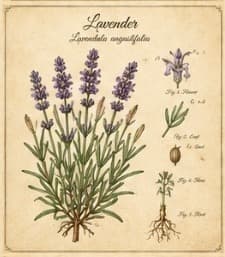
Lavender
Lavandula angustifolia
A purple-flowered herb prized for its scent and traditionally used to relax.
Lavender may interact with some medicines. If you take any medicine, read Interactions with medicines below and talk to your doctor or pharmacist before using it.
What is Lavender?
- Plant family
- Lamiaceae, the mint family
- Parts used
- The flowers (the flowering spikes). The essential oil is made by steam-distilling the flowers.
- Where it grows
- The Mediterranean region: native to northeastern Spain, southern France, Andorra and Italy
- Genus
- Lavandula
- Species
- angustifolia
Also called
English Lavender, True Lavender, Garden Lavender, Common Lavender
Older scientific names
Lavandula officinalis Chaix ex Vill., Lavandula vera DC.
Traditionally used for
- Aromatherapy
- Sleep
- Skin care
Traditionally described as
- May ease anxiety
- Calming
- May fight germs
Health topics
Where Lavender appears in symptom search, and why. Being listed doesn't mean it's a proven treatment.
- Anxiety
Research suggests lavender oil taken by mouth might help anxiety, but the studies have limitations.
Traditions that use it
Mediterranean Folk Medicine
The ancient Greeks, Romans and Egyptians used lavender as a medicine and for its scent. They valued it for fighting germs, calming, and easing inflammation. These traditional uses continued in European herbal medicine through the Middle Ages.
Technical detail: traditionally described as antiseptic, calming, anti-inflammatory and antioxidative.
Natural compounds
Safety
Interactions with medicines
In theory, lavender might add to the effects of medicines or herbs that make you sleepy (sedatives). This matters especially before surgery.[1]
Who should avoid it
A few reports describe breast swelling in children after lavender-containing products were used on their skin. It has not been shown that lavender caused it.[1]
Allergies
Long-term skin contact with linalool, a major natural compound in lavender oil, can cause allergic reactions. European Union cosmetics rules require linalool to be listed as a possible allergen.[2]
Side effects
Lavender taken by mouth may cause diarrhea, headache, nausea or burping. Breathing it in (aromatherapy) can cause headache or coughing. Putting it on the skin can cause allergic skin reactions.[1]
Pregnancy
There isn't enough safety information about using lavender during pregnancy or while breastfeeding. Little is known about its safety in these situations.[1]
Toxicity testing
Swallowing about 5 mL (one teaspoon) of diluted lavender essential oil can poison an adult, and as little as 2–3 mL may poison a child. Symptoms include nausea, vomiting, diarrhea, trouble breathing and confusion. Reported poisonings are rare.[2]
Technical detail: oral LD50 of the essential oil in animal studies is 13.5 g/kg.
What does the research say?
Traditional use
These are traditional uses, not proven treatments.
Since ancient times, the Greeks, Romans and Egyptians used lavender as a medicine and for its scent. They valued it for fighting germs, calming, and easing inflammation. These traditional uses continued in European herbal medicine through the Middle Ages, and lavender was historically used for conditions such as stomach ulcers and asthma.[2]
Technical detail: traditionally described as antiseptic, calming, anti-inflammatory and antioxidative.
Laboratory & animal research
Lab and animal results show what might be worth studying in people. They don't show that the herb has these effects in humans.
In mice under social stress, lavender essential oil reduced anxious behavior. Both the oil and linalool, its main natural compound, reversed the mice's tendency to avoid other mice, acting much like antidepressants. Neither had a calming effect on mice that weren't stressed. In lab tests on nerve cells, linalool blocked certain chemical signals inside the cells, which may help explain how it affects the brain.[3]
Technical detail: social defeat stress model; Lavandula angustifolia essential oil 200 mg/kg intraperitoneal; linalool 100 mg/kg; in vitro linalool 100–200 µg/mL inhibited pERK and PKA signaling in SH-SY5Y neuroblastoma cells.
Research in people
Research suggests lavender oil taken by mouth, including a branded product called Silexan, might help with anxiety, including anxiety that comes with depression. But the studies have limitations, such as being small and not being independently funded. It's unclear whether breathing in lavender (aromatherapy) improves sleep or insomnia. Early findings suggest lavender capsules or tea may ease depression in some people, but these results should be treated with caution. One study found that putting lavender on the skin had no effect on depression.[1]
Clinical trials have reported:
- Less anxiety after breathing in lavender essential oil, in hospital patients having a bone marrow biopsy.
- Less depression and anxiety in older adults who drank lavender tea.
- Less anxiety before surgery with lavender aromatherapy, without the sleepiness caused by anti-anxiety medicines called benzodiazepines.
Trials of lavender oil taken by mouth used about 80 mg a day (Silexan).[2]
In short
Don't swallow the essential oil undiluted.
Sources
- [1] Lavender: Usefulness and Safety — National Center for Complementary and Integrative Health (NIH)Government health agency
- [2] A Comprehensive Review on Anxiolytic Effect of Lavandula Angustifolia Mill. in Clinical Studies — Food Science & Nutrition · DOI: 10.1002/fsn3.70993Peer-reviewed study
- [3] Lavandula angustifolia Essential Oil and Linalool Counteract Social Aversion Induced by Social Defeat — Molecules · DOI: 10.3390/molecules23102694Peer-reviewed study
This information is educational and traditional in nature, and is not a substitute for professional medical advice.