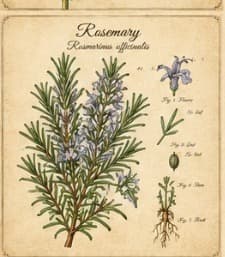
Rosemary
Salvia rosmarinus
A woody, pine-scented kitchen herb popular in roasted dishes and hair care.
What is Rosemary?
- Plant family
- Lamiaceae, the mint family
- Parts used
- The leaves, fresh or dried. The essential oil is distilled from the leaves and flowering tops.
- Genus
- Salvia
- Species
- rosmarinus
Older scientific names
Rosmarinus officinalis L.
Traditionally used for
- Roasted meats and vegetables
- Hair rinses
- Memory
Traditionally described as
- Antioxidant
- May fight germs
- May boost circulation
Health topics
Where Rosemary appears in symptom search, and why. Being listed doesn't mean it's a proven treatment.
- Gallbladder, Gallstones and Bile Flow
Rosemary medicines aren't recommended for people with gallstones, a blocked bile duct, an inflamed gallbladder or liver disease.
Traditions that use it
Mediterranean Folk Medicine
Native to the Mediterranean region, where it has long been used in cooking and in folk medicine for digestive complaints, muscle and joint pain, minor wounds and poor circulation.
Natural compounds
Safety
Interactions with medicines
No interactions between rosemary leaf and medicines had been described in the research at the time of this assessment.[1]
Who should avoid it
Rosemary medicines are not recommended for children under 12, or for people with a blocked bile duct, an inflamed gallbladder, gallstones or liver disease.[1]
Allergies
Don't use rosemary leaf if you are allergic to it.[1]
Side effects
Allergic reactions, including skin rashes from contact, can happen; how often is not known. Preparations meant to be taken by mouth should not be put on broken or irritated skin.[1]
Pregnancy
Rosemary medicines are not recommended during pregnancy, according to the European Medicines Agency's traditional-use assessment.[1]
Breastfeeding
Rosemary medicines are not recommended while breastfeeding, according to the European Medicines Agency's traditional-use assessment.[1]
What does the research say?
Traditional use
These are traditional uses, not proven treatments.
In traditional medicine, rosemary leaves have been used to fight bacteria, relieve gas, and ease muscle and joint pain. Oils and extracts from the flowers and leaves have traditionally been put on minor wounds and rashes, and used for headache, indigestion and poor circulation, to loosen mucus, to increase urination, and to ease cramping pain from kidney stones. Rosemary is widely used in Mediterranean cooking, and in folk medicine to prevent and treat colds, rheumatism, and muscle and joint pain.[2]
Technical detail: carminative, analgesic, expectorant, diuretic, antispasmodic for renal colic; dyspepsia.
Laboratory & animal research
Lab and animal results show what might be worth studying in people. They don't show that the herb has these effects in humans.
Lab and animal studies of rosemary's main natural compounds report:
- Carnosic acid slowed or killed several kinds of human cancer cells in the lab, including breast and colon cancer cells, improved blood fat levels in rats, and acted against a common respiratory virus (RSV).
- Carnosol was toxic to several kinds of cancer cells, showed antioxidant activity, and reduced inflammation.
- Rosmarinic acid protected nerve cells and blocked an enzyme that breaks down a memory-related brain chemical (acetylcholine).
These are lab and animal findings, not established effects in people.[2]
Technical detail: carnosic acid: HepG2, COLO 205 and HL-60 cell lines, dose-dependent; inhibited gastric lipase in Zucker rats. Carnosol: inhibited lipid peroxidation; COX-1/COX-2 inhibition. Rosmarinic acid: cholinergic effects, acetylcholinesterase inhibition, reduced pro-inflammatory cytokines.
Research in people
In a study of 144 healthy adults doing computer tests of memory and thinking, people smelled rosemary oil, lavender oil or nothing. The scent of rosemary had measurable effects on how people performed on the tests, and on how they said they felt, compared with lavender and no scent.[3]
Technical detail: randomized controlled study; objective effects on cognitive performance and subjective effects on mood.
In short
High doses may cause contractions of the womb; avoid during pregnancy.
Sources
- [1] Rosmarini folium - herbal medicinal product — European Medicines Agency (EMA), Committee on Herbal Medicinal Products (HMPC)Government health agency
- [2] Rosmarinus officinalis L.: an update review of its phytochemistry and biological activity — Future Science OA · DOI: 10.4155/fsoa-2017-0124Peer-reviewed study
- [3] Aromas of rosemary and lavender essential oils differentially affect cognition and mood in healthy adults — International Journal of Neuroscience · DOI: 10.1080/00207450390161903Review or clinical trial
This information is educational and traditional in nature, and is not a substitute for professional medical advice.