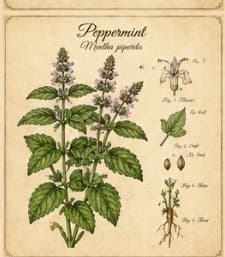
Peppermint
Mentha piperita
A cooling, menthol-rich herb traditionally used for digestion and headaches. Research suggests peppermint oil may help IBS symptoms.
What is Peppermint?
- Plant family
- Lamiaceae, the mint family
- Parts used
- The leaves and flowering above-ground parts, which are also the source of peppermint essential oil
- Where it grows
- Native to Europe and Central Asia. Peppermint is a natural cross between watermint (Mentha aquatica) and spearmint (Mentha spicata). It is now grown and growing wild around the world, including across North America.
- Genus
- Mentha
- Species
- × piperita
Older scientific names
Mentha × piperita L., Mentha × balsamea Willd., Mentha aquatica × Mentha spicata
Traditionally used for
- Digestive tea
- Headaches
- Aromatherapy
Traditionally described as
- May ease cramps
- May relieve pain
- May relieve gas
Health topics
Where Peppermint appears in symptom search, and why. Being listed doesn't mean it's a proven treatment.
- Colds and Nasal Congestion
Traditionally used for colds and fever.
- Indigestion
Evidence covers only combination products (such as with caraway oil); peppermint oil alone may make indigestion worse.
- Irritable Bowel Syndrome (IBS)
Research suggests enteric-coated peppermint oil capsules may improve IBS symptoms in adults.
- Occasional Nausea
Peppermint by mouth, or breathing in the oil, may help nausea and vomiting during chemotherapy.
- Sore Throat
Traditionally used for a sore or inflamed mouth and throat.
Traditions that use it
Western Herbalism
People in ancient Greece, Rome and Egypt used mint plants for digestive problems. Peppermint oil has been used for centuries in Western herbal medicine for stomach and gut complaints.
Natural compounds
Safety
Who should avoid it
Don't let a baby or young child breathe in menthol (found in peppermint oil), and don't put it on their face. It may affect their breathing.[1]
Side effects
Peppermint oil taken by mouth can cause heartburn, nausea, stomach pain and dry mouth. Rarely, it can cause allergic reactions. On the skin, it can cause rashes and irritation.[1]
Pregnancy
Peppermint in normal food amounts is likely safe during pregnancy. Little is known about whether larger, medicinal amounts are safe during pregnancy.[1]
Breastfeeding
Peppermint in normal food amounts is likely safe while breastfeeding, but there is no safety data for medicinal amounts. A gel, water or cream with peppermint oil put on the nipple area may help reduce pain and cracked skin. Use it only after breastfeeding, and wipe it off before the next feeding.[1]
Depends on how it's prepared
Peppermint oil appears to be safe when taken by mouth or used on the skin in commonly used doses, and it has been used safely in many clinical trials. Peppermint oil capsules are often enteric-coated (designed to open in the intestine) to make heartburn less likely.[1]
What does the research say?
Traditional use
These are traditional uses, not proven treatments.
People in ancient Greece, Rome and Egypt used mint plants for digestive problems, and peppermint oil has been used for centuries for stomach and gut complaints. Today, peppermint is traditionally promoted for irritable bowel syndrome (IBS), indigestion, headaches, muscle tension and nausea.[1]
Besides flavoring food, peppermint has long been used in traditional medicine for fever, colds, digestive complaints, and sore or inflamed mouth and throat. It is traditionally thought to fight viruses and fungi.[2]
Laboratory & animal research
Lab and animal results show what might be worth studying in people. They don't show that the herb has these effects in humans.
In lab and animal studies, peppermint extracts and oil showed antioxidant, germ-fighting and antiviral activity, and reduced inflammation. They also killed or repelled insects and their larvae, slowed cancer cells, protected against radiation damage and lowered blood sugar. These effects are credited to the many natural compounds in the plant.[2]
Technical detail: biopesticidal, larvicidal, anticancer, radioprotective, anti-diabetic; flavonoids, phenolics, lignans, stilbenes and essential oil components.
Research in people
A small amount of research, mostly on irritable bowel syndrome (IBS), suggests peppermint oil in enteric-coated capsules (capsules designed to open in the intestine rather than the stomach) may improve IBS symptoms in adults. A 2022 review of 10 studies with 1,030 people found peppermint oil worked better than placebo (a dummy pill) for overall IBS symptoms and stomach pain, though it caused more mild side effects, mainly acid reflux and indigestion. A 2021 guideline from the American College of Gastroenterology recommends peppermint oil, preferably enteric-coated, for overall IBS symptoms.[1]
A small amount of research suggests that taking peppermint extract by mouth, or breathing in peppermint oil, can help reduce nausea and vomiting during cancer chemotherapy. A 2024 review of aromatherapy studies, including 4 trials with 290 people using peppermint oil, found breathing in peppermint oil was especially effective for chemotherapy-related nausea and vomiting.[1]
For indigestion, the evidence only covers specific products that combine peppermint oil with caraway oil, or combination products that contain peppermint leaf. There is no evidence that peppermint oil on its own helps indigestion, and it may make indigestion worse for some people. A limited amount of evidence suggests peppermint oil rubbed on the skin might relieve tension headaches.[1]
In short
Can make acid reflux worse in some people.
Sources
- [1] Peppermint Oil: Usefulness and Safety — National Center for Complementary and Integrative Health (NIH)Government health agency
- [2] Ethnomedicinal, phytochemical and pharmacological updates on Peppermint (Mentha × piperita L.)-A review — Phytotherapy Research · DOI: 10.1002/ptr.6664Peer-reviewed study
This information is educational and traditional in nature, and is not a substitute for professional medical advice.