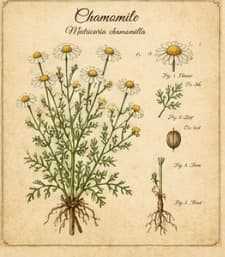
Chamomile
Matricaria chamomilla
A daisy-like flower, usually made into tea, traditionally used for relaxation and digestive comfort.
Chamomile may interact with some medicines. If you take any medicine, read Interactions with medicines below and talk to your doctor or pharmacist before using it.
What is Chamomile?
- Plant family
- Asteraceae, the daisy family
- Parts used
- The flower heads
- Genus
- Matricaria
- Species
- chamomilla
Also called
German Chamomile, Wild Chamomile, Scented Mayweed
Older scientific names
Chamomilla recutita (L.) Rauschert, Matricaria recutita L.
Traditionally used for
- Sleep
- Calming tea
- Soothing skin
Traditionally described as
- Mildly relaxing
- May help reduce inflammation
- May ease cramps
Health topics
Where Chamomile appears in symptom search, and why. Being listed doesn't mean it's a proven treatment.
- Anxiety
Early studies suggest it may help generalized anxiety disorder.
- Sleep Problems (Insomnia)
Traditionally used for relaxation and known as a sleep aid, but a 2019 review found little research support for insomnia.
Traditions that use it
Western Herbalism
Recorded in ancient Egyptian, Greek and Roman medical writings, with long-standing use for digestive complaints and skin irritation.
Natural compounds
Safety
Interactions with medicines
Chamomile may affect how these work:
- Birth control pills
- Medicines that are broken down by the liver
- Blood thinners, such as warfarin
- Sedatives (medicines that make you sleepy)
Who should avoid it
Chamomile may act a little like the hormone estrogen. This could make hormone-sensitive conditions worse, such as breast or uterine cancer.[1]
Allergies
You're more likely to react to chamomile if you're allergic to ragweed, chrysanthemums, marigolds, daisies or related plants.[1]
Side effects
Side effects are uncommon. They can include nausea, dizziness and allergic reactions. In rare cases, people have had a severe allergic reaction (anaphylaxis). It can irritate the eyes if it gets in them.[1]
Pregnancy
Little is known about whether chamomile is safe during pregnancy or while breastfeeding.[1]
What does the research say?
Traditional use
These are traditional uses, not proven treatments.
Chamomile appears in ancient Egyptian, Greek and Roman medical writings. Traditionally, it has been used for digestive discomfort, skin irritation, and calming and relaxation.[2]
Research in people
Studies in people have not produced enough reliable evidence to show that chamomile works for the conditions it's commonly promoted for. Early studies suggest it may help people with generalized anxiety disorder (long-lasting, hard-to-control worry) and the depression that can come with it. A 2019 review found little research support for using chamomile for insomnia, despite its reputation as a sleep aid.[1]
In short
May cause an allergic reaction in people allergic to ragweed.
Sources
- [1] Chamomile: Usefulness and Safety — National Center for Complementary and Integrative Health (NIH)Government health agency
- [2] Chamomile (Matricaria chamomilla L.): An overview — Pharmacognosy Reviews · DOI: 10.4103/0973-7847.79103Peer-reviewed study
This information is educational and traditional in nature, and is not a substitute for professional medical advice.