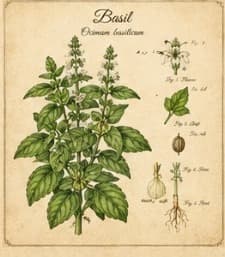
Basil
Ocimum basilicum
A fragrant, warm-weather kitchen herb central to Italian and Southeast Asian cooking.
What is Basil?
- Plant family
- Lamiaceae, the mint family
- Parts used
- Leaves, plus the above-ground parts used to make essential oil
- Genus
- Ocimum
- Species
- basilicum
Also called
Sweet Basil, Genovese Basil, Saint Joseph's Wort, Basil Seeds, Sabja Seeds, Tukmaria Seeds
Older scientific names
Ocimum odorum Salisb.
Traditionally used for
- Pesto
- Tomato dishes
- Teas
- Aromatherapy
- Basil seed drinks and desserts
Traditionally described as
- May help reduce inflammation
- Antioxidant
- May fight bacteria
Traditions that use it
African Traditional Medicine
Used in African traditional medicine for allergic reactions, inflammation and the common cold.
Ayurveda
Used in Ayurvedic and Unani medicine, especially in South Asia, for fever, cough, colds, digestive complaints and reproductive problems.
Natural compounds
Safety
Side effects
In the 4-week trial of basil syrup taken alongside sertraline, side effects were mild and short-lived: stomach discomfort (1 of 27 people) and headache (2 of 27). There were no serious side effects, and people generally tolerated the basil syrup well.[1]
Pregnancy
European guidance does not recommend basil herbal medicines (or other products containing estragole) during pregnancy above 0.05 mg of estragole a day, unless a proper risk assessment supports it. This applies to medicinal preparations, not normal cooking amounts.[2]
Breastfeeding
European guidance does not recommend basil herbal medicines (or other products containing estragole) while breastfeeding above 0.05 mg of estragole a day, unless a proper risk assessment supports it.[2]
Toxicity testing
Basil essential oil can contain a lot of a natural compound called estragole, anywhere from about 20% to 89% depending on the type of basil. The European Medicines Agency's herbal committee has concluded that estragole damages DNA and causes cancer in animal studies. It recommends keeping exposure from herbal products as low as practically possible.[2]
Technical detail: estragole is also called methyl chavicol; HMPC classifies it as a genotoxic carcinogen in animal studies; content varies by chemotype.
How much to use
European guidance limits herbal medicines that contain estragole, such as basil preparations, to short-term use of no more than 14 days. The suggested maximum is 0.05 mg of estragole a day for adults, and 1 microgram per kg of body weight a day for children up to age 11.[2]
Depends on how it's prepared
Basil seeds are usually soaked before eating, because they're hard to chew dry: about 1 tablespoon (13 g) in 1 cup (237 ml) of water for 15 minutes, until they swell to about three times their size. Buy seeds sold for eating; seeds packaged for planting may have been treated with pesticides. Their high fibre can cause bloating, so add them to your diet gradually.[3]
What does the research say?
Traditional use
These are traditional uses, not proven treatments.
Basil has been used in many traditional medicine systems:
- Ayurvedic and Unani medicine (South Asia): fever, cough, colds, digestive problems and reproductive problems.
- Southeast Asian traditions: gas, stomach ulcers, tuberculosis and ringworm (a fungal skin infection).
- African traditional medicine: allergic reactions, inflammation and the common cold.
- Brazilian folk medicine: late periods, indigestion and a stuffy nose.
Traditional preparations included teas and infusions, steam inhalations, pastes and powders.[4]
Basil seeds (also called sabja or tukmaria seeds) have traditionally been soaked in water as a refreshing, nourishing food. In Middle Eastern countries they're added to drinks (sharbat) and frozen desserts (faloodeh). In traditional medicine they've been used for:
- Indigestion and ulcers
- Diarrhoea
- Sore throats
- Kidney problems
- Long-term constipation and piles
- Washed and pounded into poultices for sores and sinus problems
Laboratory & animal research
Lab and animal results show what might be worth studying in people. They don't show that the herb has these effects in humans.
In lab tests and animal studies, basil has shown a wide range of effects: it acted against several viruses (including SARS-CoV-2, dengue, HIV, herpes simplex, hepatitis B and Zika) and against many bacteria and fungi, including Candida yeast. It also showed antioxidant activity, slowed some breast and brain cancer cells in the lab, had insulin-like effects, improved memory and reduced seizures in mice, reduced swelling in mice, and helped wounds heal when applied to the skin. The review included no human trials. All of this comes from lab, animal or computer-model studies.[4]
Technical detail: antiviral, antibacterial (Gram-positive and Gram-negative), antifungal (Candida albicans, Aspergillus), antioxidant (DPPH assays), anticancer (breast cancer and glioblastoma cell lines), antidiabetic, neuroprotective and anticonvulsant (mice), anti-inflammatory (carrageenan-induced paw edema in mice) and wound-healing effects in topical formulations.
Lab analyses show basil seeds are rich in protein, fibre and fats (mostly linoleic acid and alpha-linolenic acid, a plant omega-3), plus calcium, potassium and magnesium, though amounts vary a lot between samples. About a fifth of the seed is a gel-forming fibre (mucilage) that swells when soaked; food makers use it to thicken and stabilize ice cream, puddings and low-fat yogurt and to replace fat in cakes. In lab tests, compounds from the seeds blocked a starch-digesting enzyme, a possible way they could affect blood sugar. These effects haven't been tested in people.[5]
Technical detail: protein 11.4–22.5 g/100 g; dietary fibre 7.1–26.2 g/100 g; mucilage about 17–20%; α-amylase inhibitory peptides.
Research in people
In one trial, 60 people with major depression who were already taking the antidepressant sertraline added either a basil syrup or a placebo (a dummy syrup) every night for 4 weeks. The basil group had much larger drops in anxiety and depression scores than the placebo group. This is a single trial, and the result needs to be repeated to be confirmed.[1]
Technical detail: single-blind, randomized, placebo-controlled; hydroalcoholic-extract syrup, 1100 mg extract per 5 mL; Hamilton Anxiety Rating Scale and Beck Depression Inventory, p < 0.001 for both.
In short
Generally safe in cooking amounts.
Sources
- [1] Basil (Ocimum basilicum) to Alleviate Anxiety in Patients With Major Depressive Disorder: A Randomized Placebo-Controlled Clinical Trial — Brain and Behavior · DOI: 10.1002/brb3.70994Review or clinical trial
- [2] Public statement on the use of herbal medicinal products containing estragole – Revision 1 — European Medicines Agency (EMA), Committee on Herbal Medicinal Products (HMPC)Government health agency
- [3] Basil Seeds: Benefits, Nutrition, and How to Use Them — HealthlineGeneral reference
- [4] Sweet Basil (Ocimum basilicum L.)―A Review of Its Botany, Phytochemistry, Pharmacological Activities, and Biotechnological Development — Plants (Basel) · DOI: 10.3390/plants12244148Peer-reviewed study
- [5] Basil Seeds as a Novel Food, Source of Nutrients and Functional Ingredients with Beneficial Properties: A Review — Foods · DOI: 10.3390/foods10071467Peer-reviewed study
This information is educational and traditional in nature, and is not a substitute for professional medical advice.